Every spring, a familiar scene plays out in suburban backyards and manicured gardens across the country. As the winter frost retreats and the first warm rays of sunshine pierce the soil, a vibrant, low-growing carpet of soft purple and deep green begins to blanket the earth.
For many homeowners, this sudden explosion of color is met not with admiration, but with immediate frustration.
Backs are bent, weeding tools are brandished, and chemical sprays are prepared, all in a collective effort to eradicate a plant deemed an unwelcome intruder.
But what if this common backyard nuisance is actually one of the most versatile, nutrient-dense, and medicinally potent gifts your soil can offer? Before you wage your annual war against the early-season ground cover, it is time to drop the trowel and take a closer look at what is truly growing beneath your feet.
Far from a useless weed, this resilient plant is a powerhouse of natural wellness that has been cherished by traditional herbalists for centuries.
Meet the Intruder: What is Purple Dead-Nettle?
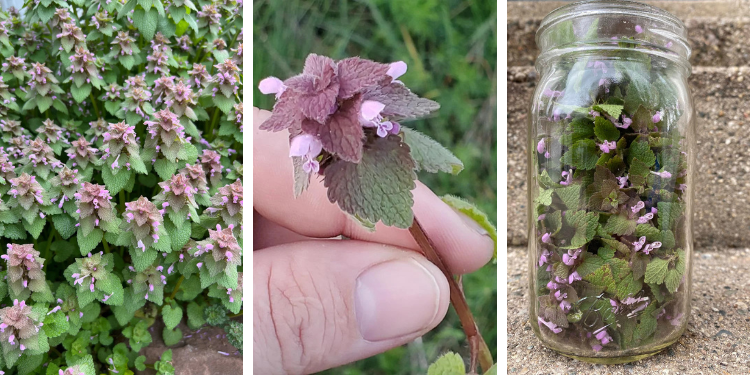
The mysterious purple carpet dominating your spring lawn is almost certainly Lamium purpureum, commonly known as purple dead-nettle.
Despite its somewhat intimidating common name, there is absolutely nothing to fear from this gentle plant.
The term “dead-nettle” refers to the fact that while its foliage closely resembles that of the infamous stinging nettle (Urtica dioica), it completely lacks the microscopic stinging hairs. It is entirely safe to touch, harvest, and handle with bare hands—it is “dead” to stinging.
Taxonomically, purple dead-nettle is a proud member of the Lamiaceae, or mint family. Once you know what to look for, its familial traits become strikingly obvious.
A casual inspection reveals a perfectly square stem, a signature characteristic shared by mint, basil, rosemary, and lemon balm. The leaves are heart-shaped, deeply veined, and covered in fine, downy hairs.
They grow in opposite pairs along the stem, clustering tightly at the top where they undergo a stunning transformation from rich green to dusty, vibrant shades of magenta, violet, and purple. Tucked neatly beneath these colorful upper leaves are tiny, tubular, hooded pinkish-purple flowers that act as beacons for early-season pollinators.
Native to Europe and Asia, purple dead-nettle has naturalized beautifully across North America. It is classified as a winter annual, meaning its seeds germinate during the cool autumn months, lie dormant through the bitterest stretches of winter, and explode into rapid growth at the very first sign of spring thaw.
By mid-summer, its life cycle is complete, and it naturally fades away, leaving the soil enriched and a new generation of seeds waiting patiently for the autumn chill.
Botanical ID Quick Check Do not confuse purple dead-nettle with its close cousin, henbit (Lamium amplexicaule). While both are purple-flowered mint relatives that bloom simultaneously, henbit has rounded, scalloped leaves that clasp the stem directly without any leaf stalks (petioles), and its leaves do not turn the distinct deep purple color at the top.
The Hidden Ecological Hero of the Early Spring
To understand why you should stop pulling purple dead-nettle, you must first understand its critical role in the local ecosystem.
When dead-nettle emerges in late March and early April, the vast majority of native flora is still sound asleep. Fruit trees have not yet blossomed, and traditional garden flowers are nothing more than tiny green shoots hidden beneath the mulch.
For queen bumblebees waking up hungry from their long winter hibernation, and for honeybees venturing out on their first foraging flights, the early spring landscape can be a perilous food desert.
Purple dead-nettle is one of the very first reliable sources of both nectar and pollen available to them. The bright purple tops and tubular flowers are perfectly adapted to invite these vital pollinators.
When you spray or pull these patches, you are quite literally removing a primary survival food source for the insects responsible for pollinating our global food supply.
Allowing dead-nettle to thrive for just a few short weeks provides a crucial ecological bridge that supports healthy bee populations well into the summer.
The Herbalist’s Secret: Medicinal Properties and Benefits
Beyond its ecological value, purple dead-nettle is a foundational herb in traditional folk medicine.
For generations, rural homesteaders and indigenous healers recognized that the plants growing closest to our doorsteps are often the ones we need the most.
Dead-nettle boasts an impressive pharmacological profile, acting as an anti-inflammatory, natural antihistamine, antimicrobial, and styptic agent.
1. The Ultimate Natural Antihistamine
Perhaps the most compelling reason to cultivate a relationship with purple dead-nettle is its remarkable ability to soothe seasonal allergies.
It is an exquisite irony of nature that a plant frequently targeted by homeowners trying to clean up their spring lawns is the exact remedy needed to treat the allergy symptoms brought on by spring pollen.
Dead-nettle is packed with secondary metabolites, including flavonoids and volatile compounds, that stabilize mast cells and inhibit the release of histamine.
Drinking an infusion or taking a tincture made from the fresh plant can significantly reduce red, itchy eyes, sneezing, and sinus congestion without the drowsiness associated with over-the-counter pharmaceuticals.
2. Powerful Anti-Inflammatory Support
Chronic inflammation is at the root of numerous modern discomforts, from aching, arthritic joints to systemic soreness.
Purple dead-nettle contains high concentrations of iridoid glycosides and rosmarinic acid—the same potent anti-inflammatory compound found in rosemary and sage.
Regular use of dead-nettle preparations helps downregulate inflammatory pathways in the body, offering a gentle, systemic ease to aching joints, sore muscles, and swollen tissues. It serves as an excellent, locally forageable alternative for long-term musculoskeletal comfort.
3. A Natural Skin Soother and Styptic
In traditional first aid, purple dead-nettle was frequently utilized as a “vulnerary”—a herb used to promote wound healing.
It possesses mild styptic properties, meaning it helps constrict blood vessels to stop minor external bleeding from small cuts, scrapes, or razor burns.
Its antimicrobial components help protect broken skin from opportunistic bacterial infections, while its soothing mucilage calms the intense itching and irritation associated with insect bites, stings, eczema, and minor burns.
| Active Compound Class | Primary Health Benefit | Practical Application |
| Flavonoids & Quercetin |
Antihistamine & Mast Cell Stabilizer |
Relief from spring allergies, sneezing, and itchy eyes |
| Rosmarinic Acid |
Systemic Anti-Inflammatory |
Soothing arthritic joint pain and muscular swelling |
| Tannins & Glycosides |
Styptic & Antimicrobial |
Stopping minor bleeding, healing cuts, and calming stings |
| Vitamin C & Iron |
Nutritional & Immune Support |
General vitality, dietary boost, and winter recovery |
Nutritional Abundance Hidden in Plain Sight
If you have never considered eating your lawn weeds, purple dead-nettle is the perfect place to start. The entire aerial portion of the plant—the stems, leaves, and flowers—is completely edible and highly nutritious.
It is an exceptional source of dietary iron, essential vitamins (particularly Vitamin C and Vitamin K), dietary fiber, and powerful antioxidants.
When consumed fresh and raw, dead-nettle has a unique, mildly earthy flavor profile with subtle, sweet undertones reminiscent of spinach mixed with a very faint hint of mint.
Because the leaves are finely fuzzy, they are best enjoyed when blended or finely chopped rather than eaten as a whole salad leaf.
Adding a handful of freshly washed dead-nettle tops to your morning green smoothie is an exceptional way to sneak in a massive dose of wild, living nutrients without altering the flavor profile of your favorite fruits.
How to Safely Harvest and Use Your Backyard Harvest
Foraging for purple dead-nettle is incredibly straightforward, making it an ideal project for beginners. However, safety and respect for the land should always come first.
Before harvesting any wild plant, ensure that your lawn has not been treated with synthetic chemical fertilizers, herbicides, or pesticides, and that it is well away from the road spray of passing vehicles or areas frequented by neighborhood pets.
The best time to harvest is on a dry, sunny morning after the dew has evaporated but before the afternoon sun saps the plant’s volatile oils.
Look for vibrant patches where the purple tops are bright and the tiny pink flowers are just beginning to peek out.
Using a clean pair of scissors, snip the top three to four inches of the plant. This leaves the lower root system intact, allowing the plant to continue its cycle while providing you with the most tender, nutrient-dense, and chemically active portions of the foliage.
Crafting a Soothing Spring Herbal Infusion
One of the easiest and most traditional ways to enjoy the allergy-relieving and calming properties of purple dead-nettle is by brewing a hot herbal infusion.
Unlike a standard tea, an infusion steeps for a longer duration to extract the dense minerals and medicinal compounds from the plant material.
-
Gather roughly one cup of fresh, thoroughly washed purple dead-nettle tops (or two tablespoons of dried herb).
-
Place the herb into a clean quart-sized glass jar.
-
Pour boiling water over the plant material, filling the jar completely to the rim.
-
Cover the jar tightly with a lid to trap the volatile oils, which would otherwise escape with the steam.
-
Allow the mixture to steep on the counter for 15 to 20 minutes for a lighter beverage, or up to 4 hours for a deep, medicinal, mineral-rich brew.
-
Strain the liquid through a fine-mesh sieve, discard the spent plant matter to your compost pile, and enjoy. You can drink it warm with a touch of local raw honey (which provides additional allergy-fighting synergy) or chill it over ice for a refreshing, wild-crafted summer tonic.
Creating a First-Aid Poultice
If you are working out in the garden and find yourself dealing with an unexpected scratch, a minor bee sting, or an itchy mosquito bite, purple dead-nettle can provide immediate on-the-spot relief.
Select a few clean leaves from a nearby patch, crush them vigorously between your fingers to break the cell walls and release the plant’s medicinal juices, and apply the crushed mass directly to the affected skin.
Hold it in place for several minutes. The natural anti-inflammatory and styptic qualities will rapidly reduce swelling, stop minor oozing, and draw out the sting.
By reframing our relationship with plants like purple dead-nettle, we step away from an adversarial relationship with nature and move toward one of harmony, abundance, and self-reliance.