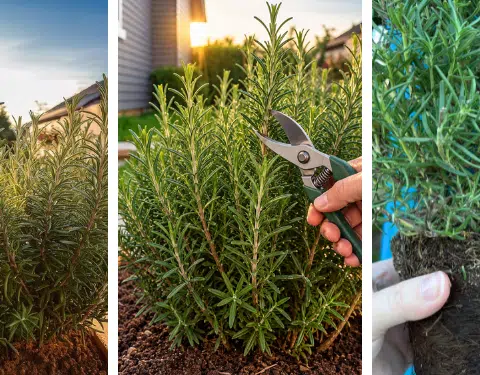
Few sensory pleasures in the garden match the experience of brushing past a healthy rosemary bush (Salvia rosmarinus) and releasing a rich wave of pine-scented, resinous oil.
Rosemary is a rugged, Mediterranean perennial that can anchor a landscape for over a decade. Yet, left entirely to its own devices, a pristine young rosemary plant can quickly transform into a woody, sprawling, and leggy mess with sparse foliage clustered only at the very tips of its branches.
When a rosemary plant goes woody, its culinary value plummets, and its vulnerability to harsh winter weather increases. Many gardeners hesitate to prune because they fear killing this slow-growing herb.
However, achieving a fuller, bushier, and more fragrant rosemary plant doesn’t require luck – it all comes down to understanding the plant’s unique biological growth patterns and applying the right pruning techniques at the correct time.
By mastering these maintenance fundamentals, you can transform a scraggly specimen into a dense, productive green canopy overflowing with aromatic oils.
The Growth Habit: Why Rosemary Needs Your Help
To prune rosemary effectively, you must understand how the plant functions at a cellular level. Rosemary branches are divided into three distinct zones, each behaving differently when cut:
-
The Green, Softwood Zone: This is the current season’s fresh growth at the outer tips of the plant. The stems are flexible, pale green, and packed with aromatic leaves. This zone has an incredibly high concentration of active growth buds hidden just beneath the leaf junctions.
-
The Semi-Ripe Zone: Located just below the soft tips, this section of the stem transitions from green to a light, tan-colored bark. The stem is firmer but still flexible. It contains active latent buds ready to break open if stimulated.
-
The Old, Hardwood Zone: This is the structural interior and base of the bush. The wood is thick, dark gray or brown, flaky, and completely bare of leaves. Crucially, rosemary wood rarely features latent dormant buds. If you cut entirely back into this bare, old wood, that branch will almost never generate new green growth, leaving a permanent dead spot in your plant.
When you snip off the tip of a green rosemary branch, you disrupt a biological process called apical dominance.
The tip produces hormones (auxins) that suppress the growth of lower side-shoots, forcing the plant to grow straight up.
By removing that dominant tip, you release the brake pedal on the lower nodes. The plant immediately redirects its energy sideways, forcing two or three new, leafy branches to sprout from the leaf joints directly below the cut.
Repeat this process across the whole plant, and you double its density in a single season.
Mastering the Calendar: When to Prune Rosemary
Timing is everything. Cutting a Mediterranean subshrub at the wrong time of year can expose tender inner tissue to killer frosts or disrupt its natural flowering cycles.
Your annual pruning strategy should follow a strict seasonal calendar.
1. The Main Spring Pruning (Late Spring)
The absolute best time to perform a major structural reshape or size reduction is in the spring, just after the plant finishes its initial bloom cycle.
By this point, the plant is waking up from winter dormancy, and its sap is flowing rapidly. Pruning now gives the herb an entire spring and summer growing season to heal its wounds, push out a high volume of dense new branches, and mature that fresh growth before winter returns.
2. Light Summer Maintenance (Early to Mid-Summer)
Throughout June and July, you can perform light, cosmetic maintenance. This is the prime window for culinary harvesting.
Every time you snip off a 4-to-6-inch sprig for the kitchen, you are executing a miniature prune that keeps the plant’s dome shape compact and forces continual branching.
3. The Autumn Cut-Off: A Critical Warning
The Golden Rule of Late-Season Care: Stop all significant pruning at least 6 to 8 weeks before your region’s expected first hard autumn frost.
Pruning triggers a burst of tender, moisture-rich green growth. This fresh growth takes several weeks to harden off (lignify) into wood capable of surviving sub-freezing temperatures.
If you prune in late September or October, a sudden freeze will destroy those soft new shoots, causing dieback that can travel down the branches and kill the entire plant over the winter.
How to Prune Rosemary for Maximum Thickness
When you are ready to reshape your herb, gather a pair of bypass hand pruners and a bottle of rubbing alcohol.
Always sterilize your blades before moving between plants to prevent spreading fungal pathogens like root rot or powdery mildew.
Follow this precise, step-by-step procedure to maximize branching without over-stressing the plant:
1. Clear Out the Three ‘D’s: Assess the internal structure first.
Boosting Fragrance: The Direct Link Between Pruning and Essential Oils
The intense, intoxicating fragrance of rosemary comes from its volatile essential oils, primarily camphor, 1,8-cineole, and alpha-pinene.
These chemical compounds are stored inside microscopic, balloon-like structures called glandular trichomes that cover the surfaces of the leaves and stems.
Pruning directly maximizes the fragrance profile of your plant in two distinct ways:
-
Age of Tissue: Young, actively growing soft green leaves possess a significantly higher density of healthy, intact oil glands than older, tough leaves located deep inside a woody canopy. By continually forcing new growth via pruning, you increase the ratio of high-oil foliage on your bush.
-
Sunlight Synthesis: Rosemary requires intense, direct sunlight to synthesize these complex essential oils. A dense, pruned, outward-facing canopy maximizes the surface area exposed to UV rays, forcing the plant to pump out a higher concentration of aromatic resins as a natural shield against sun stress.
Troubleshooting Common Rosemary Mistakes
If your rosemary isn’t responding well to your care, check for these common environmental and maintenance errors:
| Symptom | Primary Cause | Immediate Remedy |
| Yellowing lower leaves and dropping foliage | Soggy soil or overwatering | Stop watering immediately. Ensure the pot has drainage holes or amend garden beds with coarse sand. |
| Gaps that remain bare after cutting | Cut too deeply into old hardwood | Do not touch the area. Allow surrounding green branches to grow long enough to drape over and hide the bare spot. |
| White, dusty coating on leaves | Powdery mildew from poor airflow | Prune out congested interior stems to improve wind passage and move pots into full sun. |
Pro Tip: If your rosemary has grown into a giant, completely out-of-control woody monster, do not try to fix it all in one spring. Instead, employ a “staged rejuvenation strategy.” Cut back one-third of the green branches this spring, another third next year, and the final third the year after. This gradual approach keeps enough green foliage intact to safely feed the root system while slowly forcing the plant back into a compact shape.
By synchronizing your shears with the Mediterranean rhythm of this beautiful herb, you can banish leggy, woody growth for good.