Sweet basil (Ocimum basilicum) is the undisputed crown jewel of the summer herb garden.
Whether your goal is to blend batches of vibrant, emerald-green pesto, dress sun-ripened summer tomatoes, or infuse aromatic oils, a single, spindly grocery store basil plant rarely suffices.
To maintain a truly continuous harvest throughout the long growing season, you do not need to purchase dozens of separate plants. Instead, you need to master the botanical mechanics of a single, highly optimized basil shrub.
In its native tropical habitats across Asia and Africa, basil is not a delicate, fleeting salad green; it is a robust, branching, woody perennial.
When cultivated with an understanding of its evolutionary biology, cellular hydration needs, and hormonal growth triggers, a standard basil plant can be transformed into a massive, highly productive bush that yields armfuls of aromatic leaves week after week.
The Biological Engine of Continuous Harvesting
To grow a giant basil plant, you must first understand its internal hormonal signaling network. The growth pattern of basil is governed by a phenomenon known as apical dominance.
The main center stem of the plant (the apical meristem) produces a class of growth hormones called auxins.
These auxins travel downward through the plant’s vascular system, systematically suppressing the growth of the lower side branches (lateral buds). If left unpruned, the plant directs all its energy into growing a single, tall, skinny stalk that flowers early and dies quickly.
When you intentionally remove that main terminal tip, the downward flow of auxins stops instantly. This hormone drop signals the lower side buds to wake up and grow.
Two new, vigorous stems will erupt from the site of the single cut. By consistently managing this hormonal balance, you can expand a single stem exponentially into a dense, bushy powerhouse.
Basil Cultivation Vital Statistics
To build the ideal foundation for a massive basil plant, your soil and environmental metrics must match its native tropical baseline:
| Botanical Standard | Ideal Target Range | Physiological Impact |
| Soil pH Profile | 6.5 to 7.0 (Slightly Acidic to Neutral) | Optimizes macro-nutrient availability and root uptake |
| Daily Photoperiod | 6 to 8 Hours of Direct Sunlight | Fuels rapid carbohydrate synthesis for leaf production |
| Minimum Soil Temp | 65°F (18°C) to 70°F (21°C) | Prevents vascular shock, root stunting, and damping-off |
| Root Space Volume | Minimum 12-inch diameter pot (5-gallon volume) | Allows for expansive lateral root branching and stability |
7 Advanced Tips to Grow a Giant Basil Plant
1. Optimize Root Volume and Choose the Right Pot
You cannot grow a giant top-side canopy if your plant’s root system is cramped inside a small, restrictive pot. Basil develops a highly fibrous, expansive root matrix that requires deep structural space to efficiently draw up water and nutrients.
-
The Container Strategy: Avoid small, shallow planters. Select a heavy container that holds at least 5 gallons of soil (approximately 12 inches in diameter and depth). Terracotta or unglazed clay pots are highly recommended; their porous walls allow oxygen to easily reach the roots while preventing standing water from pooling at the bottom.
-
The Soil Engine: Fill your container with a premium, lightweight potting mix enriched with organic worm castings and compost. Avoid dense, heavy garden soils, which pack down tightly over time, suffocating the roots and slowing down the plant’s growth.
2. Master the Core Science of Structural Pruning
Pruning is not just about gathering leaves for dinner; it is an active method of structural engineering. To build a massive, sturdy bush, you must begin pruning when the plant is just a few inches tall.
-
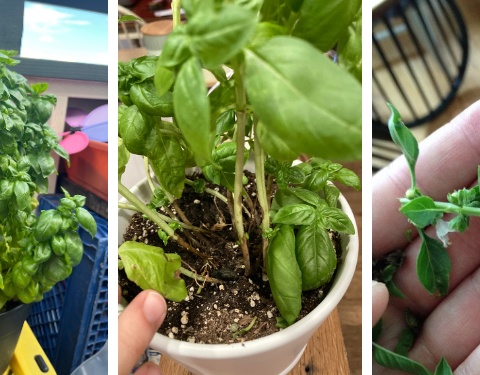
The First Cut: Wait until your young basil plant has grown at least three to four full sets of leaves (nodes). Locate the topmost node, trace down just above the next set of leaves, and cleanly snip the main stem using sharp, sterile shears.
-
Locating the Lateral Buds: Always make your cut just above a pair of small, emerging leaves. These tiny buds will rapidly grow into two completely independent branches.
-
The Continuous Cycle: As those two new branches grow and develop three nodes of their own, prune their tips in exactly the same way. This strategic pruning multiplies your harvesting points exponentially, transforming a single stem into a broad, multi-branched shrub.
3. Implement Deep-Zone Hydration Practices
Basil leaves are composed of roughly 90% water. To maintain large, tender, and juicy leaves, the plant requires consistent moisture.
However, shallow, frequent watering is a common mistake that leads to weak, superficial roots and fungal issues.
-
The Deep Watering Method: Water your basil deeply and thoroughly until you see moisture running freely from the bottom drainage holes. This forces water deep into the pot, encouraging the roots to grow downward in search of moisture, creating a strong, drought-resilient foundation.
-
The Moisture Threshold: Wait to water again until the top inch of soil feels completely dry to the touch. Never allow the soil to dry out to the point where the plant wilts completely; severe wilting damages the delicate root hairs, causing leaf drop and bitter flavors. Always water early in the morning to allow any moisture on the leaves to dry in the sun, preventing fungal spores from taking root.
4. Provide Premium Thermal and Solar Energy
Basil is incredibly sensitive to cold temperatures. It turns black and collapses at the first hint of frost, and its growth stalls completely whenever temperatures dip below 50°F (10°C).
-
Sunlight Requirements: To fuel its rapid growth, place your basil in a prime location that receives 6 to 8 hours of unfiltered, direct morning and afternoon sun daily. If you are growing basil indoors on a windowsill, choose a bright, south-facing window or support it with a full-spectrum LED grow light positioned 6 inches above the canopy for 14 hours a day.
-
The Thermal Threshold: Do not transplant young basil starts outdoors until night temperatures consistently stay above 55°F (13°C). If an unseasonal cold snap hits, protect your plants by covering them with a light frost cloth or moving containers indoors to prevent thermal shock.
5. Feed with Liquid Organic Nitrogen
Because you are constantly harvesting leaves from your basil plant, it must continuously rebuild its vegetative canopy.
This intensive growth requires a steady, reliable supply of nitrogen, the primary macro-nutrient responsible for leaf and stem development.
-
The Feeding Routine: Feed your basil every two weeks with a high-quality, liquid organic fertilizer, such as a fish emulsion or kelp blend. Liquid fertilizers are readily bioavailable, allowing the roots to absorb the nutrients instantly.
-
Avoid Over-Fertilizing: Do not use high-potency, synthetic chemical fertilizers. While they do cause rapid growth, they also dilute the concentration of essential volatile oils inside the leaves, leaving you with large leaves that lack that classic, rich basil flavor.
6. Aggressively Manage and Prevent Flowering
A basil plant’s primary biological goal is to reproduce by flowering and setting seed. When a basil plant enters this reproductive phase, its internal chemistry changes dramatically.
-
The Chemical Shift: As soon as flower buds emerge at the tips of the stems, the plant stops producing new leaves and focuses all its energy on seed production. The remaining leaves quickly become tough, small, and bitter as the aromatic essential oils drop.
-
The Eradication Protocol: Inspect your basil plant every few days for any sign of central flower spikes. The moment you see a tight, pointed flower bud forming, snip the entire stem down to the next lower leaf node. This removes the reproductive signal, forcing the plant to return its focus to growing fresh, sweet vegetative leaves.
7. Harvest by Whole Nodes, Never Single Leaves
Plucking individual leaves off your basil plant is a counterproductive harvesting method. It leaves behind naked, bare stems that cannot photosynthesize effectively, stressing the plant and leaving it vulnerable to pests.
Troubleshooting Common Basil Pathologies
Even with excellent care, large basil plants can occasionally run into environmental issues or pests. Use this quick-reference guide to diagnose and resolve problems early:
| Visual Symptom | Primary Diagnosis | Corrective Action Protocol |
| Yellowing Lower Leaves | Nitrogen deficiency or overwatered, oxygen-starved roots | Reduce watering frequency and apply an organic fish emulsion fertilizer. |
| Purple Tinting on Undersides | Thermal stress from cold night air or phosphorus deficiency | Move containers indoors or wrap the pot in burlap to warm the root zone. |
| Fine Webbing Under Leaves | Two-Spotted Spider Mite infestation due to dry air | Spray the undersides of the leaves thoroughly with organic neem oil or insecticidal soap. |
| Fuzzy Gray Fungus on Stems | Botrytis Blight or poor air circulation within the canopy | Prune away affected stems and space your plants further apart to maximize airflow. |
Growing a massive, productive basil plant is a rewarding exercise in understanding basic plant biology.
By providing your plants with ample root space, fast-draining gritty soil, deep watering, and plenty of direct sunlight, you create the ideal environment for healthy growth.