For many homeowners, the arrival of peak summer brings a mix of excitement and gardening frustration. We envision a backyard oasis bursting with color and life, but the reality of intense July and August heatwaves can quickly shatter that dream.
As temperatures spike and natural rainfall diminishes, many traditional garden plants begin to show signs of severe stress.
Leaf borders scorch, prized blooms drop prematurely, and substantial hours are spent dragging hoses and heavy watering cans across parched soil just to keep struggling species alive.
The secret to a beautiful, vibrant summer landscape doesn’t lie in constant irrigation or expensive shade cloths. It lies in proper, climate-conscious selection.
Here are 15 exceptional low-maintenance plants that treat intense heat as an invitation to thrive, rather than a struggle to survive.
The Botanical Adaptations Behind Heat Tolerance
To appreciate these rugged selections, it helps to understand how they effortlessly manage intense environmental stress.
High heat and direct full sun cause rapid evaporation, which can drain a standard plant’s water reserves within hours. The species featured on our list rely on specialized evolutionary mechanisms to survive:
-
Silver or Glaucous Foliage: Plants with hazy grey, blue, or silver leaves (like Lavender or Russian Sage) are coated in tiny, light-reflective hairs or natural waxes. This reflective barrier bounces harsh UV rays away from the leaf surface, keeping the plant’s internal temperature significantly cooler.
-
Deep Taproots: Instead of producing shallow, delicate networks that dry out as soon as the topsoil bakes, many prairie natives drive a single, thick anchor root deep into the earth. This allows them to draw moisture from deep underground reserves during prolonged dry spells.
-
Succulent Structures: Varieties like Sedum store water directly inside thick, fleshy leaf tissues and stems, creating an internal reservoir they can tap into during heatwaves.
15 Elite Sun-Loving, Low-Maintenance Plants
1. Purple Coneflower (Echinacea purpurea)
A classic native perennial of North American prairies, the Purple Coneflower is a primary selection for any sunny border.
Featuring daisy-like blossoms with reflexed, purple-pink petals surrounding a prominent, spiked bronze central cone, this plant is as durable as it is beautiful.
Once its deep root system establishes itself in your bed, it handles intense heat and poor soil without flinching. As a bonus, the dried central cones provide a valuable seed source for goldfinches in late autumn.
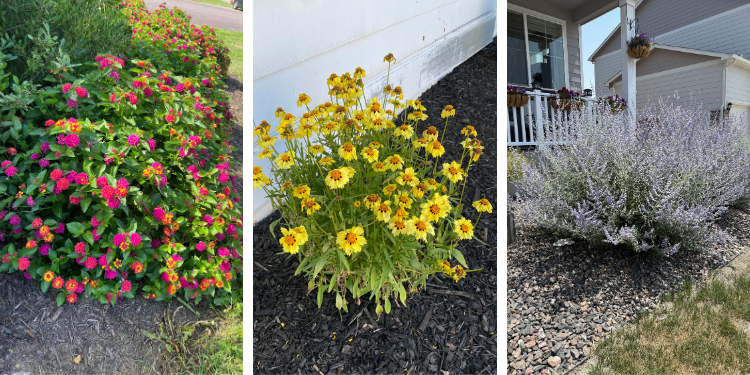
2. Russian Sage (Salvia yangii / Perovskia atriplicifolia)
If you need a plant to fill a large, sun-baked gap along a concrete driveway or a south-facing wall, Russian Sage is an outstanding choice.
This woody perennial produces airy, cloud-like spikes of lavender-blue blossoms atop fine, silvery-grey foliage.
Its fragrant leaves are highly unpalatable to deer and rabbits, and its open, tubular flowers are constantly covered in native pollinators from mid-summer until the first hard frost.
3. Sedum ‘Autumn Joy’ (Hylotelephium)
‘Autumn Joy’ is the ultimate “set-it-and-forget-it” structural succulent for sunny landscapes. It features thick, jade-green leaves that store water efficiently, allowing it to shrug off prolonged droughts.
In mid-summer, it produces large, flat broccoli-like green flower heads that slowly transition to a soft rose-pink in late August, eventually darkening to a rich, coppery rust-red by autumn.
4. Blanket Flower (Gaillardia)
True to its common name, this short-lived native perennial forms a dense, spreading blanket of fiery color across hot, sandy soils.
The daisy-like blossoms feature bold bands of bright crimson, golden yellow, and deep orange. Blanket Flower requires exceptionally well-draining, lean soil; it thrives in hot locations where heavy clay or rich compost would cause traditional perennials to rot.
5. Black-Eyed Susan (Rudbeckia fulgida)
Few plants embody the cheerfulness of a classic summer garden quite like the Black-Eyed Susan. Featuring flat, glowing golden-yellow petals wrapped around a deep, dark brown central disk, this rugged native perennial thrives in full sun.
It handles high humidity, heavy clay, and intense afternoon sun with absolute ease, making it a reliable choice for mass borders.
6. Yarrow (Achillea millefolium)
Yarrow is a historic botanical marvel that features feathery, fern-like green or silver foliage topped by wide, flat-topped flower clusters.
Available in an expansive array of colors – including bright lemon yellow, pastel pink, terracotta orange, and crisp white – yarrow uses its deep root network to hold slopes together and stabilize sandy soils while requiring zero supplemental fertilizer.
7. Lantana (Lantana camara)
In northern zones, Lantana is grown as a high-performing annual, while in southern climates, it grows into a sprawling woody shrub.
This tropical native produces dense, rounded flower clusters that often display a striking multi-color effect, with individual clusters shifting from neon yellow to bright orange and hot pink simultaneously. The rough, sandpaper-textured leaves are naturally deer-resistant.
8. Moss Rose (Portulaca grandiflora)
If you have a hot rock garden, a shallow stone container, or a thin strip of dry soil along a concrete walkway, Moss Rose is the perfect low-growing choice.
This annual succulent features needle-like leaves and bright, paper-thin blossoms that open wide under full sun and close on overcast days. It thrives in intense heat and handles sandy, nutrient-depleted gravel with ease.
9. Sweet Potato Vine (Ipomoea batatas)
While many sun-loving plants focus on floral displays, the Sweet Potato Vine is grown entirely for its aggressive, cascading foliage.
Available in eye-catching chartreuse green or deep, dramatic purple-black, this fast-growing annual vine drapes beautifully over the edges of sun-baked patio containers and hanging baskets, handling high temperatures without losing its crisp color.
10. Agastache / Hummingbird Mint (Agastache)
Agastache is a premier wildlife magnet for sun-drenched gardens. Both the tubular, colorful flower spikes (available in shades of blue, purple, coral, and orange) and the mint-scented leaves are highly saturated with natural aromatic oils.
This scent acts as a natural deterrent against deer while drawing hummingbirds, butterflies, and bees from across the neighborhood.
| Plant Name | Mature Height | Primary Flower Color | Major Landscape Benefit |
| Purple Coneflower | 2 to 3 feet | Pinkish Purple | Attracts songbirds, native prairie hardiness |
| Russian Sage | 3 to 4 feet | Lavender Blue | Excellent choice for hot driveways and walls |
| Moss Rose | 6 inches | Mixed Neon Tones | Exceptional choice for rock gardens and dry gravel |
| Agastache | 2 to 3 feet | Purple, Coral, Orange | High nectar production draws hummingbirds |
11. Salvia ‘May Night’ (Salvia x sylvestris)
This award-winning perennial is a staple of modern landscape design for good reason. ‘May Night’ produces dense, upright spikes of deep indigo-purple flowers that rise above a compact mound of aromatic green leaves.
If you shear the plant back sharply after its initial spring bloom cycle, it will quickly reset and reward you with a second wave of intense color during the height of the summer heatwave.
12. Catmint (Nepeta x faassenii)
Not to be confused with common catnip, ornamental Catmint forms a soft, mounding cloud of gray-green leaves topped by an abundance of small, lavender-blue flowers.
It is incredibly drought-resistant and serves as a fantastic, low-maintenance alternative to lavender in regions with cold winters or heavy, moisture-retentive spring soils.
13. Coreopsis / Tickseed (Coreopsis)
Coreopsis is a cheerful native perennial that produces hundreds of bright, star-shaped flowers throughout the summer months.
Available in threadleaf varieties (like ‘Moonbeam’) that display a delicate texture, or broad-leaf types with deep red centers, this plant handles lean soils and hot summer sun without showing signs of stress.
14. Verbena (Verbena canadensis)
Verbena is a trailing, low-profile plant that serves as an exceptional groundcover for hot slopes or an elegant addition to hanging baskets.
It produces rounded clusters of small, five-petaled flowers in brilliant shades of violet, rich purple, scarlet, and white. It handles high heat easily, provided it is planted in fast-draining soil.
15. Ornamental Grasses (e.g., Miscanthus, Little Bluestem)
To bring movement and a sense of grace to a sun-drenched garden, architectural ornamental grasses are essential.
Species like Little Bluestem (Schizachyrium scoparium) or Switchgrass (Panicum virgatum) feature deep, stabilizing root networks.
They remain upright through summer droughts, shifting from soft green-blue tones to rich coppery golds as autumn approaches, providing exceptional structure through the winter months.
The Master Planting Sequence for Success
Even the toughest, most drought-tolerant plants require a basic level of care during their initial installation. To ensure your sun-loving selection thrives through summer heatwaves, follow this precise establishment timeline:
By shifting your garden design away from delicate, water-dependent varieties and embracing these 15 sun-loving survivors, you can step away from constant maintenance chores.