When designing a home landscape, the garden walkway is often treated as a strictly utilitarian feature – a hard, solid line of concrete, flagstone, or brick intended to get you from point A to point B without stepping in the mud.
Homeowners frequently flank these paths with standard turf grass or high-maintenance annual flowers. However, there is a brilliant, living design secret that transforms a cold stone path into a dynamic, sensory journey: the thyme patch.
Cultivating a dedicated border or carpet of thyme (Thymus) right along your primary garden walkway is one of the most rewarding decisions a gardener can make.
Beyond its classic culinary utility, this low-growing, ancient Mediterranean herb acts as a highly resilient structural landscape asset.
From releasing an intoxicating herbal perfume every time your foot brushes its leaves to serving as a tough, drought-resistant weed barrier and an active ecological haven for native pollinators, a walkway thyme patch is a multi-sensory landscape upgrade.
1. The Footstep-Activated Aromatherapy Experience
The primary reason to line your walkway with thyme is the interactive, sensory experience it creates.
Unlike many garden plants that hold their fragrance deep within their flowers, thyme stores its highly concentrated essential oils -predominantly thymol and carvacrol – in tiny, microscopic glands covering the surface of its leaves.
When you plant thyme directly along the edges of a path, or even in the crevices between stepping stones, it becomes a dynamic part of your walk:
-
The Intentional Brush: As you, your children, or your guests walk down the path, shoes and hemlines naturally brush against the low cushions of foliage.
-
The Atmospheric Release: This minor physical friction bruises the leaves, rupturing the oil glands and instantly casting a warm, earthy, and slightly sweet herbal aroma into the air.
-
The Welcoming Transition: Walking down a path lined with thyme becomes a therapeutic ritual, providing a grounding transition zone between the hectic outside world and the sanctuary of your home.
2. A Resilient, Living Weed Barrier
Lining a walkway with traditional mulch requires annual replacement, and standard grass edges constantly creep over into the stone, demanding tedious weekly edging. Thyme solves both problems beautifully by functioning as a dense, living mulch.
Many varieties of thyme, particularly creeping cultivars, exhibit a prostrate (low-growing) growth habit. They spread horizontally via tiny, rooting stems, creating a thick, interlocking mat of foliage. This dense green carpet leaves virtually no bare soil exposed to the air.
By blocking out light and physically crowding the ground, a mature thyme patch prevents wind-blown weed seeds from ever making contact with the soil and germinating, cutting down your seasonal weeding chores significantly.
3. High-Impact Visuals with Zero Foot Traffic Anxiety
One of the greatest challenges in walkway landscaping is handling the inevitable “accidental step.” Delicate annual flowers snap instantly if a guest steps off the stone, and traditional lawn grass quickly wears down into a compaction-stressed mud puddle under heavy traffic.
Thyme, by contrast, is an absolute tank. It boasts a unique cellular flexibility that allows it to easily withstand moderate foot traffic.
Instead of snapping under a boot, the wiry, resilient stems simply bend, release their signature fragrance, and spring back into place shortly after.
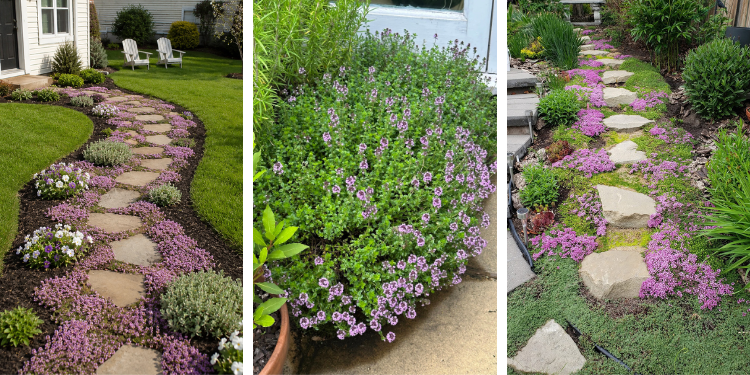
Furthermore, during the early summer months, a walkway thyme patch transforms from a simple green frame into a sea of brilliant color.
The plants explode with thousands of tiny, tubular flowers ranging from deep pinks and bright purples to pristine whites, softening the hard, cold lines of stone walkways with architectural elegance.
| Thyme Variety | Maximum Height | Growth Character | Optimal Path Placement |
| Creeping Red Thyme (T. praecox ‘Coccineus’) | 1 to 2 inches | Extremely flat, mat-forming; deep crimson blooms | Directly in the joints between stepping stones |
| Woolly Thyme (T. pseudolanuginosus) | 1 inch | Fuzzy, silver-gray leaves; rarely blooms; ultra-dense | Heavy foot-traffic zones and stone cracks |
| Lemon Thyme (T. x citriodorus) | 6 to 12 inches | Upright, bushy mound; intense citrus-herb scent | Walkway borders and garden bed edges |
| Elfin Thyme (T. serpyllum ‘Elfin’) | 0.5 inches | Slow-growing, tight gray-green cushions | Fine detailed paving gaps and patio joints |
4. An Eco-Friendly Magnet for Beneficial Wildlife
Lining your walkway with thyme does more than please human senses—it actively supports your local ecosystem.
When a thyme patch bursts into bloom, its nectar-rich flowers become an essential sanctuary for native pollinators.
The shallow, easily accessible flowers are perfectly shaped for honeybees, solitary bumblebees, hoverflies, and delicate predatory wasps.
Bringing these beneficial insects straight to your walkway creates a lively, buzzing ecosystem right at your feet.
Because many predatory insects use thyme as a home base, they will actively venture out into the rest of your garden beds, hunting down troublesome pests like aphids, thrips, and destructive caterpillars naturally, reducing your need for chemical interventions.
5. Unmatched Drought Tolerance and Climate Resilience
As global weather patterns shift toward hotter, drier summers and unpredictable water restrictions, traditional lawns and thirsty ornamental borders are becoming increasingly impractical. Thyme is perfectly evolved to handle these environmental challenges with ease.
Originating on the arid, sun-baked hillsides of the Mediterranean basin, thyme features tiny, narrow leaves covered in a fine, protective waxy coating designed to trap internal moisture.
Once its root system establishes itself under your walkway stones, a thyme patch can easily survive weeks of intense summer heat waves without showing signs of wilting or browning.
It completely eliminates the need for expensive drip irrigation systems or daily hose watering along your paths, thriving in poor, rocky soils where other plants would quickly shrivel.
Setting Up Your Walkway Thyme Patch for Success
Thyme is incredibly independent and thrives on neglect, but it will quickly perish if forced into dark, soggy conditions. To establish a flawless, long-lasting aromatic path, follow this fundamental planting routine:
Transforming your garden path from a sterile, cold line of hardscape into an inviting, aromatic journey is as simple as replacing standard borders with a resilient patch of thyme.
By pairing this tough, drought-resistant herb with plenty of bright sunlight and fast-draining soil, you create a living welcome mat that suppresses weeds, feeds local pollinators, and rewards every step you take with a soothing burst of natural fragrance.