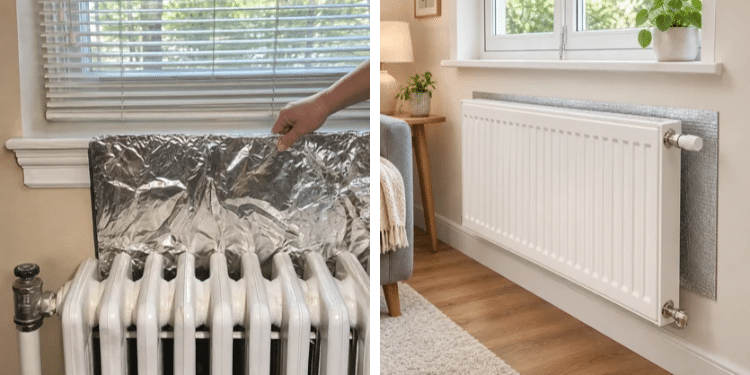

Placing reflective foil behind a home radiator is a classic energy-saving practice in older homes and drafty apartments.
When a radiator sits on an exterior wall, heat moves in two main directions: outward into the living space and backward into the wall behind the unit.
In solid masonry, uninsulated brick, or thin plaster walls, backward heat loss wastes energy and cools the wall surface. Installing a reflective aluminum surface behind the radiator redirects part of that heat back into the room.
The Physics: How Reflective Foil Alters Radiator Heat Transfer
Radiators heat a room through two primary mechanisms: convection (warming air that rises and circulates) and radiation (emitting infrared waves from hot metal surfaces).
-
Low Infrared Emissivity: Polished or clean aluminum has very low emissivity (often under $0.10$), meaning it emits little heat on its own. Instead, it reflects a high share of incoming infrared radiation back toward the radiator and into the room.
-
Reducing Conductive Wall Loss: Standard painted plaster or drywall absorbs thermal radiation readily and conducts heat into the wall structure. A reflective barrier reduces the amount of radiant heat absorbed by the wall behind the radiator.
-
Air Gap Necessity: Radiant reflection works best when an air space separates the foil from the radiator and when the foil is not pressed flat against a cold, conductive surface without insulation. Direct contact with a cold wall increases heat conduction through the backing.
How Effective Is It? Real-World Impact and Limits
Reflective foil behind a radiator is real physics, not a myth, but its impact depends heavily on the building envelope.
1. Where It Works Best
-
Uninsulated Exterior Walls: Solid brick, stone, or older uninsulated walls lose substantial heat to the outdoors. Reflecting radiant heat back into the room yields the clearest improvement.
-
Radiators Mounted Close to the Wall: Units mounted directly against exterior walls benefit more than freestanding units set far out into a room.
2. Where Impact Is Small
-
Well-Insulated Modern Walls: If a wall already has modern cavity or exterior insulation, heat loss through that wall is already low. Adding foil produces only a minor gain.
-
Convection-Dominated Heaters: Fan convectors or heaters that rely almost entirely on forced air rather than radiant heat see less benefit from a passive reflector.
Radiator Backing Options Compared
| Option | Primary Mechanism | Thermal Performance | Cost & Effort | Best For |
| Foil-Faced Foam or Bubble Board | Reflects radiation + blocks conduction | High | Low to Moderate; cut to fit | Uninsulated exterior walls with small gaps |
| Plain Aluminum Foil on Cardboard | Reflects radiation + adds rigid backing | Moderate | Very Low; easy DIY assembly | Tight spaces where thick foam does not fit |
| Bare Kitchen Foil on Wall | Reflects radiation only | Low to Moderate | Lowest; tears easily | Quick temporary test on small units |
| External / Cavity Wall Insulation | Cuts conductive heat loss across wall | Very High | High; major renovation | Whole-room and long-term efficiency |
Step-by-Step: How to Install Foil Behind a Radiator
Follow this sequence to install a reflective backing cleanly and safely:
Safety Limits and Practical Tips
-
Do Not Cover Thermostatic Valves: Never wrap or cover a radiator thermostat valve with foil or insulation. Trapped heat around the sensor tricks the valve into shutting off heat prematurely.
-
Keep Clear of Electrical Components: Aluminum conducts electricity. Keep foil away from exposed wires, sockets, and electric heaters.
-
Fix Drafts First: Sealing gaps around windows, doors, and floor edges often saves more heat than foil alone. Foil works best as a supporting measure alongside basic weatherproofing.