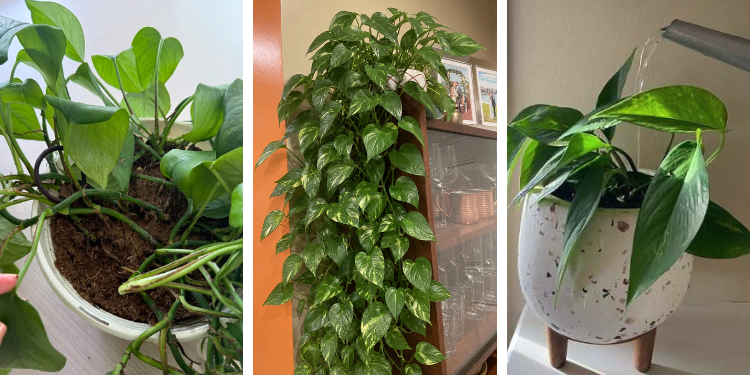
Pothos (Epipremnum aureum) is widely regarded as one of the most forgiving, adaptable indoor houseplants in the world.
Capable of trailing several feet with lush, heart-shaped variegated leaves, it is often touted as nearly unkillable.
However, there is a distinct difference between a pothos that merely survives and one that truly thrives with thick vines, large glossy foliage, and robust root health.
The single most common cause of pothos decline – manifesting as yellowing leaves, root rot, leaf drop, or stunted growth – is improper watering.
Because pothos foliage is expressive, learning how to interpret its signals, test soil moisture accurately, and adapt to seasonal shifts will keep your plant thriving for years to come.
The Root Physiology of Pothos (Epipremnum aureum)
To understand how to water a pothos correctly, you must first understand its root biology and natural environment:
-
Epiphytic Roots: In its native tropical habitat across French Polynesia and the Solomon Islands, pothos grows as an epiphyte, climbing up rainforest tree trunks. Its root system is adapted to absorb quick bursts of rainwater while clinging to bark, requiring significant oxygen flow around the roots rather than remaining submerged in dense, waterlogged soil.
-
Aerenchyma and Oxygen Sensitivity: Plant roots need oxygen for cellular respiration to absorb nutrients and moisture. When soil remains saturated for extended periods, air pockets collapse. Trapped moisture deprives the roots of oxygen, causing cell collapse and creating ideal conditions for fungal pathogens like Pythium and Phytophthora (root rot).
-
Semi-Succulent Water Retention: Pothos leaves and stems are slightly thick and semi-succulent, allowing the plant to store small amounts of water internally. This makes pothos significantly more tolerant of under-watering than over-watering.
The Golden Rule: The 50% to 75% Dry Test
The single biggest mistake plant owners make is watering on a rigid calendar schedule (such as “every Tuesday”).
Indoor environmental factors – including ambient temperature, relative humidity, light exposure, seasonal growth phases, and pot material – change how quickly soil dries.
Instead of a fixed schedule, follow the Dryness Ratio Rule:
Only water your pothos when the top 50% to 75% of the soil volume has dried out completely.
How to Test Soil Moisture Accurately
-
The Finger Test: Insert your index finger 2 to 3 inches deep into the pot soil. If the soil feels damp, cool, or sticks to your skin, do not water. If it feels completely dry, dusty, and loose, your plant is ready for a drink.
-
The Wooden Skewer Test: Push a clean wooden chopstick or skewer down to the bottom half of the pot and pull it out. If it comes out with dark, moist soil clinging to it, wait. If it comes out clean and dry, water immediately.
-
The Pot Weight Method: Lift the pot right after watering thoroughly to feel its “fully hydrated” weight. Lift it again several days later. As water evaporates and is consumed by the plant, the pot will feel significantly lighter. With practice, weight is the most reliable measure of deep soil dryness.
Over-Watering vs. Under-Watering: Reading the Leaf Signals
Your pothos communicates its hydration status through clear visual cues. Learning to read these signals prevents severe stress before permanent damage occurs.
Signs of Over-Watering (Too Much Moisture)
-
Yellowing Lower Leaves: Older leaves nearest the soil turn bright yellow and drop off frequently.
-
Soft, Black, or Mushy Stems: Stems at the soil line feel soft, squishy, or turn dark brown/black.
-
Edema and Guttation: Leaves release droplets of water from their tips in the morning (guttation) or develop water-soaked dark spots (edema).
-
Musty Soil Smell: The pot smells sour or decay-like, indicating anaerobic bacterial activity.
Signs of Under-Watering (Too Little Moisture)
-
Drooping and Wilting: Leaves lose their turgor pressure and soft green gloss, curling inward into tight tubes.
-
Crispy, Brown Leaf Tips: Leaf edges turn papery, dry, and brown.
-
Soil Shrinkage: The potting soil shrinks away from the inside edges of the pot, leaving a noticeable gap around the rim.
-
Rapid Recovery: Within 2 to 4 hours of a thorough watering, an under-watered, wilted pothos will perk back up completely.
Diagnostic Matrix: Hydration Symptoms
| Symptom | Primary Cause | Soil Condition | Corrective Action |
| Leaves curling inward, soft foliage | Under-watering | Bone dry throughout | Bottom-water soak for 30 minutes |
| Yellowing leaves, mushy stems | Over-watering / Root Rot | Waterlogged / Saturated | Stop watering; trim rot; repot into fresh soil |
| Brown papery leaf tips | Low humidity / Dry soil | Dry top layer | Water thoroughly; increase room humidity |
| Water droplets on leaf tips (Morning) | Guttation (High pressure) | Very moist | Reduce watering frequency slightly |
| Pale, dull green leaves, slow growth | Light shortage / Under-water | Dry or improper pot | Move to brighter light; check moisture level |
The Correct Technique: How to Water Your Pothos
When it is time to water, the method you use matters just as much as the timing.
Seasonal Adjustments: Summer vs. Winter Care
Pothos growth cycles fluctuate significantly with seasonal shifts in light and temperature:
Spring & Summer (Active Growth Phase)
-
Higher Water Demand: Long daylight hours and warmer temperatures drive rapid leaf production and transpiration.
-
Action: Test moisture levels frequently (typically watering every 7 to 10 days, depending on light levels). Feed with a balanced liquid houseplant fertilizer diluted to half-strength once every month.
Autumn & Winter (Dormant / Slow Phase)
-
Lower Water Demand: Shorter days and cooler indoor air slow down plant metabolism dramatically. Soil dries out much slower.
-
Action: Reduce watering frequency significantly (often every 14 to 21 days). Always double-check that the soil is dry deep down before adding water, and pause fertilizing until spring returns.
Pro-Tip: Repotting Soil Blend for Error-Free Watering
Standard commercial potting soil often holds too much water for indoor pothos. To create an ideal aerated mix, combine 60% high-quality potting soil, 20% perlite (for drainage), and 20% orchid bark (for root oxygenation). This airy mix allows you to water deeply without risking soil compaction or root suffocation.
By honoring the natural drying cycle of the plant, choosing proper potting media, and using thorough watering techniques, your pothos will reward you with dense, vibrant, trailing foliage that beautifies your space for years to come.
The best gardens don’t just brighten your yard – they become something you can enjoy season after season.
If you’re ready to grow your own backyard pharmacy, the Medicinal Garden Kit is a wonderful place to begin.
Inside you’ll find 2,409 non-GMO seeds, a detailed Herbal Medicinal Guide, and 2 FREE bonuses to help you grow a wide variety of traditional medicinal herbs with confidence.
Take a look at the Medicinal Garden Kit and start growing something truly rewarding.