Few container plants bring the sheer, explosive color of a healthy petunia basket. In early spring, they look impeccable – a dense dome of velvet trumpet flowers cascading over the edges.
But by mid-summer, many gardeners notice an annoying shift. The stems grow long, leggy, and bare. The blooms thin out, appearing only at the very tips of the branches.
When this happens, the standard response is to pluck away the wilted, papery petals. Yet, despite this effort, the plant continues to decline.
The reason is simple: standard plucking misses the botanical engine driving the plant’s life cycle. To keep petunias blooming like a solid sheet of color from spring until the first frost, you have to change your technique.
True deadheading isn’t just about cleaning up the plant; it requires removing the hidden structure beneath the bloom.
The Simple Step Everyone Misses
If you only take one lesson away from maintaining petunias, let it be this: never just pull off the dead petal.
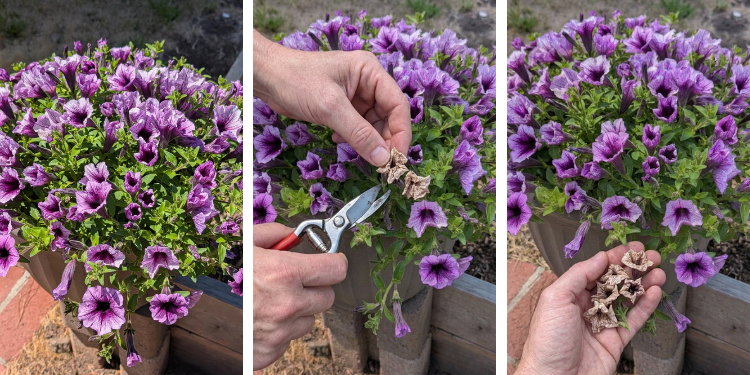
When a petunia flower finishes blooming, the colorful corolla (the trumpet-shaped petal structure) shrivels up and detaches easily with a gentle tug.
Pulling it away makes the plant look cleaner instantly, but it leaves behind the green, cup-like base known as the calyx.
Inside that tiny green cup sits the ovary of the flower. Once pollination has occurred, the plant immediately shifts its hormonal focus away from producing new flowers. Instead, it pours its energy into developing a hard, teardrop-shaped seed pod inside that calyx.
An annual plant’s biological goal is to reproduce. Once a petunia successfully produces seeds, it considers its job done. Flower production slows down, the stems stretch out to scatter seeds, and the plant begins to deteriorate.
The Golden Rule of Petunias: To stop seed production, you must remove the flower petal and the green base node right behind it. If you don’t feel the snap of the stem, you haven’t actually deadheaded the plant.
Anatomy of a Petunia: What to Look For
Before reaching for your garden shears, it helps to distinguish between a new, upcoming flower bud and an old, spent seed pod. Mistaking one for the other can accidentally strip away next week’s color display.
The Three Stages of a Stem Node
-
The New Bud: Pointed, tightly coiled, and firm to the touch. New buds usually point upward or outward, eagerly reaching for sunlight.
-
The Spent Bloom: Soft, wet, and wrinkled like wet tissue paper. The color fades rapidly into a dull purple, brown, or translucent hue.
-
The Seed Pod: A swollen, green or browning teardrop hidden inside the five-pointed green calyx. If you squeeze it gently, it feels like a hard little bead.
How to Deadhead Correctly: Step-by-Step
Once you know exactly what to look for, the process becomes quick and therapeutic. You can use your fingers for a quick daily cleanup, or micro-tip pruners if you want to avoid sticky fingers.
Fixing Leggy Petunias: The Mid-Summer Reset
Even with precise deadheading, standard petunias have a natural tendency to drift into a “leggy” growth pattern by late July or August. The stems stretch out, looking bare near the root base while only holding flowers at the tips.
If your hanging basket looks sparse and stringy, deadheading individual flowers won’t fix it. You need to perform a structural pruning reset.
The 1/3 Pruning Method
Do not be afraid to cut back your petunias. They are incredibly resilient and respond to aggressive trimming with a massive surge of fresh, compact growth.
-
Avoid the Clean Shave: Never chop the entire plant down to the soil all at once. This shocks the root system and leaves your basket looking empty for weeks.
-
Stagger Your Cuts: Choose one-third of the longest, most leggy stems on the plant. Cut them back by half their length, making the slice right above a leaf node.
-
The Rolling Rotation: The remaining two-thirds of the plant will continue blooming, hiding your cuts. A week later, cut back the next third of long stems. By week three, prune the final third.
-
The Result: Within 10 to 14 days, the hidden buds near the center of the plant will break dormancy. This transforms a stringy, tired basket into a thick, fluffy mound of fresh green foliage loaded with brand-new flower buds.
Variety Matters: Do All Petunias Need Deadheading?
The world of petunias has evolved significantly over the last few decades. The amount of maintenance your garden requires depends heavily on the specific variety you planted in the spring.
| Petunia Class | Deadheading Required? | Growth Habit | Best Use Case |
| Grandiflora / Multiflora (Classic heirloom types) | Yes — Strictly | Mounding, bushy, large trumpets | Window boxes, garden beds, patio pots |
| Wave Series / Spreading (Modern hybrids) | No — Self-Cleaning | Aggressive cascading, ground-hugging | Large hanging baskets, retaining walls |
| Supertunias / Proven Winners (Sterile vegetative types) | No — Self-Cleaning | Vigorous trailing, highly weather resistant | Premium mixed containers, accent baskets |
The “Self-Cleaning” Myth
If you bought modern hybrids like Wave Petunias or Supertunias, the tag likely proudly stated that they are “self-cleaning.”
This means the flowers drop cleanly from the plant when spent without leaving a fertile seed pod behind. These varieties are selectively bred to be sterile, meaning they cannot easily produce seeds.
However, even self-cleaning varieties benefit enormously from a mid-summer haircut. While you don’t need to pick off every individual flower, cutting back trailing stems by 20-30% in mid-August rejuvenates the foliage, boosts bloom count, and prevents the center of the basket from dying out due to heat stress.
Fueling the Bloom: Post-Pruning Care
Deadheading and pruning are only half the battle. Think of pruning as hitting the accelerator pedal on a car—if there’s no fuel in the gas tank, the engine stalls.
Because petunias are forced to grow and bloom at an unnatural pace all summer, they are incredibly heavy feeders.
The Liquid Gold Feeding Routine
Every time you trim or heavily deadhead your plants, follow up with a targeted feeding routine to spark rapid recovery:
-
The Weekly Flush: Apply a water-soluble, high-phosphorus fertilizer (often labeled as a “Bloom Booster” with an N-P-K ratio like 10-52-10 or 15-30-15) once every 7 to 10 days.
-
The Container Exception: Plants in hanging baskets lose nutrients quickly because water drains through the potting soil daily. For containers, feed with a half-strength fertilizer solution every single week rather than a full-strength dose once a month.
-
Watering Order: Always check the soil moisture before feeding. Never apply chemical fertilizer to bone-dry, wilted soil, as this can burn the tender root hairs. Water thoroughly with plain water first, then follow up with your nutrient mix.
By mastering the simple click of removing the green calyx and pairing it with a staggered mid-summer trim, you disrupt the plant’s natural aging clock.