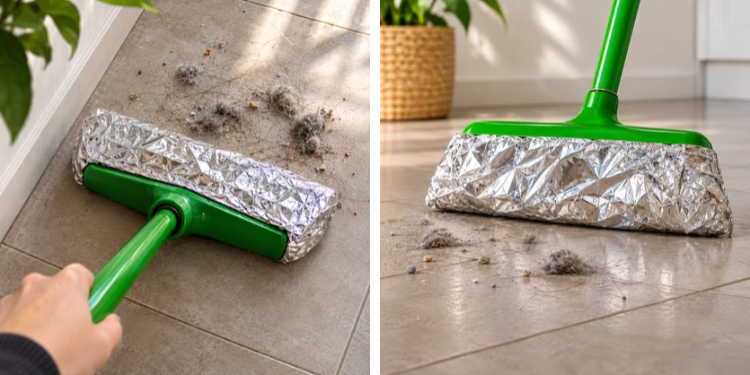
If you keep a close eye on modern home cleaning hacks and eco-friendly household shortcuts, you might occasionally spot an unexpected metallic attachment on a broom: a sheet of standard household aluminum foil wrapped snugly around the base of the bristles or along the sweeping edge.
At first glance, placing foil on a broom seems almost counterintuitive. Brooms are designed to sweep away loose dirt and dust, while aluminum foil belongs in the kitchen for baking and wrapping food.
However, wrapping or attaching a piece of aluminum foil to your broom is a clever, science-backed hack that tackles three of the most annoying challenges in household floor care: eliminating static electricity cling, repelling stubborn pet hair, and scraping away sticky, ground-in floor debris.
Here is a breakdown of why people put aluminum foil on their brooms, the physics and chemistry behind its effectiveness, and how to execute this simple trick in your own cleaning routine.
The Physics: How Aluminum Foil Changes Sweeping Mechanics
To understand why this simple household hack works so well, it helps to examine the physical forces generated during standard sweeping.
1. Dissipating Triboelectric Static Charge
Synthetic broom bristles – typically made from polypropylene, PET plastic, or nylon – are non-conductive insulators.
When you sweep a synthetic broom across synthetic flooring (like vinyl, laminate, or linoleum) or finished hardwood, the friction strips electrons from one material and transfers them to another.
This process, known as triboelectric charging, builds up a powerful static electric charge on the broom bristles.
-
The Static Problem: Charged bristles act like tiny magnets for fine dust, lightweight ash, and dry pet hair. Instead of falling into your dustpan, the dust clings stubbornly to the bristles, scattering back across the floor with every push of the broom.
-
The Foil Solution: Aluminum is an excellent electrical conductor. Wrapping aluminum foil around the base of the bristles provides an immediate pathway for static charge to discharge. The metallic foil safely neutralizes the static voltage, allowing dust, lint, and hair to slide freely off the bristles and directly into the dustpan.
2. Micro-Scraping Action for Sticky Debris
Standard broom bristles are flexible, which makes them great for pushing loose dirt but weak at removing dried food spills, sticky muddy spots, or hardened kitchen grime stuck to floorboards.
Attaching a folded strip of aluminum foil across the bottom edge of the broom creates a semi-rigid, non-abrasive scraping bar.
The malleable aluminum edge dislodges stuck-on spots without scratching sensitive floor sealants or polyurethane finishes.
4 Main Reasons People Put Aluminum Foil on Their Brooms
1. Stopping Pet Hair from Tangling in Bristles
Pet owners know the frustration of sweeping up dog or cat hair, only to find the hair tightly woven into the broom bristles within minutes. Removing tangled fur by hand is unpleasant and slow.
Because animal fur is highly susceptible to static accumulation, neutralizing static friction with an aluminum foil wrap prevents hair from sticking to the bristles. The fur rolls smoothly across the floor into neat piles, leaving your broom clean.
2. Capturing Fine Micro-Dust and Ash
Sweeping fine particulate matter – such as fireplace ash, drywall dust, flour, or fine craft glitter – often results in a cloud of airborne dust that settles back onto furniture.
Static electricity causes fine dust particles to repel each other and stick to synthetic bristles. Using a foil-wrapped broom grounds the static charge, keeping micro-dust grouped together on the floor surface so it can be swept cleanly into a dustpan without kicking up airborne clouds.
Floor Sweeping Hack Comparison Matrix
| Method | Static Charge Control | Pet Hair Repulsion | Sticky Spot Scraping | Bristle Protection |
| Aluminum Foil Wrap | High (Drains static via conductivity) | High (Prevents hair cling) | Moderate (Acts as a gentle scraper) | Keeps bristles clean & untangled |
| Standard Plastic Broom | Low (Generates strong static) | Low (Hair tangles in bristles) | Low (Bristles bend over spots) | Accumulates dust & hair |
| Rubber Broom Squeegee | Moderate | High (Pulls hair mechanically) | Low | Durable but heavy |
| Anti-Static Spray on Broom | Moderate (Temporary chemical coat) | Moderate | Low | Requires constant reapplication |
3. Cleaning Rugs and Doormats Without a Vacuum
Pulling a heavy vacuum cleaner out just to sweep a small entryway rug or doormat can feel like a hassle.
However, standard brooms often fail on carpets because static cling and fabric friction hold dust deep inside carpet fibers.
Sweeping a rug with a foil-enhanced broom breaks the static lock between synthetic rug fibers and trapped pet hair, allowing the broom to lift surface dirt and hair off low-pile mats effortlessly.
4. Extending the Lifespan of Your Broom
Over time, broom bristles absorb oils, static dust, and debris, causing the bristles to splay outward and lose structural stiffness.
Wrapping aluminum foil firmly around the upper crown of the bristles holds the broom shape intact, reinforcing structural rigidity and extending the functional lifespan of the broom.
Step-by-Step: How to Put Aluminum Foil on Your Broom
Setting up your broom with aluminum foil takes less than two minutes:
Pro-Tips for Static-Free Home Care
-
Combine with Dryer Sheets: For extreme static issues on dry winter days, rub a used dryer sheet over the aluminum foil wrap before sweeping. This double-action approach guarantees zero static cling even on dry synthetic carpets.
-
Ideal for Baseboard Cleaning: Turn the broom sideways and run the foil-wrapped edge along wooden baseboards. The anti-static metal prevents dust from clinging to wall trim, keeping baseboards cleaner for longer.
Putting a piece of aluminum foil on your broom is an easy, low-cost, and clever trick that turns an ordinary sweeping chore into a quick, static-free, and satisfying cleanup.