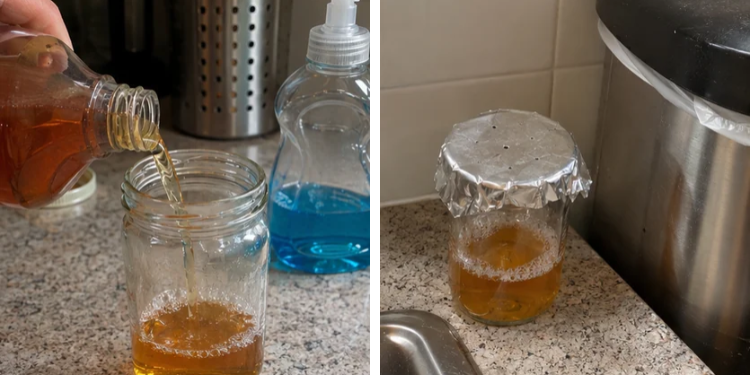
If you glance near the fruit bowl, trash bin, or sink area in a well-managed kitchen during the warmer months of the year, you might notice an unpretentious setup sitting on the countertop: a small glass jar half-filled with an amber liquid, finished with a slick of foam or a punctured foil lid.
While it might look like a forgotten cleaning project, putting a glass jar filled with a mixture of vinegar (specifically apple cider vinegar) and liquid dish soap in your kitchen is an old-fashioned, highly effective pest control tradition.
By taking advantage of the olfactory attraction of fermented acetic acid and manipulating the fluid surface tension of water, this simple DIY trap forms a non-toxic, chemical-free defense against one of the most stubborn kitchen nuisances: fruit flies (Drosophila melanogaster) and fungus gnats.
Here is a scientific breakdown of how this simple combination works, why it outperforms commercial chemical sprays, and how to set up and maintain your own trap.
The Science: Smell Attraction Meets Surface Tension
To understand why this simple two-ingredient combination is so effective at clearing a kitchen of flying pests, it helps to break down the distinct chemical and physical roles played by each component.
1. The Bait: Acetic Acid and Fermentation Volatiles
Fruit flies do not possess keen eyesight; instead, they navigate their environment almost entirely using specialized olfactory receptors on their antennae.
They are biologically programmed to seek out the volatile organic compounds emitted by overripe, decaying, or fermenting fruit.
-
Apple Cider Vinegar (ACV): Unlike plain distilled white vinegar, apple cider vinegar is made from fermented apple juice. It contains a rich cocktail of acetic acid, ethanol, and aromatic fruit esters.
-
The Olfactory Signal: To a fruit fly, the sweet, sour, fermented aroma of apple cider vinegar signals an ideal feeding and egg-laying site. The airborne vapors travel quickly across the kitchen, luring flies directly toward the mouth of the jar.
2. The Trap: Breaking Liquid Surface Tension
If you fill a jar with pure apple cider vinegar alone, you will watch fruit flies land on the surface of the liquid, take a drink, and fly away completely unharmed.
Water and vinegar molecules possess high surface tension due to hydrogen bonding, creating a microscopic elastic “skin” across the top of the liquid that easily supports the light body weight of a fruit fly.
This is where liquid dish soap plays its crucial role:
-
Surfactant Action: Liquid dish soap consists of amphiphilic surfactants—molecules with a water-loving (hydrophilic) head and an oil-loving (lipophilic) tail. When added to the vinegar, these surfactant molecules wedge themselves between the water molecules, disrupting the hydrogen bonds and collapsing the liquid’s surface tension.
-
Immediate Drowning: The moment a fruit fly lands on the vinegar-soap solution, the surface skin gives way instantly. The fly sinks beneath the surface, where the soapy liquid coats its waxy outer cuticle and blocks its respiratory spiracles (breathing pores), neutralizing the pest within seconds.
4 Reasons People Recommend the Vinegar and Soap Jar
1. Completely Non-Toxic for Food Preparation Areas
Commercial insecticide aerosols often rely on synthetic pyrethroids or organophosphates. Spraying these synthetic chemicals in a kitchen environment carries severe risks of contaminating food prep surfaces, cutting boards, open fruit, and eating utensils.
The vinegar-and-soap jar relies entirely on food-safe, non-toxic household ingredients. It can sit directly next to a fruit bowl or food prep station without introducing harmful fumes or chemical residues into your living space.
2. Targets Pests at the Source Without Disrupting Your Home
Catching fast-moving fruit flies with manual swatters or rolling newspapers is frustrating and ineffective, as a single female fruit fly can lay up to 500 eggs in her brief lifespan.
A liquid trap works silently and continuously 24 hours a day, drawing incoming flies away from your fresh produce and trapping them before they can reproduce in your pantry or trash bin.
3. Highly Budget-Friendly and Environmentally Sustainable
Commercial sticky traps, electric UV zappers, and chemical refills can be expensive and generate unnecessary plastic waste.
A simple mason jar, a few tablespoons of store-bought apple cider vinegar, and two drops of standard dish soap cost less than 0.10$ per fill.
The glass jar is completely reusable, and the spent liquid can be flushed down the kitchen drain, which doubles as a quick rinse to clear fruit fly eggs hiding in the sink trap!
4. Broad-Spectrum Action for Common Household Gnats
While engineered specifically for fruit flies, this trap also captures drain flies (Psychodidae) and fungus gnats (Sciaridae) that migrate into the kitchen from indoor houseplant soil or moist sink drains, keeping your entire cooking space free of small flying insects.
Kitchen Insect Control Methods Compared
| Method | Safety Around Food | Active Mechanism | Environmental Impact | Maintenance Cost |
| Vinegar & Dish Soap Jar | 100% Safe & Food-Grade | Olfactory attraction + Surfactant drowning | 100% Biodegradable (Zero plastic waste) | < 0.10$ |
| Aerosol Insecticide Spray | Unsafe (Requires food removal) | Neurotoxic synthetic pyrethroids | High (Propellant cans & chemical residue) | 5.00 – 10.00$ |
| Yellow Sticky Paper Sheets | Safe | Visual color attraction + Glue adhesion | Moderate (Non-recyclable plastic trash) | 3.00 – 6.00$ |
| Electric UV Bug Zapper | Moderate (Splatters micro-particles) | Light attraction + High-voltage shock | High (Continuous energy consumption) | 20.00 – 40.00$ |
Step-by-Step: How to Make and Maintain the Ultimate Fruit Fly Trap
Setting up your vinegar-and-soap jar takes under two minutes. Follow this step-by-step guide for maximum efficiency:
Pro-Tips for a Completely Pest-Free Kitchen
-
Clean the Sink Drain: Fruit flies frequently breed in the organic bio-film coating the inside of garbage disposals and sink drains. Pouring a kettle of boiling water followed by a splash of white vinegar down the drain eliminates hidden eggs and larvae.
-
Store Fresh Produce in the Fridge: While your vinegar jar works on active adult flies, store ripe bananas, peaches, and tomatoes in the refrigerator during warmer months to eliminate the breeding grounds that attract new fruit flies in the first place.
Setting up a glass jar with vinegar and dish soap in your kitchen is an easy, scientific, and non-toxic habit that keeps your food prep areas clean, hygienic, and entirely pest-free naturally.