By August, Black-Eyed Susans are often among the brightest flowers left in the summer garden. Their golden-yellow petals and dark central cones seem perfectly suited to late summer, when many earlier perennials have already finished flowering.
With the right care, many Rudbeckia plants can continue providing color into early fall.
August, however, can also be a challenging month for them. Weeks of heat, dry soil, fading flowers, seed production, crowded foliage, and occasional disease pressure can leave plants looking tired.
You may notice brown flower heads, drooping stems, yellowing lower leaves, or fewer new buds appearing than earlier in the season.
This doesn’t necessarily mean your Black-Eyed Susans are finished.
A little maintenance in August can help repeat-flowering plants use their remaining energy more efficiently, keep foliage healthier, and encourage additional flowers.
The goal isn’t to force the plants into producing endless blooms but to provide the conditions they need to continue flowering naturally for as long as possible.
Here are seven things to do with your Black-Eyed Susans in August if you want healthy plants, a tidy garden, and as many late-season flowers as possible.
1. Deadhead Faded Flowers Before They Produce Too Much Seed
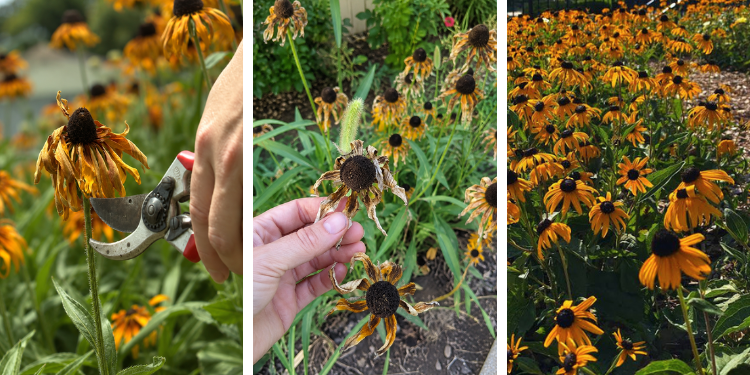
If you do only one thing to your Black-Eyed Susans in August, make it regular deadheading.
Once a flower finishes blooming, the yellow petals begin fading and dropping while the dark central cone remains. The plant can then devote increasing amounts of energy to developing mature seeds.
That is useful if you want the plant to reproduce, but it may not be what you want if your priority is extending the flowering season.
Removing faded flowers can encourage Rudbeckia to continue blooming, particularly when there are already smaller buds and side shoots developing farther down the stems.
Don’t simply pull off the yellow petals. Follow the flower stem downward until you reach a healthy leaf, side shoot, or developing bud. Cut just above this point using clean pruning shears or scissors.
This creates a much neater plant and allows any developing side shoots to continue growing.
Walk through your Black-Eyed Susan patch every few days during August rather than waiting until nearly every flower has faded. Removing old blooms gradually is easier on the plant and keeps the display looking fresh.
There is one good reason not to deadhead everything: wildlife.
Black-Eyed Susan seed heads can provide food for birds later in the season, and the dried cones add attractive structure to autumn and winter gardens. A good compromise is to deadhead aggressively during the earlier part of August and begin leaving more seed heads as the season progresses.
This way, you can encourage additional flowers now while still providing seeds later.
2. Water Deeply During August Heat
Black-Eyed Susans are famous for being tough, drought-tolerant plants. Established Rudbeckia can survive conditions that cause many other flowering perennials to wilt.
But drought tolerance does not mean the plant flowers best without water.
A plant that is simply surviving drought behaves differently from one that has enough moisture to continue producing flowers. During prolonged dry periods, Rudbeckia may conserve resources by slowing new growth, dropping lower leaves, and producing fewer buds.
If August is hot and dry, check the soil several inches below the surface. If it feels dry at that depth, give the plants a thorough watering.
Deep watering is preferable to sprinkling a small amount of water over the soil every day.
A slow, thorough watering allows moisture to penetrate deeper into the root zone. The upper layer of soil may then dry slightly between waterings while moisture remains available farther down.
This encourages a stronger root system and makes the plants more resilient during future dry periods.
Whenever possible, water around the base of the plant rather than spraying the leaves and flowers.
Morning is an excellent time to water. Plants have moisture available before afternoon temperatures rise, while any foliage that becomes wet has plenty of time to dry.
Container-grown Black-Eyed Susans need closer attention because potting mix dries considerably faster than garden soil. During a heatwave, containers may need checking every day.
The important thing is balance. Rudbeckia appreciates moisture but does not want to sit in constantly soggy soil. Good drainage remains essential.
3. Don’t Overfeed Them in an Attempt to Force More Flowers
When a plant begins producing fewer flowers, reaching for fertilizer may seem like the obvious solution.
With Black-Eyed Susans, more fertilizer isn’t necessarily better.
Rudbeckia naturally grows in relatively ordinary soil and usually does not require heavy feeding. Excessive fertilizer—particularly products high in nitrogen—can encourage the plant to produce large amounts of soft green foliage rather than flowers.
You may end up with a very green Black-Eyed Susan that produces fewer blooms and has weaker stems.
If your plants are growing in healthy garden soil and already produced a strong display earlier in summer, they may need no August fertilizer at all.
A layer of compost around the plants is often sufficient for maintaining soil health.
Container-grown plants are somewhat different because nutrients are gradually washed from the potting mix every time the container is watered. A diluted balanced liquid fertilizer may be useful when growth has clearly slowed, but follow the product instructions and avoid assuming that doubling the amount will produce twice as many flowers.
If your Black-Eyed Susans consistently produce lush foliage but disappointing flowers, excessive fertility may actually be part of the problem.
Sunlight, moisture, and deadheading are usually more important for extending the late-summer display than heavy feeding.
4. Remove Diseased and Damaged Leaves
By August, Black-Eyed Susan foliage has already endured months of rain, watering, heat, insects, and humidity.
This is often when leaf problems become more noticeable.
You may see lower leaves turning yellow or brown. Other leaves may develop spots or a whitish coating associated with powdery mildew.
Rudbeckia can be susceptible to powdery mildew, particularly when plants are crowded and air circulation is poor.
Inspect your plants closely while you deadhead them.
Remove leaves that are badly damaged or clearly diseased, particularly those near the bottom of the plant. Place diseased foliage in the trash rather than using it as ordinary garden mulch around the plant.
Don’t strip healthy foliage unnecessarily. The remaining green leaves are still photosynthesizing and producing energy that the plant needs for flowers, roots, and future growth.
The objective is simply to remove problem foliage and improve airflow.
Also look around the base of the plants. If weeds or neighboring plants have grown into the Rudbeckia clump, remove or trim them where appropriate. Better airflow can help foliage dry more quickly after rain.
Avoid repeatedly wetting the leaves during irrigation. Watering at soil level is usually preferable, especially during warm, humid weather.
5. Give Them As Much Sunlight as Possible
Black-Eyed Susans are sun-loving plants.
Although many Rudbeckia tolerate partial shade, flowering is generally strongest when plants receive abundant direct sunlight. Around six or more hours of sun is a useful target for many varieties.
Sometimes a location that was sunny in spring becomes considerably shadier by August.
Nearby shrubs have filled out, trees have developed dense foliage, or taller perennials may have grown in front of the Black-Eyed Susans.
Take a look at your garden during the middle of the day.
If another plant is completely covering your Rudbeckia, selective pruning or moving an overcrowding annual may restore some sunlight.
Don’t dig up an established Black-Eyed Susan during severe August heat simply because it receives a little afternoon shade. Transplanting during hot weather can create considerably more stress than the shade itself.
If the location is fundamentally too shady, make a note to divide or move the plant during a more appropriate season.
Plants receiving insufficient light may stretch toward the sun, develop weaker stems, and produce fewer flowers.
Sunlight becomes particularly important when you’re asking the plant to produce another round of blooms late in the season.
6. Add Mulch, but Don’t Pile It Against the Crown
August sun can heat exposed garden soil quickly.
A modest layer of organic mulch around Black-Eyed Susans can help keep the root zone cooler and slow the loss of soil moisture between waterings.
Materials such as shredded leaves, fine bark, or clean organic mulch can work well.
Spread the material over exposed soil around the plants, but leave a small gap around the stems and crown.
Piling thick mulch directly against the plant can trap excessive moisture and reduce airflow around the base.
Mulching also helps suppress weeds.
This matters more than it might seem. Weeds growing around Rudbeckia are competing for the same water and nutrients at exactly the time your Black-Eyed Susans are trying to maintain flowers during summer heat.
Removing those competitors and covering the exposed soil can make late-summer maintenance much easier.
If the bed was already mulched earlier in the year, don’t automatically add another thick layer. Check how much remains first. The goal isn’t to continuously pile material onto the bed; it is simply to maintain enough coverage to protect the soil.
7. Start Leaving Some Seed Heads for Birds and Next Year’s Garden
August care should not focus exclusively on producing more flowers.
As the month progresses, it is worth thinking about what you want from your Black-Eyed Susans after flowering ends.
Rudbeckia commonly reproduces by seed, and allowing selected flower heads to mature can produce seedlings around the parent plants.
If you want a more natural, meadow-like Black-Eyed Susan patch next year, stop deadheading some of the healthiest late-season flowers.
Allow the central cones to mature and dry naturally.
Seeds may eventually fall onto the surrounding soil and germinate when conditions are appropriate. Just remember that seedlings from cultivated varieties may not always look exactly like the parent plant.
Leaving seed heads also supports wildlife.
Birds can feed from mature Rudbeckia seed heads, while the dark cones remain standing long after the yellow petals disappear. In autumn and winter, they can give perennial beds texture rather than leaving an entirely bare landscape.
You don’t have to choose between more August flowers and winter seed heads.
Use selective deadheading.
During early and mid-August, remove many fading blooms to encourage continued flowering. Toward the end of the flowering season, gradually stop removing them.
You get the best of both approaches: additional flowers followed by seeds and winter structure.
What If Your Black-Eyed Susans Stop Blooming Anyway?
Sometimes good care won’t produce another large flush of flowers.
That doesn’t necessarily mean you’ve done something wrong.
The exact flowering behavior depends heavily on the Rudbeckia species, cultivar, climate, plant age, and weather conditions.
Some Black-Eyed Susans are annuals or biennials, while others are long-lived perennials. A plant naturally reaching the end of its life cycle will behave differently from an established perennial Rudbeckia fulgida preparing for another year.
Extreme heat can also temporarily reduce flowering. Once temperatures moderate, plants that still have healthy buds may resume blooming.
Look at the overall condition of the plant rather than judging it only by flower numbers.
Green foliage and healthy stems indicate that the plant is still functioning even if flowering temporarily slows.
Should You Cut Black-Eyed Susans Down in August?
Usually, no.
If the plant is healthy, cutting the entire clump to the ground in August removes green leaves that are still producing energy.
Instead, remove individual faded flowers, damaged leaves, and completely dead stems.
A very untidy plant can receive a light cleanup, but avoid severe pruning while it still has healthy foliage and developing flowers.
Perennial Rudbeckia can eventually be cut back after the growing season. However, many gardeners deliberately leave stems and seed heads standing through winter because they provide food for birds and visual interest.
The dried stems can then be removed before fresh growth begins.
A Simple August Routine
You don’t need to spend hours maintaining Black-Eyed Susans.
Walk through the planting once or twice each week.
Remove faded flowers you don’t want to turn into seed, inspect the foliage for disease, pull nearby weeds, and check the soil moisture.
During extended dry weather, provide a deep watering.
As August progresses, leave an increasing number of healthy flower heads intact if you want seeds for birds or natural reseeding.
This small amount of attention is usually much more beneficial than repeatedly fertilizing or heavily pruning the plants.
Black-Eyed Susans are famous for being tough, dependable flowers, but even low-maintenance perennials benefit from a little attention during the hottest part of summer.
The best gardens don’t just brighten your yard – they become something you can enjoy season after season.
If you’re ready to grow your own backyard pharmacy, the Medicinal Garden Kit is a wonderful place to begin.
Inside you’ll find 2,409 non-GMO seeds, a detailed Herbal Medicinal Guide, and 2 FREE bonuses to help you grow a wide variety of traditional medicinal herbs with confidence.
Take a look at the Medicinal Garden Kit and start growing something truly rewarding.