When planning a home garden, most growers default to annual crops – tomatoes, peppers, lettuce, and squash.
While rewarding, annual vegetables require a heavy investment of time, labor, and money every single spring.
Beds must be tilled, seeds started, seedlings hardened off, and soil continually amended to replace depleted nutrients.
Perennial vegetables completely change this equation. Once established, these resilient plants return year after year, yielding abundant harvests for decades with minimal maintenance.
They develop deep, expansive root systems that mine minerals from deep subsoil, resist drought, build topsoil structure, and suppress weeds naturally.
By incorporating these 15 perennial vegetables into your garden or food forest layout, you can create a self-sustaining, low-maintenance food source that yields fresh produce from early spring through late autumn.
The Ecological Advantage of Perennial Crops
Transitioning part of your garden footprint to perennial food crops offers profound ecological and agricultural benefits:
-
Soil Health Preservation: Because perennials remain in the ground year-round, there is no need for annual tilling. This preserves delicate soil fungal networks (mycorrhizae), prevents topsoil erosion, and encourages earthworm populations.
-
Deep Mineral Mining: Deep perennial roots access minerals and trace elements trapped far below the shallow root zones of annual vegetables, bringing those nutrients up into edible leaves and stems.
-
Resource Efficiency: Established perennials require significantly less supplemental watering than annuals, possess superior pest resistance, and eliminate the annual cost of buying seeds and seed-starting supplies.
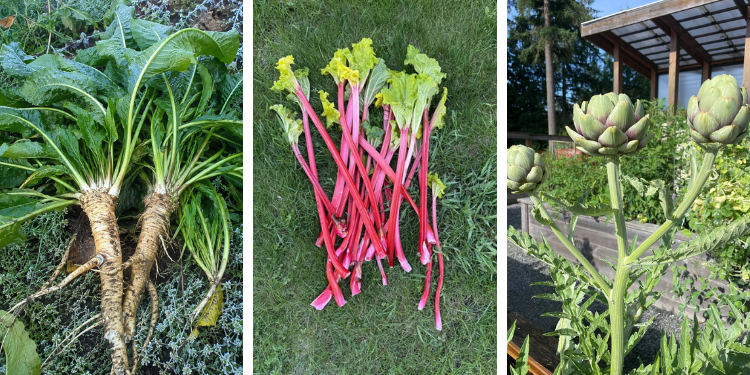
1. Asparagus (Asparagus officinalis)
Asparagus is the undisputed monarch of perennial vegetables. A single well-maintained asparagus bed can produce crisp, tender spears every spring for 20 to 30 years.
-
Growing Conditions: Full sun and light, sandy, well-draining soil with a pH around 6.5\7.5.
-
Harvest Window: Spring (April to June).
-
Culinary Use: Snap tender spears near the base and roast with olive oil, steam, or grill.
-
Pro Tip: Plant 1-year-old crowns in deep trenches enriched with compost, and hold off on harvesting during the first year so roots can establish strong energy reserves.
2. Rhubarb (Rheum rhabarbarum)
With its bold crimson stalks and oversized green leaves, rhubarb is as ornamental as it is delicious. This cold-hardy perennial thrives in northern climates and provides tart, tangy stalks from early spring onward.
-
Growing Conditions: Cool climates, full sun to partial shade, rich organic soil.
-
Harvest Window: Early spring through midsummer.
-
Culinary Use: Stew stalks into jams, pies, compotes, or tangy sauces.
-
Safety Warning: Only eat the thick stalks. Rhubarb leaf blades contain high concentrations of toxic oxalic acid and must never be consumed.
3. Globe Artichoke (Cynara cardunculus)
A dramatic member of the thistle family, the globe artichoke produces massive silver-green leaves and large, edible flower buds. In USDA Zones 7 and warmer, it acts as a reliable perennial for 5 to 7 years.
-
Growing Conditions: Full sun, rich soil, deep moisture, and mild winters.
-
Harvest Window: Early summer through autumn.
-
Culinary Use: Harvest flower buds while tightly closed. Steam whole, pull off scales, and dip the fleshy bases in melted butter or garlic aioli.
4. Jerusalem Artichoke / Sunchoke (Helianthus tuberosus)
A native North American relative of the sunflower, sunchokes produce towering 8 foot stems topped with bright yellow blossoms. Below ground, they yield heavy crops of knobby, nut-flavored tubers.
-
Growing Conditions: Tolerates almost any soil type; thrives in full sun.
-
Harvest Window: Late autumn after the first frost, or throughout winter.
-
Culinary Use: Roast, mash, or slice raw into salads for a crisp, water-chestnut-like crunch.
-
Caution: Sunchokes spread vigorously! Dedicate a specific, contained bed for them, or harvest thoroughly each autumn to keep them in check.
5. Horseradish (Armoracia rusticana)
Horseradish is an unkillable perennial root crop grown for its sharp, pungent bite. Its deep taproots store volatile mustard oils that clear the sinuses the moment the root is grated.
-
Growing Conditions: Full sun to partial shade; prefers loose, deep soil free of stones.
-
Harvest Window: Late autumn after foliage dies back.
-
Culinary Use: Grate fresh root and mix with white vinegar and sea salt to make homemade prepared horseradish sauce for meats and roasted vegetables.
Perennial Vegetable Profiles & Growing Specs
| Crop Name | Botanical Name | USDA Zones | Primary Edible Part | Sunlight Needs |
| Asparagus | Asparagus officinalis | 3–9 | Young spring spears | Full Sun |
| Rhubarb | Rheum rhabarbarum | 3–8 | Fleshy leaf stalks (Petiole) | Full Sun to Partial Shade |
| Globe Artichoke | Cynara cardunculus | 7–10 | Unopened flower buds | Full Sun |
| Sunchoke | Helianthus tuberosus | 3–9 | Underground tubers | Full Sun |
| Sea Kale | Crambe maritima | 4–9 | Blanched spring shoots & leaves | Full Sun |
| Good King Henry | Blitum bonus-henricus | 3–9 | Spring shoots & summer leaves | Partial Shade to Full Sun |
| Egyptian Walking Onion | Allium x proliferum | 3–10 | Green tops, bulblets, & roots | Full Sun |
6. Sea Kale (Crambe maritima)
Sea kale is a rugged coastal perennial that yields delicious blanched shoots in early spring, followed by attractive blue-grey ruffled foliage and fragrant white spring flowers.
-
Growing Conditions: Well-drained sandy soil, full sun, highly salt-tolerant.
-
Harvest Window: Early spring (for blanched shoots) through early summer.
-
Culinary Use: Cover emerging spring shoots with a terracotta pot to “blanch” them white. Cook these tender shoots like asparagus – their flavor resembles a blend of broccoli, hazelnut, and cabbage.
7. Good King Henry (Blitum bonus-henricus)
A traditional European cottage garden staple, Good King Henry was grown for centuries as a reliable perennial alternative to spinach.
-
Growing Conditions: Moist, fertile soil rich in nitrogen; thrives in partial shade.
-
Harvest Window: Spring through early autumn.
-
Culinary Use: Harvest young spring shoots and steam them like asparagus. Pick tender summer leaves and saute them in butter just as you would fresh spinach.
8. Egyptian Walking Onion (Allium x proliferum)
Also known as the “tree onion,” this bizarre perennial produce cluster of mini-bulblets at the top of its stalks instead of flowers.
As bulblets grow heavy, the stalk bends over, roots into neighboring soil, and “walks” across your garden bed over time.
-
Growing Conditions: Adaptable to almost any well-drained soil; full sun.
-
Harvest Window: Year-round (greens in spring, bulblets in late summer, ground bulbs in fall).
-
Culinary Use: Use green shoots like scallions, and harvest the pungent top bulblets for pickling or stir-fries.
9. Sorrel (Rumex acetosa)
Sorrel is one of the very first leafy greens to emerge in early spring garden beds. Its bright green leaves deliver an invigorating, sharp lemon flavor thanks to natural trace oxalates.
-
Growing Conditions: Partial shade to full sun; prefers moist, slightly acidic soil.
-
Harvest Window: Early spring through late autumn.
-
Culinary Use: Shred raw leaves thinly into green salads, or purée them into classic French cream of sorrel soup, egg dishes, and fish sauces.
10. Watercress (Nasturtium officinale)
If you have a shady damp spot, rain garden, or water feature, watercress is the ultimate perennial superfood green. It packs an intense peppery crunch and exceptional nutrient density.
-
Growing Conditions: Wet soil, bog margins, or shallow running water in partial shade.
-
Harvest Window: Spring through mid-autumn.
-
Culinary Use: Toss fresh leafy stems into sandwiches, salads, or blend into green smoothies and chilled spring soups.
11. Okinawan Spinach (Gynura crepioides)
A striking tropical perennial green featuring dark green leaves with deep purple undersides. In frost-free climates (Zones 9–11), it forms a dense groundcover that produces year-round.
-
Growing Conditions: Warm climates, partial shade to full sun, moist soil.
-
Harvest Window: Year-round in warm climates; spring to autumn in temperate zones.
-
Culinary Use: Eat tender leaf tips raw in salads, or stir-fry with garlic, ginger, and soy sauce.
12. Tree Collards (Brassica oleracea var. acephala)
Unlike annual collard greens, tree collards develop a woody trunk and grow up to 6 to 8 feet tall, yielding sweet, purple-tinted green leaves continuously for 5 to 8 years.
-
Growing Conditions: Mild, temperate climates (Zones 7–10); full sun and rich compost.
-
Harvest Window: Year-round (leaves grow sweeter after light winter frosts).
-
Culinary Use: Strip leaves from the woody midrib and braise slowly with garlic, vegetable broth, and apple cider vinegar.
13. Sweet Potato Vine (Ipomoea batatas) – As a Perennial
While temperate gardeners grow sweet potatoes as annuals, in Zones 9b and warmer, sweet potatoes act as a creeping perennial groundcover that supplies both edible roots and succulent leafy greens year after year.
-
Growing Conditions: Warm soil, full sun, medium moisture.
-
Harvest Window: Leafy greens throughout summer; tubers harvested as needed.
-
Culinary Use: Sauté the tender leaf tips like spinach, and dig up select tubers while leaving the main root crown undisturbed to continue growing.
14. Wild Leek / Ramps (Allium tricoccum)
Ramps are prized wild forest perennials that grow in rich, damp woodland soil beneath deciduous leaf canopies. They yield a delicate, sweet onion-garlic flavor every spring.
-
Growing Conditions: Deep shade, damp woodland leaf mold soil high in organic matter.
-
Harvest Window: Early spring (a short 4-to-6-week window before forest trees leaf out).
-
Culinary Use: Sauté whole leaves and bulbs in butter, blend into wild ramp pesto, or pickle bulbs for long-term storage.
15. Groundnut (Apios americana)
A native nitrogen-fixing vine that climbs up trellises or surrounding shrubs, producing edible stringed chains of subterranean tubers that contain 3 times the protein of standard potatoes.
-
Growing Conditions: Moist soil near streams or low spots; full sun to partial shade.
-
Harvest Window: Autumn through winter.
-
Culinary Use: Boil, roast, or slice thin and fry into chips. Groundnut tubers must always be cooked before eating.
How to Establish a Low-Maintenance Perennial Vegetable Bed
Setting up a perennial bed requires careful upfront preparation, as these plants will occupy the same soil space for years to come.
By integrating these 15 perennial vegetables into your garden layout, you can spend less time tilling and planting every spring and more time harvesting fresh, nutrient-dense produce year after year.
The best gardens don’t just brighten your yard – they become something you can enjoy season after season.
If you’re ready to grow your own backyard pharmacy, the Medicinal Garden Kit is a wonderful place to begin.
Inside you’ll find 2,409 non-GMO seeds, a detailed Herbal Medicinal Guide, and 2 FREE bonuses to help you grow a wide variety of traditional medicinal herbs with confidence.
Take a look at the Medicinal Garden Kit and start growing something truly rewarding.