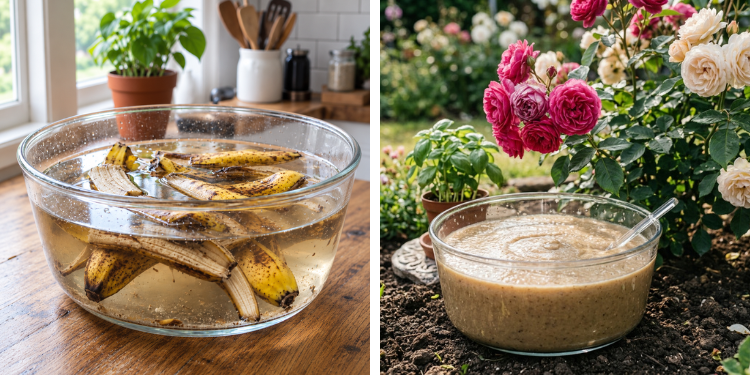
If you eat bananas regularly, you’ve probably thrown hundreds of peels into the trash or compost without giving them much thought. But lately, gardeners have been putting those peels into a blender instead.
The idea is incredibly simple:
Banana peels + water + blender = a homemade mixture for the garden.
Why Do Gardeners Blend Banana Peels?
Banana peels are organic plant material.
Like other fruit and vegetable scraps, they contain nutrients that originally came from the soil in which the banana plant grew.
When the peel decomposes, microorganisms break the organic material down.
Over time, some of those nutrients become available within the soil system.
Instead of waiting for an entire peel to slowly decompose, some gardeners chop or blend it first.
Why blend it?
Breaking the peel into tiny pieces creates more surface area.
More surface area means soil microorganisms can reach more of the material.
In practical terms:
Whole peel = slower decomposition
Finely chopped or blended peel = potentially faster decomposition
That’s the main advantage.
The blender isn’t magically transforming the peel into instant fertilizer. It’s simply breaking the organic material into much smaller pieces.
What Nutrients Are in Banana Peels?
The nutrient most commonly associated with banana peels is potassium.
Potassium is one of the three primary nutrients commonly represented on fertilizer labels:
N – Nitrogen
P – Phosphorus
K – Potassium
Potassium plays important roles in plants, including water regulation, enzyme activity, and many physiological processes involved in overall plant function.
Banana peels also contain other mineral nutrients, though their exact composition varies.
This is where the internet sometimes takes things too far.
A banana peel containing potassium does not mean pouring banana water onto a plant will automatically make it produce enormous flowers or fruit.
Plants need many nutrients in appropriate proportions.
If the soil already contains sufficient potassium, adding more isn’t necessarily beneficial.
Is Blended Banana Peel Water Really Fertilizer?
In the broadest sense, you’re adding nutrient-containing organic matter to the soil.
But it isn’t comparable to a standardized commercial fertilizer.
When you purchase a fertilizer labeled something such as 5-5-5, you’re getting a product with known nutrient concentrations.
Homemade banana-peel mixtures don’t provide that precision.
The amount of nutrients varies according to:
- The banana
- How much peel you use
- How much water you add
- How finely it’s blended
- How the mixture is applied
- Soil conditions
- Decomposition
- Microbial activity
That’s why it’s better to think of blended banana peels as a homemade organic soil addition, not a precisely measured fertilizer.
How to Make Blended Banana Peel Water
The method couldn’t be much easier.
You’ll need:
- 1–2 banana peels
- About 2–4 cups of water
- A blender
- A watering container
Cut the banana peels into smaller pieces.
Place them in the blender.
Add water.
Blend until the peel is broken into very small particles.
You don’t necessarily need to create a perfectly smooth liquid.
Once blended, you have two main options.
Method 1: Pour the Mixture Around Garden Plants
This is the simplest approach.
Dilute the blended mixture with additional water and pour a modest amount onto the soil around established plants.
Avoid pouring thick banana sludge directly against plant stems or crowns.
Afterward, lightly water the area if necessary to help move the material into contact with the soil.
The tiny peel particles will begin decomposing.
Good rule:
Use small amounts rather than saturating the garden with banana puree.
More isn’t automatically better.
Method 2: Bury the Blended Material Lightly
This is often more practical outdoors.
Instead of leaving banana particles sitting on the surface, lightly incorporate them into the upper soil away from plant stems.
Why?
Fruit scraps left exposed can:
- Attract flies
- Attract other insects
- Develop unpleasant odors
- Encourage animals to investigate
- Become slimy
Getting the material into contact with soil also puts it where decomposer organisms can begin working on it.
Important:
Don’t bury large quantities immediately beside delicate roots.
A little organic material is very different from filling a planting hole with fermenting kitchen scraps.
Why Not Just Put Banana Peels in the Compost?
You absolutely can—and in many cases, that’s the easiest option.
A compost pile allows banana peels to decompose alongside a mixture of other organic materials.
Finished compost provides a more balanced soil amendment than relying on one type of kitchen scrap.
So why blend peels separately?
Mostly because some gardeners:
- Don’t have a compost pile
- Have only a few kitchen scraps
- Want to reduce waste
- Enjoy experimenting with homemade garden inputs
If you already make good compost, there’s no urgent reason to remove banana peels from it just to make banana water.
Composting is still an excellent use for them.
1. Gardeners Use It Around Tomatoes
Tomatoes are probably the plant most frequently mentioned in connection with banana-peel fertilizer.
The reasoning is usually potassium.
Tomatoes require potassium along with nitrogen, phosphorus, calcium, magnesium, and numerous micronutrients.
A small amount of decomposing banana peel can contribute organic material and nutrients to garden soil.
But don’t make the mistake of thinking banana peels provide everything tomatoes need.
Tomatoes still require:
- Plenty of sunlight
- Consistent moisture
- Fertile, well-drained soil
- Appropriate nutrition
- Good airflow
- Proper support
Banana peel water can’t compensate for poor growing conditions.
Important:
Don’t rely on banana peels to prevent blossom-end rot.
Blossom-end rot is closely associated with calcium movement into developing fruit and is often triggered by inconsistent moisture and root stress.
Adding random kitchen scraps isn’t a reliable treatment.
2. Gardeners Use It Around Peppers
Peppers have similar popularity among gardeners using homemade banana mixtures.
Again, the idea is to recycle nutrient-containing organic matter into the soil around productive plants.
Apply only a modest amount to established plants.
Don’t replace your normal pepper-care routine.
Healthy peppers still depend on sufficient sunlight, proper watering, good soil, and balanced nutrition.
If your pepper plants show signs of a nutrient deficiency, don’t assume potassium is automatically the problem.
Several nutrient deficiencies and environmental stresses can produce similar symptoms.
A soil test can provide much more useful information than guessing.
3. It Can Be Used Around Flowering Plants
You’ll often see banana-peel mixtures recommended for roses, geraniums, petunias, and other flowering plants.
Potassium is involved in many aspects of plant growth, so the idea isn’t completely random.
But the popular statement that “potassium makes plants flower” oversimplifies plant nutrition.
Flowering depends on numerous factors, including:
- Plant genetics
- Sunlight
- Temperature
- Plant maturity
- Water
- Pruning
- Nitrogen balance
- Phosphorus
- Potassium
- Overall plant health
If a rose isn’t flowering because it’s sitting in deep shade, banana water won’t fix it.
If the soil is severely deficient in a nutrient, an appropriate fertilizer or soil amendment provides a much more predictable solution.
4. Some Gardeners Use It Around Roses
Roses are heavy feeders compared with many low-maintenance perennials, so homemade banana-peel mixtures are especially popular among rose growers.
A small amount of finely blended peel can become part of the organic material around an established rose.
But don’t pile fresh banana scraps directly around the crown.
And don’t make banana peels your rose’s only source of nutrition.
For consistently strong rose performance, focus first on:
Sun + healthy soil + appropriate fertilizer + consistent watering + disease management + correct pruning.
Banana peels are an extra, not the foundation.
5. It Can Add Organic Material to Garden Soil
This is one of the most realistic reasons to use blended banana peels.
Garden soil benefits from organic matter.
Organic materials support soil organisms and, as they decompose, contribute to nutrient cycling.
Of course, one banana peel isn’t going to transform poor soil.
But if you’re consistently composting and recycling suitable organic materials, all those small additions contribute to a larger soil-building strategy.
Think long term.
Healthy garden soil isn’t usually created with one miracle ingredient.
It’s created through repeated additions of:
- Compost
- Plant residues
- Mulches
- Organic matter
- Appropriate nutrients
Banana peels can simply become part of that cycle.
6. It’s an Easy Way to Reduce Kitchen Waste
This may actually be the best reason to try it.
If you regularly eat bananas, the peels add up quickly.
Instead of treating them as garbage, you can return them to the biological cycle.
You can:
Compost them.
Chop them.
Blend and incorporate them into garden soil.
The method isn’t revolutionary, but it does encourage gardeners to see kitchen scraps as resources.
And that mindset can eventually reduce household waste.
What About “Banana Peel Tea”?
Another popular method involves soaking banana peels in water for several days and then using the liquid on plants.
This is commonly called banana peel tea.
The idea is that some soluble compounds move from the peel into the water.
However, there’s no standardized recipe, so you don’t know exactly how much of each nutrient is present.
Leaving fruit scraps soaking in water for extended periods can also create unpleasant smells and microbial growth.
Blending has one advantage:
You’re actually using the peel itself rather than soaking it and throwing it away afterward.
But remember that nutrients locked in the solid organic material still need decomposition before they become fully integrated into the soil nutrient cycle.
Can You Use Blended Banana Peels on Houseplants?
This is where I’d be more cautious.
Outdoor garden soil contains a huge ecosystem of microorganisms and organisms involved in decomposition.
A small indoor flowerpot is a very different environment.
Putting blended fruit scraps into houseplant soil can encourage:
- Fungus gnats
- Mold
- Unpleasant odors
- Fermentation
- Other insects
For houseplants, a properly formulated houseplant fertilizer is much easier to control.
If you want to recycle banana peels for your indoor plants, composting them first and later using properly finished compost where appropriate is generally a cleaner approach.
Quick note:
What works reasonably well in an outdoor garden isn’t automatically a good idea inside a flowerpot.
Will Banana Peels Make Flowers Bloom More?
This is one of the biggest claims associated with banana peel fertilizer.
The answer is:
Not necessarily.
Yes, banana peels contain potassium.
And yes, potassium is important for normal plant function.
But plants don’t respond according to the simple formula:
More potassium = more flowers.
If your soil already contains enough potassium, adding extra may provide little benefit.
If the plant isn’t flowering because of inadequate sunlight, incorrect pruning, drought, excess nitrogen, age, or another issue, banana peels won’t solve the underlying problem.
Use them as an organic soil addition—not a guaranteed bloom booster.
How Often Should You Use Banana Peel Water?
There isn’t a scientifically established schedule such as “one banana every seven days.”
That’s important because many online recipes make homemade fertilizer sound far more precise than it actually is.
If you choose to use blended banana peels, treat them as an occasional organic addition.
For example, applying a small diluted amount periodically during active growth is far more sensible than repeatedly pouring banana mixture onto the same soil.
Watch your plants.
If they’re growing beautifully, don’t assume they need more of everything.
Gardening rule worth remembering:
Don’t treat a problem your plant doesn’t have.
Blending banana peels with water is one of those gardening tricks that contains a useful idea wrapped in a little internet hype.
The best gardens don’t just brighten your yard – they become something you can enjoy season after season.
If you’re ready to grow your own backyard pharmacy, the Medicinal Garden Kit is a wonderful place to begin.
Inside you’ll find 2,409 non-GMO seeds, a detailed Herbal Medicinal Guide, and 2 FREE bonuses to help you grow a wide variety of traditional medicinal herbs with confidence.
Take a look at the Medicinal Garden Kit and start growing something truly rewarding.