When most people finish eating a banana, the peel is immediately tossed into the trash or standard compost bin without a second thought.
However, for organic gardeners and houseplant enthusiasts, these thick, fibrous skins are viewed as a concentrated, free source of essential plant nutrients.
Banana peels (Musa acuminata) are packed with macro- and micronutrients that are absolutely vital for plant development, specifically root architecture, water regulation, and flower production.
Placing two banana peels beside your plants—whether in an outdoor vegetable patch or directly on the soil of your indoor potted greens—initiates a rapid biological decomposition process.
As soil microbes break down the plant tissues, they unlock a steady stream of minerals that feed the soil food web and support robust plant growth.
The Botanical Chemistry: The Potassium Powerhouse
To understand why banana peels have such a profound impact on plant health, you have to look at their nutritional profile.
While most synthetic fertilizers rely heavily on nitrogen to force rapid, leafy green growth, banana peels are naturally tuned to support a plant’s structural and reproductive phases.
-
The Potassium Supremacy: Banana peels boast an exceptionally high potassium content, often making up nearly 40% of the peel’s total mineral ash. Potassium is the element responsible for osmotic regulation—controlling how efficiently a plant moves water and nutrients between its cells.
-
The Flower and Fruit Trigger: Potassium and phosphorus are the exact raw materials required for plants to develop flower buds and mature sweet fruits. Introducing banana peels to crops like tomatoes, peppers, or roses provides a direct boost to their blooming capacity.
-
Zero Nitrogen Safety: Banana peels contain almost no nitrogen. This makes them incredibly safe to use around flowering plants, as excess nitrogen can trick a plant into growing massive leaves while completely stalling its fruit and flower production.
Banana Peel Nutritional Breakdown
When two banana peels decompose into the soil matrix, they deliver a highly balanced blend of minerals specifically tailored to support long-term plant vitality:
| Nutrient Element | Role in Plant Physiology | Visual Benefit to Your Garden |
| Potassium | Manages water pressure and enzyme activation | Stronger stems, drought resistance, and larger blooms |
| Phosphorus | Fuels early root branching and cell division | Faster establishment and robust root networks |
| Calcium | Builds strong, rigid cellular walls | Prevents blossom end rot in tomatoes and peppers |
| Magnesium | Forms the central atom of chlorophyll | Keeps leaves deep green and actively producing energy |
The Surprising Effects: What Happens in the Soil
1. Soil Microbes Experience a Feast
Your soil is alive with billions of beneficial bacteria and mycorrhizal fungi that make up the soil food web. These organisms cannot eat synthetic powders; they thrive on organic carbon and plant matter.
Placing two banana peels on or just under the soil acts as an immediate food source for these microbes. As they swarm the peels to break down the complex starches and cellulose, their populations explode.
This microbial activity naturally loosens the surrounding soil, making it fluffier and more aerated for plant roots.
2. Deep Root Systems Expand and Anchor
A plant is only as strong as its root system. Sluggish, shallow roots leave a plant vulnerable to drying out and tipping over in high winds.
As the phosphorus and calcium leach out of the decaying peels, they travel downward into the root zone.
This concentration of nutrients tells the plant to send out lateral roots and push deeper into the dirt, maximizing its ability to collect water and deep-earth minerals.
3. Natural Resistance to Common Garden Pests
Many gardeners report a surprising reduction in soft-bodied pests, particularly aphids, when utilizing banana peels around the base of outdoor crops.
While the exact mechanism is still debated among horticulturists, it is widely accepted that the intense, sweet, and ester-rich aroma of a decomposing banana peel can confuse the delicate sensory receptors of aphids, discouraging them from settling on nearby stems.
Furthermore, a plant supplied with optimal potassium develops thicker, tougher cell walls, making it much harder for sap-sucking insects to pierce the leaves.
3 Ways to Apply Banana Peels Safely
Simply dropping two whole, fresh banana peels directly on top of your indoor potting soil can invite fruit flies and mold.
To get the maximum benefit without any of the mess, use one of these three targeted application sequences:
Method 1: The Shallow Bury (Best for Outdoor Vegetable Beds)
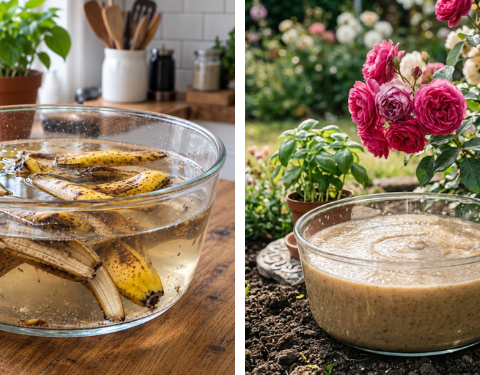
Method 2: The Overnight Liquid Infusion (Best for Indoor Houseplants)
If you want to feed delicate indoor plants like monsteras, pothos, or orchids, a liquid infusion is the cleanest option.
-
The Protocol: Place two whole banana peels into a clean quart-sized glass jar and fill it to the top with room-temperature filtered water. Cover the jar and let it sit undisturbed on your counter for 24 to 48 hours.
-
The Application: Strain the amber liquid into a watering can, discarding the spent peels into your compost bin. Use this nutrient-rich liquid to water your houseplants once a month for a gentle, organic mineral boost.
Method 3: The Dehydrated Soil Topper (Best for Potted Containers)
-
The Protocol: Lay your banana peels flat on a baking sheet and bake them at 180°F for 2 to 3 hours until they turn completely black and crispy. Alternatively, let them dry completely in a warm, sunny window for a few days.
-
The Application: Crush the brittle, dried peels into a fine, dark powder using a blender or mortar and pestle. Sprinkle two tablespoons of this slow-release powder directly onto your container soil and scratch it gently into the top inch of dirt.
Utilizing banana peels in your garden is a perfect example of closed-loop sustainability.
By choosing to reuse these mineral-rich skins instead of throwing them away, you provide your plants with a steady supply of potassium, phosphorus, and calcium.