July is often viewed by gardeners as a month strictly reserved for maintenance—deadheading spent blooms, pulling persistent weeds, and dragging the garden hose across parched lawns.
Conventional wisdom suggests that planting new perennials during the absolute zenith of summer heat is a recipe for immediate transplant shock and withered roots.
However, with the right plant selection and proper cultural care, July can actually be an incredibly strategic time to add structural perennials to your landscape.
8 Heat-Tolerant Perennials to Plant Now
These eight rugged performers thrive in intense sunlight and require minimal water once established, making them ideal candidates for mid-summer planting.
1. Purple Coneflower (Echinacea purpurea)
A true icon of the American prairie, Coneflowers are virtually bulletproof when it comes to intense summer heat.
They produce large, daisy-like blossoms with prominent, spiky central cones that double as a magnet for native pollinators and goldfinches.
Once their root system finds its footing, a coneflower clump can withstand weeks of baking sun without a hint of wilting.
-
Sun Requirements: Full Sun (6+ hours of direct light daily).
-
July Planting Tip: Choose a youthful pot with plenty of un-opened buds rather than a plant already in full bloom. This ensures the perennial focuses its initial cellular energy on root establishment rather than maintaining open petals.
2. Black-Eyed Susan (Rudbeckia fulgida)
Bringing a blanket of rich, golden-yellow color to the mid-summer garden, Rudbeckia is a foundational perennial for any sunny border.
Their coarse, slightly hairy leaves are a specialized evolutionary design: the tiny hairs trap a micro-layer of humidity right against the leaf surface, drastically reducing the rate of moisture loss caused by hot summer winds.
-
Sun Requirements: Full Sun to Light Partial Shade.
-
July Planting Tip: Space individual plants at least 18 inches apart. July planting means high humidity is likely on the horizon, and maintaining excellent air circulation around the coarse foliage helps prevent powdery mildew.
3. Blanket Flower (Gaillardia)
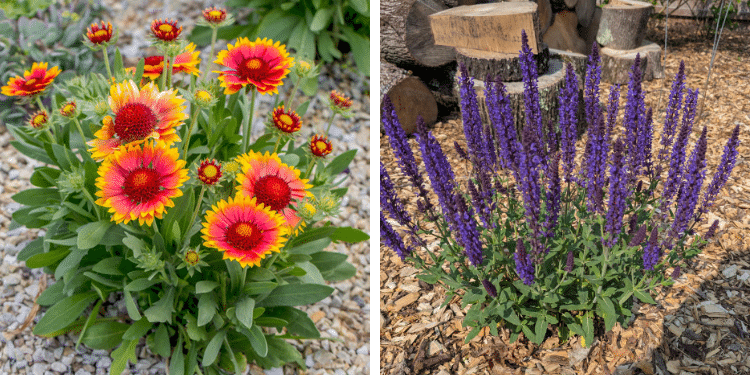
If your garden soil is sandy, rocky, poor, or prone to baking into a hard crust under the July sun, Gaillardia is the solution.
These short-lived but heavy-blooming perennials produce striking, multi-colored flowers featuring bands of fiery red, brilliant orange, and bright yellow.
They thrive on neglect and will actively produce fewer flowers if planted in overly rich, pampered garden loam.
-
Sun Requirements: Intensely Sharp Full Sun.
-
July Planting Tip: Ensure the planting hole is amended with a handful of coarse sand or fine gravel if your native soil contains heavy clay. Blanket flowers demand immaculate drainage to prevent root rot.
4. Yarrow (Achillea millefolium)
Yarrow is a historic cottage garden favorite that features flat-topped flower clusters sitting atop delicate, fern-like green or silver foliage.
These flat flower heads serve as landing pads for beneficial predatory insects like lacewings and ladybugs.
The highly divided, feathery nature of the leaves minimizes the total surface area exposed to direct overhead sunlight, making it highly efficient at moisture conservation.
-
Sun Requirements: Full Sun.
-
July Planting Tip: Cut the initial flower heads back by half immediately upon planting. This mimics a professional pruning cycle and coaxes the plant to rapidly anchor itself into its new home.
5. Autumn Joy Stonecrop (Hylotelephium ‘Autumn Joy’)
Sedums are the undisputed champions of low-water, high-heat landscaping. As classic succulents, they store vast reserves of water directly inside their thick, rubbery, pale-green leaves.
In July, ‘Autumn Joy’ presents clean, broccoli-like green heads that slowly morph into soft pink by August, before deepening to a rich, rust-red code by autumn.
-
Sun Requirements: Full Sun.
-
July Planting Tip: Do not add organic compost or high-nitrogen fertilizers to the planting hole. Rich inputs will cause sedum to grow too quickly, resulting in floppy, weak stems that split open by late summer.
6. Russian Sage (Salvia yangii / Perennial Perovskia)
With its airy, cloud-like wands of lavender-blue flowers and finely cut, silvery-white stems, Russian Sage introduces exceptional texture and cool tones to a sun-baked landscape.
The silver coloring of the woody stems isn’t just ornamental—it acts as a physical mirror, bouncing harsh UV rays away from the plant to keep internal tissue temperatures cool.
-
Sun Requirements: Blazing Full Sun.
-
July Planting Tip: Dig a hole twice as wide as the nursery pot but exactly the same depth. Planting Russian Sage too deeply can trap moisture against the woody crown, leading to premature decline.
7. Perennial Sage (Salvia nemorosa)
Perennial salvias are compact, upright dynamos that produce dense spikes of rich purple, blue, or pink flowers. The leaves are rich in volatile essential oils that give off a distinct, herbal aroma when brushed against.
This oil chemistry serves a dual purpose: it deters browsing deer and rabbits while forming a protective chemical shield that reduces water evaporation through the leaf pores.
-
Sun Requirements: Full Sun.
-
July Planting Tip: If the nursery plant you purchase looks a bit spent or leggy from sitting on a hot garden center asphalt lot, shear the entire plant back by one-third right after planting. It will reward you with a flush of fresh, emerald-green foliage and a secondary wave of blooms in late August.
8. Coreopsis (Tickseed)
Available in both clumping and threadleaf varieties, Coreopsis is a non-stop flower factory. Varieties like ‘Moonbeam’ or ‘Zagreb’ feature bright yellow, daisy-like blossoms that blanket fine, needle-like foliage.
Their adaptability to heat and drought makes them a premier choice for exposed hillsides, rock gardens, or the front edge of hot perennial beds.
-
Sun Requirements: Full Sun.
-
July Planting Tip: Mulch the surrounding soil with a 2-inch layer of shredded bark or clean straw immediately after planting, keeping the mulch an inch away from the green stems. This keeps the immediate root zone cool while it adjusts to the summer soil temperatures.
The 4 Golden Rules of July Planting Success
To ensure your new heat-tolerant perennials bypass transplant shock and transition seamlessly into your garden, execute these four critical cultural safeguards:
1. Never Plant in the Heat of the Day
Avoid planting during the blinding glare of a July afternoon. Instead, wait until late evening after 6:00 PM, or choose a calm, completely overcast morning.
This gives the perennial a minimum of 12 to 15 hours of cool, dark night air to settle into its new environment before it has to face the stress of direct sunlight.
2. Practice Pre-Hydration (The Mud-In Technique)
Before you even drop the plant into the dirt, fill the newly dug planting hole completely with water and let it drain away naturally. This thoroughly saturates the surrounding subsoil.
Next, submerge the entire nursery pot in a bucket of water until all air bubbles stop rising to the surface. Slip the plant out of the pot, place it in the damp hole, and backfill with native soil. This creates a continuous, highly hydrated root-to-soil bond.
3. Maintain a Strict Deep-Watering Schedule
The phrase “drought-tolerant” only applies to established plants whose roots have grown deep into the water table. For the first 3 to 4 weeks after a July planting, your perennials are entirely dependent on you for moisture.
Water them deeply at the root zone every 2 to 3 days during dry spells, rather than giving them a quick, daily splash on top. Deep watering coaxes the young roots to grow downward into the cooler soil profile, rather than staying near the hot surface.
4. Protect the Root Zone with Mulch
Exposed summer soil can quickly reach temperatures upward of 120°F (49°C), which can literally cook tender new surface roots.
Immediately after watering your new perennial, spread a 2-inch layer of organic mulch (such as shredded hardwood, clean straw, or compost) around the base of the plant.
This insulating blanket blocks weed growth, drastically reduces water evaporation, and keeps soil temperatures stable and comfortable throughout the dog days of summer.