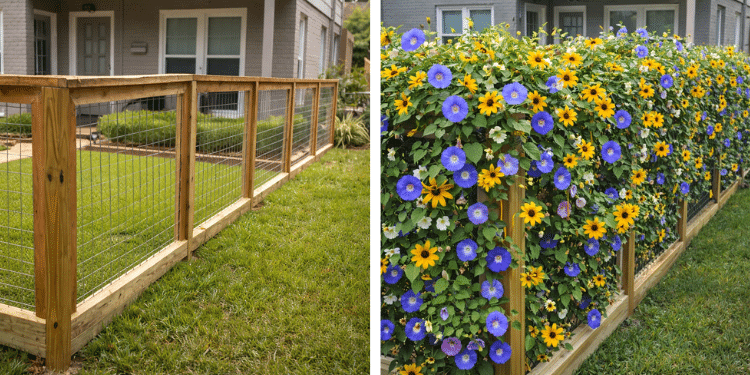
Bare wooden, chain-link, or concrete fences can feel stark, utilitarian, and visually uninspiring.
However, a plain fence also represents one of the greatest opportunities in vertical gardening: a blank canvas waiting to be transformed into a lush, living wall of green foliage and vivid blooms.
Climbing plants do far more than merely conceal an unsightly boundary. They introduce privacy, cool the surrounding microclimate through transpiration, provide vital habitat and nectar for pollinators, and add dramatic visual depth to gardens of any size.
When selecting climbers, it is essential to consider their climbing mechanics – whether they twine around supports, attach via adhesive tendrils, or require tying to a trellis – as well as their sunlight, soil, and hardiness needs.
Here are 15 beautiful climbing plants that will turn any bare fence into a stunning garden feature.
Understanding Climbing Mechanisms & Fence Support
Before choosing your plants, matching the climber’s growth method to your fence type ensures long-term success without structural damage:
1. Clematis (Clematis spp.) – The Queen of Climbers
-
Hardiness Zones: 4–9
-
Sun Exposure: Full sun to partial shade (needs cool roots)
-
Climbing Type: Leaf petioles (twining leaf stems)
Clematis is prized for its massive diversity of flower shapes, sizes, and colors – ranging from rich deep purples and pinks to pristine whites. Known as the “Queen of Climbers,” clematis uses its leaf stems to wrap around wire or wooden lattices attached to fences.
-
Care Secret: Practice the classic gardening rule: “Head in the sun, feet in the shade.” Plant low-growing perennials or lay a thick layer of organic mulch at the base to keep the root zone cool.
2. Climbing Rose (Rosa cultivars) – Classic Romance & Fragrance
-
Hardiness Zones: 5–10
-
Sun Exposure: Full sun (at least 6 hours daily)
-
Climbing Type: Scrambler (requires manual tying to trellis)
Nothing offers classic elegance like a fence draped in fragrant climbing roses such as ‘Eden’, ‘New Dawn’, or ‘David Austin’ varieties. Unlike true vines, roses do not possess tendrils or sticky pads; their long, flexible canes must be horizontally trained and tied onto a sturdy fence trellis.
-
Training Tip: Train main canes horizontally across the fence line. Horizontal canes produce far more vertical flowering shoots (lateral branches) than canes left to grow straight up.
3. Passionflower (Passiflora incarnata / caerulea) – Exotic Tropical Marvel
-
Hardiness Zones: 6–10 (varies by species)
-
Sun Exposure: Full sun to light shade
-
Climbing Type: Curling tendrils
With intricate, alien-like blossoms featuring vibrant blue, purple, and white filaments, passionflower instantly imparts a tropical feel. It climbs rapidly using delicate curling tendrils that wrap effortlessly around chain-link or wire mesh fencing.
-
Bonus: It serves as the primary host plant for Gulf Fritillary butterflies and produces edible orange passion fruits late in the season.
4. Climbing Hydrangea (Hydrangea anomala subsp. petiolaris) – Shade Champion
-
Hardiness Zones: 4–8
-
Sun Exposure: Partial shade to deep full shade
-
Climbing Type: Aerial rootlets
If you have a dark, north-facing wooden or masonry fence where most flowering plants struggle, climbing hydrangea is the ultimate solution.
This woody perennial features rich green foliage and large, fragrant white lacecap flower heads in summer, followed by peeling golden-brown bark in winter.
-
Patience Required: It establishes slowly during its first two years (“sleeps and creeps”), but grows vigorously (“leaps”) once its root system matures.
5. Honeysuckle (Lonicera periclymenum / sempervirens) – Pollinator Magnet
-
Hardiness Zones: 4–9
-
Sun Exposure: Full sun to partial shade
-
Climbing Type: Twining stems
Honeysuckle fills the summer evening air with intoxicating sweet fragrance. Native non-invasive varieties like Coral Honeysuckle (Lonicera sempervirens) feature tubular red and yellow flowers that attract hummingbirds continuously from spring through autumn.
-
Caution: Avoid invasive Asian species (Lonicera japonica) and stick to native or well-behaved cultivars like ‘Major Wheeler’ or ‘Serotina’.
6. American Wisteria (Wisteria frutescens) – Regal Purple Cascades
-
Hardiness Zones: 5–9
-
Sun Exposure: Full sun
-
Climbing Type: Heavy twining woody vines
Famous for its massive, drooping racemes of fragrant lavender-purple flowers in late spring, wisteria turns any border into a botanical showpiece.
-
Choose Native: Always select American Wisteria (W. frutescens) or Kentucky Wisteria over invasive Asian counterparts (W. sinensis / W. floribunda). The native species is non-invasive, blooms earlier in its life cycle, and grows at a much more manageable pace along sturdy wooden or iron fences.
7. Star Jasmine (Trachelospermum jasminoides) – Evergreen Sweetness
-
Hardiness Zones: 8–11
-
Sun Exposure: Full sun to partial shade
-
Climbing Type: Twining stems
In warmer climates, Star Jasmine provides year-round, glossy dark green foliage that transforms into a blanket of sweet-scented, white star-shaped flowers in late spring.
It is exceptionally drought-tolerant once established and retains its rich green color even through mild winter dips.
Quick Reference: Top 15 Fence Climbers Matrix
| Plant Name | Hardiness | Bloom Time | Ideal Fence Type | Best Feature |
| Clematis | Zones 4–9 | Spring–Autumn | Wire Mesh / Trellis | Huge color range, big blooms |
| Climbing Rose | Zones 5–10 | Late Spring–Fall | Wooden / Iron Trellis | Classic fragrance, repeat blooms |
| Passionflower | Zones 6–10 | Summer–Autumn | Chain-link / Wire | Exotic intricate blossoms |
| Climbing Hydrangea | Zones 4–8 | Early Summer | Wood / Brick / Stone | Flourishes in deep shade |
| Honeysuckle | Zones 4–9 | Late Spring–Summer | Wire / Lattice | Hummingbird magnet, sweet scent |
| American Wisteria | Zones 5–9 | Late Spring | Heavy-duty Post & Rail | Cascading purple blooms |
| Star Jasmine | Zones 8–11 | Late Spring–Summer | Trellis / Chain-link | Evergreen foliage, intense scent |
| Bougainvillea | Zones 9–11 | Spring–Autumn | Arbors / Sturdy Fence | Electric neon magenta/red bracts |
| Morning Glory | Annual | Summer–Frost | Any fence with twine | Fast growing annual cover |
| Chocolate Vine | Zones 4–8 | Early Spring | Heavy Trellis / Chain-link | Vanilla-chocolate floral scent |
| Black-Eyed Susan Vine | Annual / 9–11 | Summer–Frost | Chain-link / Wire | Cheerful black-centered blooms |
| Boston Ivy | Zones 4–9 | Inconspicuous | Brick / Stone / Wood | Fiery crimson fall foliage |
| Sweet Pea | Annual | Spring–Early Summer | String / Thin Trellis | Unbeatable heirloom perfume |
| Pipevine | Zones 4–8 | Early Summer | Sturdy Wooden Lattice | Giant heart-shaped leaves |
| Chilean Bellflower | Zones 8–10 | Summer–Autumn | Trellis / Mesh | Rare waxy pink/red bells |
8. Bougainvillea (Bougainvillea spectabilis) – Electric Sun-Lover
-
Hardiness Zones: 9–11
-
Sun Exposure: Full, baking sun
-
Climbing Type: Scrambling stems with thorny accents
For hot, sun-drenched gardens, few plants match the sheer visual impact of Bougainvillea. Its vibrant magenta, purple, orange, and red “flowers” (which are actually papery bracts) cover fences in a sheet of intense color throughout warm months. It requires minimal water once rooted and thrives in hot microclimates.
9. Morning Glory (Ipomoea purpurea) – Rapid Annual Cover
-
Hardiness Zones: Grown as an annual nationwide
-
Sun Exposure: Full sun
-
Climbing Type: Fast twining stems
If you need a quick, budget-friendly fix for a bare fence while waiting for perennial vines to mature, Morning Glory is the perfect choice.
Sown directly from seed in spring, it quickly climbs 10 to feet by mid-summer, opening hundreds of trumpet-shaped blue, purple, or pink flowers every morning.
10. Chocolate Vine (Akebia quinata) – Semi-Evergreen Elegance
-
Hardiness Zones: 4–8
-
Sun Exposure: Full sun to full shade
-
Climbing Type: Twining stems
Named for its subtle vanilla-chocolate fragrance and dark purple-brown spring flowers, Akebia quinata features attractive five-leafed foliage that remains semi-evergreen in milder winter regions.
It forms a dense, privacy-granting mat across long stretches of fencing.
11. Black-Eyed Susan Vine (Thunbergia alata) – Constant Summer Cheer
-
Hardiness Zones: 9–11 (Grown as an annual in cooler climates)
-
Sun Exposure: Full sun to partial shade
-
Climbing Type: Twining stems
This charming climber produces masses of sunny yellow, orange, or apricot blooms with deep chocolate-purple centers.
Growing quickly to 6 to 8 feet, it is ideal for covering shorter garden gates, chain-link sections, or decorative lattice screens.
12. Boston Ivy (Parthenocissus tricuspidata) – Fiery Autumn Showstopper
-
Hardiness Zones: 4–9
-
Sun Exposure: Full sun to full shade
-
Climbing Type: Adhesive holdfast disks (suction pads)
While technically non-flowering in a decorative sense, Boston Ivy offers unmatched foliage drama. It coats flat wooden or masonry fences in overlapping green leaves through spring and summer, before erupting into brilliant shades of scarlet, crimson, and burnt orange in autumn.
13. Sweet Pea (Lathyrus odoratus) – Antique Perfume & Pastels
-
Hardiness Zones: Cool-season annual
-
Sun Exposure: Full sun
-
Climbing Type: Delicate tendrils
Sweet Peas are beloved heirloom annuals known for their delicate, ruffled blossoms in pastel shades of blush, violet, cream, and rose. Their scent is unmatched in the spring garden. Because they climb via small tendrils, they prefer thin netting, twine, or fine chicken wire attached to a fence.
14. Pipevine (Aristolochia macrophylla) – Dense Privacy Shield
-
Hardiness Zones: 4–8
-
Sun Exposure: Partial shade to full shade
-
Climbing Type: Twining stems
When maximum privacy is the objective, Pipevine delivers. It features massive, overlapping heart-shaped leaves (6 to 12 inches wide) that create an impenetrable green wall. In early summer, it produces quirky, Dutch-pipe-shaped flowers tucked beneath its lush foliage.
15. Chilean Bellflower (Lapageria rosea) – Exotic Woodland Gem
-
Hardiness Zones: 8–10 (Thrives in cool, humid coastal climates)
-
Sun Exposure: Partial shade to dappled light
-
Climbing Type: Twining stems
For temperate, frost-free gardens with dappled light, the Chilean Bellflower is a rare treasure. It produces thick, waxy, pendant bell flowers in shades of deep rose-pink and cherry red that hang elegantly along fence lines from mid-summer into late autumn.
Step-by-Step Guide: Installing a Wire Trellis System on Wooden Fences
To allow twining climbers to thrive on flat wooden fences without causing wood rot, mount a simple wire trellis system:
Transforming a bare fence with climbing plants elevates your entire garden layout. By matching your fence’s exposure and structure with the appropriate climbing species, you can enjoy years of vertical color, privacy, and fragrance.
The best gardens don’t just brighten your yard – they become something you can enjoy season after season.
If you’re ready to grow your own backyard pharmacy, the Medicinal Garden Kit is a wonderful place to begin.
Inside you’ll find 2,409 non-GMO seeds, a detailed Herbal Medicinal Guide, and 2 FREE bonuses to help you grow a wide variety of traditional medicinal herbs with confidence.
Take a look at the Medicinal Garden Kit and start growing something truly rewarding.