Most gardeners think of spring as the season for sowing flower seeds. But for many flowers, fall is actually one of the best times to plant.
It makes sense when you think about how these plants reproduce naturally.
Flowers drop their seeds in late summer and fall. Those seeds spend winter outdoors, exposed to cold temperatures and moist soil. When conditions become favorable again, they germinate and begin growing.
By sowing certain flowers in fall, you’re simply copying that natural cycle.
And there’s another advantage: some flower seeds actually benefit from a period of cold, moist conditions, a process known as cold stratification.
Instead of trying to recreate winter inside your refrigerator, you can let nature handle the process.
The trick is knowing which flowers can handle fall sowing—and when to sow them in your growing zone.
Here are 12 excellent flowers to consider.
First, Know Your Zone
Fall sowing isn’t exactly the same everywhere.
A gardener in Zone 4 faces a very different winter from someone gardening in Zone 9.
As a general guide:
Zones 3–5
Fall sowing is often done after several hard frosts, when the soil is cold enough that seeds are unlikely to germinate before winter.
Zones 6–7
Late fall is usually ideal. The goal is still to prevent tender seedlings from emerging immediately before freezing weather.
Zones 8–9
Many hardy annuals can be sown in mid-to-late fall and may begin growing before winter, then continue developing during mild weather.
Zones 10–11
Fall can actually function like a second spring. Many cool-season flowers are planted in fall for winter and early-spring displays.
Important note: USDA zones describe average minimum winter temperatures, not your exact frost dates. Local weather should always determine your final planting time.
1. Poppies
Poppies are almost made for fall sowing.
Their tiny seeds naturally fall to the ground and overwinter before germinating when conditions improve.
In colder regions, sowing after the soil has cooled helps prevent premature germination. In milder climates, poppies may germinate during fall and grow slowly through winter.
Poppies also dislike having their roots disturbed, which makes direct sowing especially useful.
How to sow:
Scatter the tiny seeds over prepared soil and press them gently against the surface.
Don’t bury them deeply.
Keep the area relatively weed-free so tiny seedlings aren’t overwhelmed in spring.
Best for: Zones 3–10, depending on species and local conditions.
Quick note: If winters are extremely wet, excellent drainage becomes particularly important.
2. Bachelor’s Buttons
Bachelor’s buttons, also called cornflowers, are classic cottage-garden flowers and remarkably tolerant of cool weather.
Their blue flowers are the most familiar, although pink, white, purple, and darker varieties are also available.
In cold climates, seeds can be dormant-sown late in fall.
In warmer regions, they can often be planted earlier and allowed to establish during the cool season.
Once established, bachelor’s buttons can also self-seed readily.
Best for: Roughly Zones 3–9.
Why gardeners love them:
They’re easy to direct sow, tolerate relatively poor soil, attract pollinators, and make excellent cut flowers.
Give them plenty of sunlight and avoid overly rich soil, which can encourage floppy growth.
3. Larkspur
If you’ve ever struggled to germinate larkspur indoors, fall sowing may make your life much easier.
Larkspur appreciates cool conditions and often germinates better after exposure to cold.
In mild climates, seeds can germinate in autumn and develop into small plants that overwinter.
In colder climates, dormant sowing allows seeds to wait until spring conditions become suitable.
The result can be tall spikes of blue, purple, pink, or white flowers.
Best for: Zones 3–9, with timing adjusted for winter severity.
Helpful note:
Larkspur doesn’t particularly enjoy being transplanted, so direct sowing is usually a good approach.
Choose the location carefully before scattering the seeds.
4. Sweet Peas
Sweet peas are loved for their colorful flowers and beautiful fragrance.
But they’re cool-weather plants.
They often struggle once intense summer heat arrives, so getting them established early can mean a longer flowering season.
In colder zones:
Gardeners often wait until very late fall for dormant sowing or plant extremely early in spring.
In milder zones:
Fall sowing can work beautifully.
Plants establish during cool weather and may flower earlier the following season.
Best suited to fall planting: Generally Zones 7–10.
In Zones 3–6, late dormant sowing can sometimes work, but severe winters and wet soil can reduce success.
Remember:
Sweet peas are climbers.
Give them a trellis, fence, netting, or another support from the beginning.
Important: Ornamental sweet pea seeds are not edible.
5. Calendula
Calendula is one of my favorite flowers for gardeners who want something easy.
Its cheerful orange and yellow flowers tolerate surprisingly cool weather.
In mild climates, calendula can be planted in fall and may continue growing through much of winter.
In colder climates, seeds can be sown very late so they remain dormant until conditions improve.
Best for: Zones 3–10, although fall timing differs considerably.
Calendula prefers sun but tolerates some light shade.
It also doesn’t require extremely rich soil.
A little bonus:
Calendula is excellent around vegetable gardens because its flowers attract numerous beneficial insects and pollinators.
Allow a few flowers to mature completely and the plant may also reseed itself.
6. Nigella
Nigella, commonly called love-in-a-mist, looks delicate but is surprisingly easy to grow.
Its finely divided foliage surrounds unusual blue, white, pink, or purple flowers, followed by decorative seed pods.
Nigella performs best in cooler weather and generally prefers direct sowing.
Fall planting gives the seeds natural exposure to winter conditions and can result in early plants the following year.
Best for: Approximately Zones 3–9.
How to use it:
Scatter seeds through cottage gardens, flower borders, or between spring bulbs.
The airy foliage blends beautifully with other plants rather than forming a dense block.
Garden note: Let a few seed pods mature if you’d like nigella to return naturally.
7. California Poppies
California poppies thrive on simplicity.
They love sunshine, tolerate dry conditions once established, and generally perform best when direct sown.
In mild winter regions, fall is an excellent time to plant them.
Seeds germinate with seasonal moisture and plants establish before the following warm season.
In colder regions, dormant sowing can also be attempted, depending on local winter conditions.
Best for: Zones 6–10 for especially reliable fall sowing, with broader possibilities depending on climate.
Don’t overfeed them.
Rich soil and excessive fertilizer can encourage leafy growth at the expense of flowers.
A sunny site with well-draining soil is much more important.
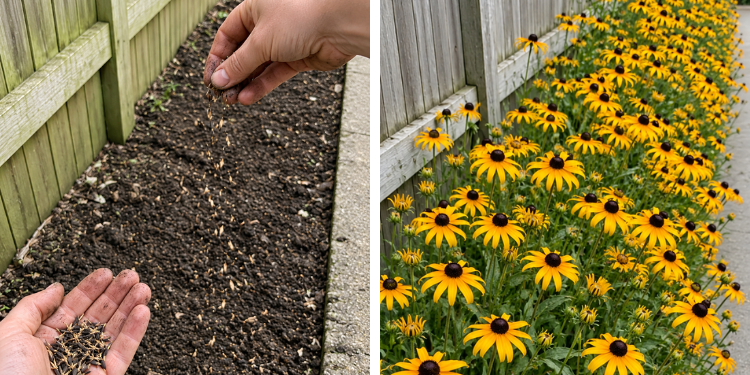
8. Black-Eyed Susans
Black-eyed Susans (Rudbeckia) bring masses of golden-yellow flowers with dark centers to summer and early-fall gardens.
Some Rudbeckia species benefit from exposure to cold conditions before germination, making fall sowing particularly convenient.
Instead of artificially cold-stratifying the seeds, let winter do it.
Scatter seeds over prepared soil and press them lightly into place.
Avoid burying them too deeply.
Best for: Zones 3–9, depending on the species.
Be patient.
Unlike some annual flowers, fall-sown perennial Rudbeckia may not give you a huge flowering display immediately.
Perennials sometimes spend their first season developing roots and foliage before producing their best flowers later.
They’re worth the wait.
9. Coneflowers
Coneflowers (Echinacea) are another perennial that can benefit from natural winter conditions.
Their large daisy-like flowers are excellent for pollinator gardens, and the mature seed heads can provide food for birds later in the season.
Fall sowing lets winter provide the cold period that can improve germination for many Echinacea seeds.
Best for: Zones 3–9.
How to plant:
Sow in a sunny, well-draining location and mark the area.
That last part is important.
Spring seedlings can be surprisingly easy to mistake for weeds.
A simple plant marker will stop you from accidentally pulling your future coneflower patch.
10. Columbine
Columbine (Aquilegia) is one of the best flowers to sow when you’re willing to let winter help.
The seeds of many columbines benefit from a period of cold, moist conditions before germinating.
Fall sowing provides that naturally.
The delicate nodding flowers are especially beautiful in woodland-style gardens, partially shaded borders, and areas receiving morning sun.
Best for: Zones 3–9, depending on species.
Don’t expect instant results.
Columbine is a perennial.
Plants grown from seed may focus on establishing themselves before producing a spectacular flower display.
Once happy, however, columbine can reseed around the garden and create wonderfully natural-looking colonies.
11. Coreopsis
Coreopsis produces cheerful daisy-like flowers, often in bright shades of yellow.
Many types are remarkably tough once established.
Certain perennial coreopsis varieties can be fall sown, allowing winter conditions to naturally prepare the seeds for germination.
Best for: Generally Zones 4–9, depending on the species and cultivar.
Choose a location with plenty of sunlight and good drainage.
One thing to remember:
Not every Coreopsis behaves exactly the same way.
Some are annuals, some short-lived perennials, and others reliably perennial.
Always check the seed packet for the particular variety you’re growing.
12. Milkweed
If you want to create a garden that supports monarch butterflies, milkweed deserves a place on your list.
Many native milkweed species produce seeds that naturally experience winter before germinating.
That makes fall an excellent time to sow them outdoors.
Winter provides the cold, moist conditions that many milkweed seeds require to break dormancy.
Best for: Zones vary widely according to species.
Rather than choosing milkweed simply by zone, select a species native to your particular region.
Why grow it?
Milkweed isn’t merely a nectar flower.
It’s the host plant monarch caterpillars depend on.
Adult monarchs lay their eggs on milkweed, and the caterpillars feed on its leaves.
So adding appropriate native milkweed creates actual butterfly habitat rather than simply providing flowers.
Don’t assume your flower-growing season ends when summer does. For many flowers, fall is where next year’s garden begins.
The best gardens don’t just brighten your yard – they become something you can enjoy season after season.
If you’re ready to grow your own backyard pharmacy, the Medicinal Garden Kit is a wonderful place to begin.
Inside you’ll find 2,409 non-GMO seeds, a detailed Herbal Medicinal Guide, and 2 FREE bonuses to help you grow a wide variety of traditional medicinal herbs with confidence.
Take a look at the Medicinal Garden Kit and start growing something truly rewarding.