Bees are some of the most extraordinary and essential creatures on Earth. These tiny, industrious insects are not only critical to pollination and biodiversity, but they are also directly tied to the global economy through their contribution to food production.
Without bees, many of the crops we rely on daily would struggle to grow, making their role in agriculture and the environment absolutely vital.
But beyond their ecological importance, bees are also master engineers, showcasing one of nature’s most iconic architectural marvels: the honeycomb.
The Honeycomb: A Masterpiece of Natural Engineering
One of the most mesmerizing structures in the natural world is the honeycomb—a geometric, hexagonal lattice created by worker bees from beeswax. The honeycomb is not just beautiful; it is the pinnacle of efficiency, utility, and precision.
Bees don’t create the honeycomb randomly or simply as a place to store honey. Every cell has a purpose—whether it’s to store nectar, pollen, or to house developing larvae—and the shape, size, and alignment of each hexagonal cell are designed with intention.
The hexagon, mathematically speaking, is the most space-efficient shape that allows for a compact grid without wasted gaps.
This means bees can maximize storage using the least amount of wax, a material that is energy-intensive for them to produce.
A Heart-Shaped Surprise at Bodiam Castle
A particularly enchanting example of bee ingenuity was recently shared by the team at Bodiam Castle, located in Robertsbridge, East Sussex, United Kingdom.
Built in 1385, this moated medieval castle is one of Britain’s most iconic historical landmarks. But today, it’s not just admired for its history and architecture—it’s also home to a hardworking colony of bees producing honey sold on-site.
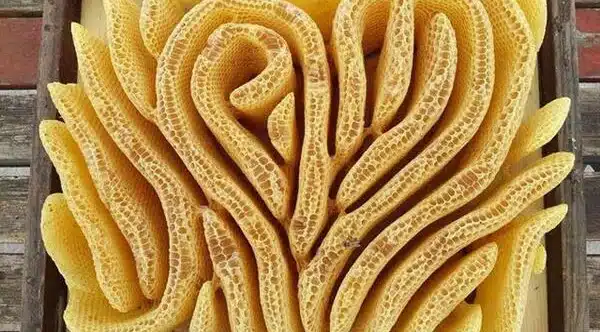
The castle’s National Trust team posted a captivating photo of a heart-shaped honeycomb, crafted with stunning symmetry and elegance by their bees. The post read:
“We love our clever bees!”
And with good reason. This image quickly captured the imagination of nature lovers and bee enthusiasts alike.
What makes this honeycomb even more remarkable is that the bees built it entirely without a structured frame.
In the absence of the traditional foundation used in most managed hives, the bees were free to shape the wax as they pleased—and the result was a delicate, perfectly formed heart.
Beauty with Purpose: Why Honeycombs Are Never Random
Though the shape may appear whimsical, the structure of a honeycomb is never accidental. In fact, the specific pattern, angle, and density of the comb are intricately linked to the bees’ thermoregulation needs and colony function.
In the wild or in frameless hive boxes, bees will design combs that promote optimal airflow, light penetration, and efficient space usage.
According to Arnia Remote Hive Monitoring, a company that specializes in high-tech hive observation:
“Brood nest temperature is of extreme importance to the colony and is controlled with utmost precision. Honey bees maintain the temperature of the brood nest between 32°C and optimally 35°C so that the brood develops normally.”
This tight temperature regulation ensures that developing bee larvae mature safely and healthily. When environmental temperatures stray from this ideal range, bees act swiftly to adjust.
-
If the nest becomes too hot, worker bees beat their wings rapidly to ventilate warm air out of the hive or utilize evaporative cooling by distributing water droplets inside the comb.
-
If it’s too cold, bees generate heat by contracting their flight muscles, creating metabolic warmth that radiates throughout the hive.
This coordination is nothing short of astonishing and underscores how sensitive and sophisticated bee colonies are as living systems.
Why This Matters: Celebrating the Small Wonders of Nature
The heart-shaped honeycomb at Bodiam Castle isn’t just a charming curiosity—it’s a testament to the intelligence, organization, and adaptability of bees.
In a world where pollinator populations are declining due to habitat loss, pesticide use, and climate change, moments like these remind us how much we have to learn—and protect—about our natural world.
Bees not only give us honey; they give us fertile crops, vibrant gardens, and healthy ecosystems.
Watching them construct something as intricate and functional as a honeycomb—especially one as symbolic and beautiful as a heart—should inspire awe and renewed dedication to supporting their survival.
How You Can Help Support Bees
If you’re feeling inspired by nature’s tiny architects, here are a few simple ways to help protect and support bee populations:
-
Plant a bee-friendly garden with native wildflowers, herbs, and flowering plants that provide nectar and pollen.
-
Avoid using pesticides, herbicides, and fungicides, especially during blooming seasons.
-
Provide a water source for bees, such as a shallow dish with pebbles or stones for landing.
-
Support local beekeepers by purchasing raw, local honey and beeswax products.
-
Allow parts of your yard or garden to grow wild, creating natural habitat for wild bees and other pollinators.
Bees are more than just honey-makers—they are living symbols of harmony, cooperation, and natural intelligence.
The stunning honeycomb crafted at Bodiam Castle is more than a picturesque marvel; it’s a reminder that even the smallest creatures can produce some of nature’s most profound beauty and function.
So the next time you see a honeybee buzzing through your garden, pause for a moment and remember: you’re looking at an artist, an engineer, and a keystone species all rolled into one.