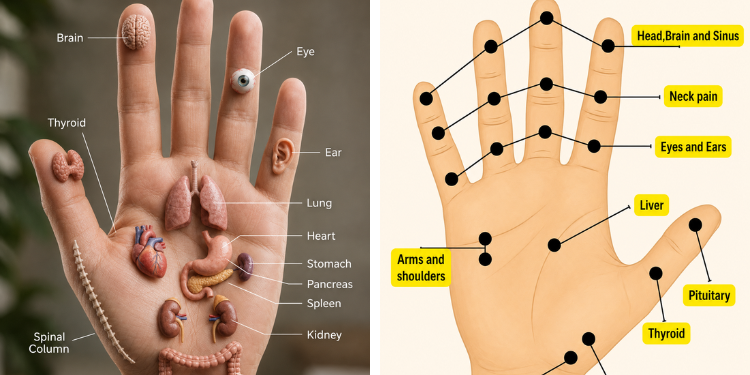
For thousands of years, traditional East Asian medicine systems – including Acupressure and Traditional Chinese Medicine (TCM) – have utilized precise points on the body to regulate energy, ease physical discomfort, and promote homeostasis.
Among all body regions, the human hand contains one of the highest concentrations of nerve endings and reflexology zones.
Acupressure operates on the principle that life energy, or Qi (pronounced “chee”), flows through a complex network of pathways called meridians.
When stress, tension, or illness creates a blockage along these pathways, applying firm, targeted pressure to specific points helps clear stagnation, stimulate peripheral circulation, and trigger the body’s innate relaxation response.
Modern neurological research suggests that stimulating these acupressure points prompts the central nervous system to release natural biochemicals – such as endorphins, serotonin, and adenosine – which modulate pain signals and calm autonomic nervous system activity.
Here is a detailed guide to 7 foundational acupressure points on your hand, including their traditional usages, anatomical locations, and a simple step-by-step method for practicing hand acupressure safely at home.
The Neurological and Meridian Mapping of the Hand
Before exploring individual points, it is helpful to understand how hand pressure influences internal balance:
-
Dermatomes & Reflex Arcs: The fingers, palm, and wrist are heavily innervated by the radial, median, and ulnar nerves. Pressure applied to these nerve zones sends tactile signals directly up the spinal cord to the brain, influencing autonomic functions like heart rate, breathing, and muscle tension.
-
Meridian Endpoints: The hand serves as the primary pathway for six major TCM meridians: the Lung, Large Intestine, Heart, Small Intestine, Pericardium, and San Jiao (Triple Burner) channels.
1. He Gu / Union Valley (Large Intestine 4 – LI4)
Located in the fleshy web between your thumb and index finger, He Gu (LI4) is widely considered the single most versatile acupressure point on the entire body. In TCM terminology, LI4 is a primary “source point” for clearing heat and moving stuck energy.
-
Traditional Uses: Headaches, migraines, tension in the neck and shoulders, sinus pressure, facial pain, and toothaches.
-
Anatomical Location: Place your thumb in the webbing between the index finger and thumb of the opposite hand. Squeeze your thumb and index finger together; LI4 is located at the highest mound of the muscle.
-
Application Technique: Apply firm, deep pressure using your opposite thumb, making small circular motions for 1 to 2 minutes while breathing deeply.
PREGNANCY CONTRAINDICATION:
He Gu (LI4) is traditionally known to stimulate uterine contractions and promote labor. Avoid stimulating LI4 during pregnancy, unless under the direct guidance of a licensed acupuncturist or obstetric practitioner.
2. Nei Guan / Inner Gate (Pericardium 6 – PC6)
Located on the inner forearm near the wrist joint, Nei Guan (PC6) sits directly along the Pericardium meridian, which governs the heart, chest, and stomach environment.
-
Traditional Uses: Relieving nausea, motion sickness, morning sickness, acid reflux, stomach upsets, and easing anxiety or chest tightness.
-
Anatomical Location: Turn your palm face up. Measure three finger-widths down from the wrist crease toward your elbow. PC6 lies centered directly between the two prominent tendons (flexor carpi radialis and palmaris longus).
-
Application Technique: Press down firmly with your thumb between the two tendons until you feel a gentle ache. Hold steady pressure for 2 to 3 minutes while practicing rhythmic diaphragm breathing.
3. Lao Gong / Palace of Toil (Pericardium 8 – PC8)
Positioned right in the center of the palm, Lao Gong (PC8) is a key “Ying-Spring” point along the Pericardium channel. In traditional energy theory, it is used to clear excess “heart fire,” which manifests as mental restlessness, anxiety, or emotional exhaustion.
-
Traditional Uses: Soothing nervous agitation, managing acute stress, relieving insomnia caused by an overactive mind, and clearing heat in the mouth (such as mouth sores).
-
Anatomical Location: Make a gentle fist with your hand. The point where the tip of your middle finger naturally touches the center of your palm marks Lao Gong.
-
Application Technique: Use the tip of your opposite thumb to press into the palm center with medium-to-firm pressure. Inhale slowly through your nose and exhale fully through your mouth for 60 to 90 seconds.
4. Shen Men / Spirit Gate (Heart 7 – HT7)
Situated on the wrist crease along the pinky finger side, Shen Men (HT7) connects directly to the Heart meridian, which TCM associates with emotional stability, sleep quality, and spiritual peace (Shen).
-
Traditional Uses: Alleviating sleep difficulties, easing heart palpitations, quietening racing thoughts, reducing panic, and supporting emotional grounding.
-
Anatomical Location: Follow your pinky finger down to the crease on your inner wrist. HT7 is located in the small depression right on the crease, just inside the prominent flexor tendon (flexor carpi ulnaris).
-
Application Technique: Apply gentle to moderate thumb pressure into the wrist indentation. Hold for 1 to 2 minutes on both wrists before sleep.
Acupressure Point Reference Summary
| Point Name | Traditional Code | Location | Primary Traditional Indications |
| He Gu (Union Valley) | LI4 | Webbing between thumb & index finger | Headaches, sinus pressure, facial/tooth pain |
| Nei Guan (Inner Gate) | PC6 | 3 finger-widths below inner wrist crease | Nausea, motion sickness, anxiety, acid reflux |
| Lao Gong (Palace of Toil) | PC8 | Center of palm (where middle finger curls) | Acute stress, mental fatigue, clearing heat |
| Shen Men (Spirit Gate) | HT7 | Inner wrist crease on pinky finger side | Insomnia, heart palpitations, emotional restlessness |
| Tai Yuan (Great Abyss) | LU9 | Wrist crease on thumb side beneath base | Coughing, asthma, seasonal allergies, lethargy |
| Hou Xi (Back Stream) | SI3 | Outer edge of palm below 5th knuckle | Upper back stiffness, neck pain, spinal alignment |
| Luo Zhen (Stiff Neck) | Extra Point | Back of hand between 2nd & 3rd knuckles | Acute neck stiffness, inability to turn head |
5. Tai Yuan / Great Abyss (Lung 9 – LU9)
Located on the wrist crease at the base of the thumb, Tai Yuan (LU9) is the “Yuan-Source” point of the Lung meridian. It plays a vital role in regulating respiration and fortifying the body’s defensive energy (Wei Qi).
-
Traditional Uses: Supporting respiratory function, easing lingering coughs, relieving asthma symptoms, mitigating seasonal allergies, and addressing low physical energy.
-
Anatomical Location: On your inner wrist crease, directly beneath the base of your thumb, in the hollow between the radial artery and the thumb tendon.
-
Application Technique: Press gently into the indentation with your opposite index or thumb tip. Avoid pressing aggressively on the radial pulse; maintain light, steady circular pressure for 1 minute.
6. Hou Xi / Back Stream (Small Intestine 3 – SI3)
Located along the outer edge of the hand, Hou Xi (SI3) is a master point for the Du Mai (Governing Vessel), an energy channel that runs up the length of the spine and neck.
-
Traditional Uses: Relieving upper back tension, easing stiffness along the neck and shoulders, mitigating spinal discomfort, and soothing tension headaches.
-
Anatomical Location: Make a loose fist. Locate the depression on the outer side of your hand, just below the knuckle of your pinky finger (the fifth metacarpophalangeal joint).
-
Application Technique: Press your thumb knuckle firmly into the outer edge of the hand, or press the outer edge of your hand against the edge of a wooden desk and roll it back and forth for 1 to 2 minutes.
7. Luo Zhen / Stiff Neck Point (Extra Point)
Unlike the numbered points along primary meridians, Luo Zhen is a famous “extra point” specifically designated in classical acupuncture texts for resolving acute neck stiffness and spasms.
-
Traditional Uses: Rapid relief for waking up with a “stiff neck,” inability to turn the head side-to-side, shoulder blade tightness, and upper back spasms.
-
Anatomical Location: On the back of the hand, in the depression between the second and third knuckles (between the index and middle finger joints), about half an inch behind the knuckles.
-
Application Technique: Use your thumb tip to locate the tender spot between the bones. Apply firm pressure while slowly turning your head gently from side to side to restore range of motion.
How to Perform a Self-Acupressure Session at Home
To maximize the therapeutic benefits of hand acupressure, follow this recommended preparation protocol:
By incorporating these 7 classical hand points into your daily wellness routine, you can leverage a time-tested, drug-free practice to manage stress, ease physical tension, and support your body’s natural balance wherever you are.