Most gardeners know that eggshells can be crushed and added to compost or sprinkled around the garden.
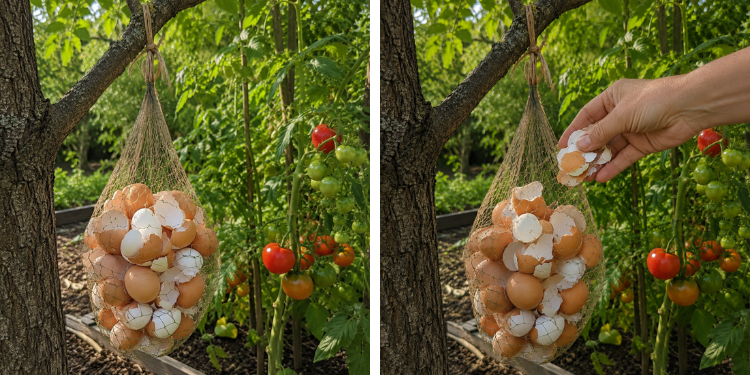
But there is another old-fashioned trick that has been passed between gardeners for years: hanging eggshells from plants, stakes, strings, fences, or branches.
It may look strange, but there are several reasons gardeners do it. Hanging shells can create movement around vulnerable plants, act as highly visible objects that may temporarily discourage some birds, mark newly planted areas, and give you somewhere to keep shells until you’re ready to crush and reuse them.
And once the shells have served their purpose, they don’t have to go in the trash. They can be crushed and added to compost or soil, where they gradually break down.
However, eggshells aren’t a miracle garden treatment. They won’t instantly fertilize tomatoes or guarantee protection from every pest. Here’s what this simple trick can – and can’t – do.
1. The Movement May Discourage Some Garden Visitors
One of the simplest reasons for hanging eggshells is movement.
When lightweight shells are suspended from string, even a small breeze can cause them to swing and turn. This adds unfamiliar movement around vegetable beds and young plants.
Gardeners use a similar principle with:
- Reflective tape
- Ribbons and streamers
- Spinning garden decorations
- Old CDs
- Other moving objects
Birds may initially be cautious about entering an area containing unfamiliar moving objects.
Keep in mind: Birds are intelligent and may eventually realize that the shells aren’t dangerous. For this reason, hanging eggshells should be considered a temporary visual deterrent rather than guaranteed protection.
If birds are seriously damaging strawberries, blueberries, cherries, or seedlings, properly installed netting or another physical barrier will usually be more effective.
2. White Eggshells Are Especially Noticeable
White eggshells stand out dramatically against green foliage.
When several shells are suspended throughout a vegetable garden, their bright color and movement can change the appearance of the area. This may cause cautious birds to hesitate before approaching.
Brown shells can also be used, but white ones are easier to see from a distance.
Simple trick: Move your hanging shells to different positions every few days. An object that constantly appears in the same location is easier for wildlife to become accustomed to.
3. Use Them Around Vulnerable Young Plants
New seedlings are particularly vulnerable to birds.
Sometimes birds aren’t even interested in eating the plant. They may simply scratch freshly disturbed soil looking for insects, worms, seeds, or other food—and accidentally uproot tiny seedlings in the process.
Hanging eggshells from short stakes around newly planted areas may provide an additional visual disturbance while seedlings become established.
Try them around:
- Tomatoes
- Peppers
- Beans
- Cabbage
- Kale
- Broccoli
- Cucumbers
- Young flowers
Their potential usefulness is greatest during the early establishment period. Once plants become larger and birds become familiar with the shells, the effect may decrease.
4. Use Them Around Cabbage and Other Brassicas
One of the most interesting traditional uses for hanging white eggshells involves cabbage white butterflies.
Some gardeners hang white shell halves around cabbage, broccoli, kale, cauliflower, and Brussels sprouts.
Why?
The traditional theory is that the white shells resemble cabbage white butterflies. An approaching butterfly may supposedly interpret the white object as another butterfly already occupying the plant and look for another place to lay its eggs.
It’s an interesting garden experiment, but it shouldn’t be treated as guaranteed cabbage-worm control.
If cabbage white butterflies are causing serious problems, fine insect mesh or row covers provide much more dependable protection by physically preventing the butterflies from reaching the leaves.
For better protection:
- Check underneath leaves regularly.
- Look for butterfly eggs and young caterpillars.
- Use fine insect mesh when necessary.
- Rotate crops between seasons.
- Keep brassica beds clean and easy to inspect.
The eggshell trick can be an additional experiment rather than your only defense.
5. Eggshells Can Eventually Add Calcium to the Garden
Eggshells are made largely from calcium carbonate, which is why gardeners have been adding them to soil and compost for generations.
Calcium is an important plant nutrient involved in healthy cell walls and developing plant tissue.
But there’s an important catch:
Plants cannot immediately absorb calcium from large pieces of eggshell.
Eggshells need time to weather and break down before their calcium becomes more available in the soil. Large shell pieces can remain visible for months or even longer.
That’s why crushing them makes a difference.
The finer the shell particles, the greater the surface area exposed to soil and moisture.
Best method:
- Rinse the shells.
- Allow them to dry completely.
- Crush or grind them finely.
- Add them to compost or appropriate garden soil.
Don’t expect immediate results. Think of eggshells as a slow garden amendment rather than a fast fertilizer.
6. What About Tomatoes and Blossom-End Rot?
This is where eggshell advice often becomes misleading.
Many gardeners add eggshells around tomatoes because blossom-end rot is associated with calcium problems in developing fruit.
Blossom-end rot creates a dark, sunken area on the bottom of tomatoes and can also affect peppers, squash, and other crops.
Adding eggshells sounds like an obvious solution.
Unfortunately, the problem isn’t always caused by a lack of calcium in the soil.
A tomato plant can have calcium available around its roots and still develop blossom-end rot if inconsistent moisture prevents the plant from transporting calcium efficiently into developing fruit.
For healthier tomatoes, concentrate on:
- Consistent watering
- Deep rather than very shallow watering
- Mulching around plants
- Avoiding root damage
- Preventing extreme wet-to-dry soil fluctuations
Eggshells can eventually contribute calcium, but hanging shells beside tomatoes will not cure blossom-end rot.
7. They May Be Useful Around Newly Planted Garden Beds
Another practical advantage of hanging shells is simply marking an area that you’ve recently planted.
When seeds are underground and nothing has germinated yet, it’s surprisingly easy to forget exactly where each row begins.
A bright eggshell hanging from a short stake can provide a simple visual marker.
You could use different positions to mark:
- Newly planted seeds
- Newly transplanted seedlings
- Different vegetable varieties
- Plants that need extra watering
- Areas you don’t want to accidentally disturb
You can even write the variety or planting date directly onto a clean, dry shell.
It’s not a permanent garden label, but it costs virtually nothing.
8. Can Crushed Eggshells Stop Slugs and Snails?
You may have heard that crushed eggshells create a sharp barrier that slugs and snails refuse to cross.
Unfortunately, this isn’t completely reliable.
Slugs are capable of crossing many rough surfaces, particularly during wet weather. Crushed shells may make an area less comfortable for some slugs, but they shouldn’t be treated as a guaranteed barrier.
If slugs are destroying seedlings, combine different approaches:
- Remove damp hiding places.
- Check plants at night or early morning.
- Keep excessive debris away from vulnerable seedlings.
- Use appropriate proven slug-control methods when necessary.
You can still scatter finely crushed eggshells around appropriate plants for their eventual soil value—just don’t depend on them alone for slug control.
9. Hanging Them Is an Easy Way to Save Shells
There may also be a very simple explanation for why some gardeners hang eggshells outside: it’s convenient.
If your household uses eggs regularly, shells can accumulate quickly.
Instead of keeping a large container of shells inside the kitchen, you can rinse and dry them and gradually collect them outdoors.
Once you’ve accumulated enough, take them down and crush them.
They can then go into:
- Compost piles
- Compost bins
- Garden soil when appropriate
- Other long-term soil-building projects
This turns an everyday kitchen scrap into something that can eventually be returned to the garden.
10. Eggshells Are Excellent for Compost
One of the most dependable ways to reuse eggshells is composting them.
After collecting your hanging shells, crush them into small pieces before adding them to the compost pile.
Smaller pieces have more exposed surface area and will weather more readily than whole shells.
Don’t worry if you still see pieces of eggshell in finished compost. They can take a long time to disappear completely.
Once the compost is spread around your garden, those remaining pieces will continue breaking down gradually.
Quick tip: The finer you grind the shells before composting, the less noticeable they will be later.
11. They Can Add a Rustic Touch to the Garden
Not every reason for hanging eggshells has to involve pests or soil nutrients.
Clean shells can also add an unusual, old-fashioned look to a vegetable or cottage garden.
They can even become a fun gardening project for children.
If you decorate them, avoid glitter, plastic decorations, or coatings if you eventually plan to compost the shells. Keeping them natural means they can go directly back into your garden when you’re finished.
How to Hang Eggshells in the Garden
The process couldn’t be much easier.
You’ll need:
- Clean eggshell halves
- Natural twine or string
- Garden stakes, branches, or a fence
First, crack your eggs carefully so that relatively large shell pieces remain. Rinse away any egg residue and allow the shells to dry completely.
Make a small hole near the edge and thread a piece of twine through it. Alternatively, simply place a shell over the end of a thin garden stake.
Hang them where they’re visible and can move slightly in the breeze.
If you’re experimenting with them as a bird deterrent, reposition them occasionally rather than leaving them in exactly the same place all summer.
When you’re finished with them, remove the string and crush the shells for compost.
One Important Thing to Remember
Natural doesn’t automatically mean your garden needs unlimited amounts of something.
Eggshells contain calcium carbonate, and calcium carbonate can influence soil chemistry over time. If your soil already contains plenty of calcium or has a relatively high pH, adding large quantities may be unnecessary.
If you’re concerned about calcium deficiency, a soil test is far more useful than guessing.
This is particularly important if you regularly add other materials that can influence soil pH, such as lime or wood ash.
What Eggshells Won’t Do
It’s worth separating useful garden recycling from exaggerated claims.
Hanging eggshells will not:
- Instantly fertilize nearby plants.
- Immediately correct calcium deficiency.
- Guarantee that birds stay away.
- Completely prevent cabbage butterflies.
- Reliably stop every slug or snail.
- Cure blossom-end rot overnight.
What they can provide is a free garden material that has several potential uses before eventually being returned to compost or soil.
Hanging eggshells in the garden is a simple old-fashioned trick that costs practically nothing to try.
The best gardens don’t just brighten your yard – they become something you can enjoy season after season.
If you’re ready to grow your own backyard pharmacy, the Medicinal Garden Kit is a wonderful place to begin.
Inside you’ll find 2,409 non-GMO seeds, a detailed Herbal Medicinal Guide, and 2 FREE bonuses to help you grow a wide variety of traditional medicinal herbs with confidence.
Take a look at the Medicinal Garden Kit and start growing something truly rewarding.