Across traditional folk practices, Vastu Shastra, Feng Shui, and modern holistic home care circles, an intriguing domestic ritual has persisted for generations: placing a clear glass filled with water and coarse salt in the corner of a bedroom or underneath the bed.
In popular wellness spaces, this practice is often framed as an energetic “cleansing” cure designed to absorb stagnant vibes, ward off nightmares, and restore emotional harmony after a stressful day.
While folklore attributes its power to spiritual purification, examining this habit through the lenses of physical chemistry, indoor air science, and environmental psychology reveals why a simple mixture of sodium chloride and water genuinely alters the micro-environment of a sleeping space.
Here is an evidence-based breakdown of what happens physically and chemically when you place a glass of salt water in your bedroom, why people recommend it, and how to set it up properly.
The Physical Chemistry: What Happens Inside the Glass
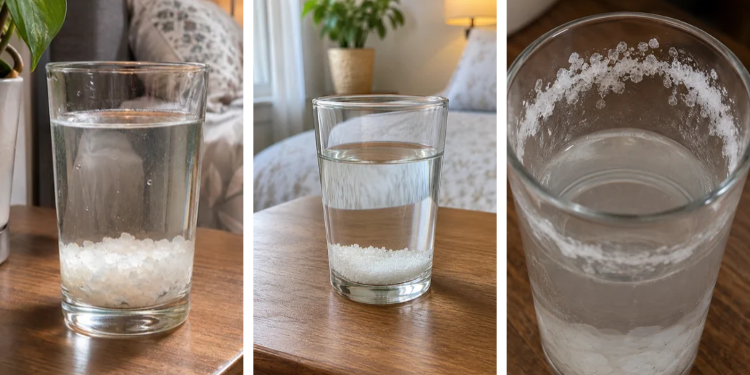
When you stir coarse salt into a glass of tap water and leave it undisturbed in an enclosed room for 24 to 48 hours, several distinct physical and chemical processes take place simultaneously:
1. Ionic Dissociation and Polarity
When crystalline sodium chloride enters water, the polar water molecules pull the crystal lattice apart, dissociating the salt into positively charged sodium ions and negatively charged chloride ions.
Because these dissolved ions carry electrical charges, the resulting saline solution exhibits higher electrical conductivity and stronger intermolecular attraction than plain tap water.
As air circulates naturally across the open surface of the glass, charged airborne particulate matter—such as fine dust, pollen grains, and volatile organic compounds (VOCs)—is subtly attracted to and trapped at the liquid-air interface.
2. Evaporation and Efflorescence (Salt Creep)
Over 24 hours, water molecules at the surface continuously evaporate into the bedroom air. Because salt does not evaporate with water, the remaining solution becomes progressively more concentrated until it reaches saturation.
Once saturated, excess sodium chloride begins to recrystallize along the glass walls. Driven by capillary action—the ability of a liquid to flow upward through narrow spaces against gravity—thin films of saline solution climb the interior sides of the glass, evaporate, and leave behind intricate white salt crusts along the rim.
In traditional folklore, heavy salt crystallization is interpreted as proof that the glass “absorbed negative energy.” In physical chemistry, this phenomenon—known as efflorescence—is a direct visual indicator of room temperature, air circulation speed, and relative humidity.
3. Vapor Pressure Equilibrium
Unlike a bowl of dry rock salt (which pulls moisture out of humid air), an open glass of liquid salt water acts as a passive humidity buffer.
Saline solutions possess a lower saturation vapor pressure than pure water, meaning they evaporate slowly and steadily.
In overly dry, heated winter bedrooms, this gradual evaporation releases modest amounts of moisture into the immediate micro-climate, helping prevent parched nasal passages overnight.
4 Practical Reasons People Recommend a Bedroom Salt-Water Glass
1. Trapping Airborne Micro-Dust and Bedroom Odors
Bedrooms accumulate high concentrations of microscopic skin dander, fabric lint from bedding, and stale respiratory moisture overnight.
An open wide-mouth glass of salt water functions as a passive, silent particulate sink. Dust motes drifting across the room settle onto the liquid surface and become permanently suspended in the saline solution rather than recirculating back into your breathing zone.
2. Acting as an Early-Warning Indoor Humidity Gauge
Because the rate of water evaporation and salt crystal formation on the glass rim depends directly on ambient moisture levels, a salt-water glass serves as a low-tech hygrometer:
-
Rapid evaporation with thick, crusty salt rings: Indicates excessively dry indoor air (often below 30% relative humidity), which can dry out sinuses and irritate airways during sleep.
-
Little to no evaporation and stagnant, cloudy water: Indicates high indoor humidity (above 60%), signaling poor ventilation and a heightened risk for dust mites or hidden mold growth.
3. Psychological Wind-Down and Environmental Control
Sleep specialists emphasize the importance of cognitive offloading—creating physical rituals that signal to the brain that the workday is finished and the bedroom is a safe sanctuary.
Setting up a fresh glass of salt water in the evening acts as a tangible, grounding mindfulness habit. By symbolically “depositing” daily stress into the water before turning off the lights, individuals often experience lower pre-sleep cognitive arousal and easier sleep onset.
4. Zero-Cost, Chemical-Free Room Refreshment
Unlike plug-in air fresheners, scented candles, or aerosol sprays that emit synthetic phthalates and endocrine-disrupting VOCs while you sleep, a glass of salt water contains zero artificial fragrances, requires no electricity, and introduces no airborne irritants into your bedroom.
Bedroom Air & Environment Methods Compared
| Method | Primary Mechanism | Dust & Odor Trapping | Humidity Impact | Maintenance & Cost |
| Salt & Water Glass | Ionic liquid surface trap + slow evaporation | Low to Moderate (Passive surface capture) | Mild passive buffering | Near zero (<0.05$ week) |
| Dry Coarse Salt Jar | Hygroscopic moisture absorption | Moderate (Binds damp odors) | Dehumidifies small spaces | Very low (<0.25$ month) |
| HEPA Air Purifier | Mechanical micron filtration | Very High (99.97% of particles) | None | High (Electricity + filter replacements) |
| Plug-In Scent Diffuser | Thermal vaporization of synthetic oils | None (Masks odors chemically) | None (Adds airborne VOCs) | Moderate (Ongoing refill costs) |
Step-by-Step: How to Set Up a Salt-Water Glass in Your Bedroom
If you want to test this traditional practice for yourself, follow this simple preparation guide:
Safety Precautions and Practical Guidelines
-
Do Not Drink the Water: Never consume water that has been left standing uncovered in a bedroom for 24 hours, as it accumulates airborne dust, bacteria, and heavy sodium concentrations.
-
Keep Away from Pets: Cats and dogs frequently drink from unattended water glasses on nightstands or floors. Ingesting concentrated salt water can cause severe dehydration and sodium ion poisoning in pets; always place the glass inside a closed-door room or high out of reach if you have animals.
-
Protect Wood Surfaces: Because saline solution creeps up and over the rim of the glass as water evaporates, salty moisture rings can etch or damage delicate wooden nightstands. Always place the glass on a waterproof ceramic, glass, or cork coaster.
While a glass of salt water will not replace a mechanical HEPA filter or solve deep structural dampness, it remains a fascinating, zero-cost domestic ritual that bridges traditional mindfulness with observable physical chemistry.