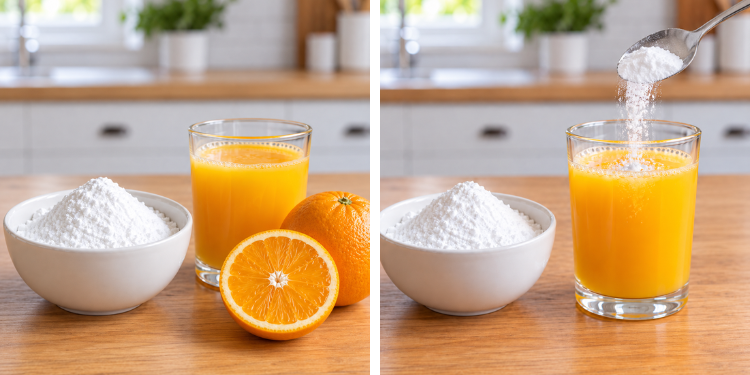
Orange juice and baking soda are two ingredients found in almost every kitchen.
Separately, they’re familiar. Orange juice is naturally acidic and provides nutrients such as vitamin C, folate, and potassium.
Baking soda – sodium bicarbonate – is an alkaline compound commonly used in baking and is also an ingredient in some antacid products.
But what happens when you put the two together?
Almost immediately, you’ll notice bubbles, foam, and fizzing.
Here’s what actually happens when you mix orange juice with baking soda – and what you should know before turning it into a daily habit.
1. The Mixture Starts Fizzing Almost Immediately
The first thing you’ll notice is the fizz.
Orange juice contains natural acids, particularly citric acid. Baking soda contains sodium bicarbonate, which acts as a base.
When an acid and bicarbonate meet, they react and produce carbon dioxide gas.
Those bubbles rising through the glass are carbon dioxide escaping from the mixture.
It’s essentially the same basic principle that makes baking soda useful in recipes: when bicarbonate reacts with an acidic ingredient, gas is produced.
Quick note: The fizzing isn’t evidence that toxins are being removed. It’s simply an acid-base chemical reaction.
Depending on how much baking soda you add, the reaction can be surprisingly vigorous, so adding a large amount to a full glass isn’t a good idea.
2. The Orange Juice Becomes Less Acidic
Because some of the acid in the orange juice reacts with the bicarbonate, the mixture becomes less acidic.
You’ll probably notice this in the taste.
Regular orange juice has a bright, tart flavor. After enough baking soda is added, that tartness decreases and the drink may taste flatter, salty, or slightly unpleasant.
This is where some confusion begins.
Because baking soda can neutralize acid in a glass, people sometimes assume drinking it will “alkalize” the entire body.
That’s not how normal human physiology works.
Important note: Changing the acidity of your drink isn’t the same thing as significantly changing the pH of your blood.
Your body tightly regulates its acid-base balance using systems involving the lungs, kidneys, and blood buffers. Serious abnormalities in blood pH are medical conditions, not something normally corrected with a homemade wellness drink.
3. It May Temporarily Neutralize Some Stomach Acid
Sodium bicarbonate has a legitimate medical use as an antacid.
That’s why some people may notice temporary relief from acid indigestion or heartburn after taking an appropriately formulated sodium bicarbonate antacid.
But that doesn’t automatically make orange juice and baking soda an ideal heartburn remedy.
Orange juice itself is acidic, and citrus drinks can trigger or worsen reflux symptoms in some people.
So you’re essentially combining an acidic beverage with an antacid ingredient.
Digestive note: If you regularly experience heartburn, reflux, or indigestion, repeatedly treating it with homemade baking-soda mixtures isn’t a substitute for determining why the symptoms keep occurring.
Occasional heartburn and frequent reflux are very different situations.
4. The Fizz Can Make You Feel Bloated
Remember the carbon dioxide produced when the ingredients react?
That gas has to go somewhere.
Some escapes from the glass before you drink it, but a fizzy bicarbonate-containing mixture may contribute to:
- Belching
- Bloating
- A feeling of fullness
- Gas
- Stomach discomfort
This is especially relevant if you use too much baking soda or drink the mixture quickly.
People sometimes interpret burping after drinking baking soda as evidence that the remedy is “working” or releasing toxins.
It isn’t.
It’s mostly gas.
Quick note: More fizz doesn’t mean more health benefit.
5. Baking Soda Adds a Significant Source of Sodium
This part is often overlooked.
Baking soda is sodium bicarbonate.
That means regularly consuming it adds sodium to your diet.
This matters particularly for people who have been advised to limit sodium or who have conditions such as high blood pressure, heart failure, or kidney disease.
Sodium bicarbonate used medicinally can also interact with medications, which is another reason it shouldn’t be treated like a completely harmless kitchen supplement.
Important: “Natural” or “found in the kitchen” doesn’t automatically mean something is safe to consume in unlimited quantities.
A pinch used in cooking isn’t the same as repeatedly swallowing spoonfuls dissolved in drinks.
6. It Doesn’t “Detox” Your Body
This is probably the biggest myth surrounding the combination.
You’ll sometimes see claims that baking soda and citrus juice “flush toxins,” “clean the blood,” or “detox the liver.”
There’s no good reason to describe the reaction that way.
Your body already has sophisticated systems for processing and eliminating waste, particularly involving the liver, kidneys, lungs, and gastrointestinal tract.
Making orange juice fizz doesn’t suddenly activate a special detoxification pathway.
The chemical reaction is happening primarily inside the glass.
Reality check: Bubbles are visually dramatic, but they’re not evidence of detoxification.
If you enjoy orange juice, drink it because you enjoy it and because it provides nutrients—not because it needs baking soda to transform it into a detox drink.
7. It Won’t “Alkalize Your Blood” in a Healthy Person
This claim deserves special attention because “alkaline” diets and drinks remain popular online.
Your blood needs to stay within a very narrow pH range for normal physiology.
Your body works constantly to maintain that balance.
If drinking a kitchen mixture could dramatically alter blood pH, that wouldn’t be a wellness benefit—it could be dangerous.
Urine pH can change depending on diet and other factors, but that doesn’t mean your blood has become “alkaline.”
Simple way to remember it: You can change the pH of what’s in your glass much more easily than you can change the pH of your bloodstream.
True metabolic acidosis or alkalosis requires medical evaluation and treatment of the underlying cause.
8. Large Amounts of Baking Soda Can Be Dangerous
This is where an innocent kitchen experiment can become a real health concern.
Consuming excessive sodium bicarbonate can disturb the body’s normal electrolyte and acid-base balance.
Large amounts have been associated with symptoms such as vomiting, weakness, muscle spasms, frequent urination, and other potentially serious complications.
So if you see an online recipe recommending large spoonfuls of baking soda several times per day, don’t assume it’s safe because baking soda is sold in the grocery store.
Safety note: Baking soda is safe in normal culinary use, but deliberately consuming large quantities is a different matter.
Children should not be given sodium bicarbonate as a home remedy without appropriate medical guidance.
Mixing baking soda with orange juice creates a quick acid-base neutralization reaction that transforms sour, acidic juice into a mild, fizzy, buffered citrus drink.
While it offers a gentler option for acid-sensitive stomachs, keeping sodium content in mind ensures it remains a safe, enjoyable kitchen experiment.