Lavender is often described as a low-maintenance plant, and for the most part, it is. Give it plenty of sunshine, well-drained soil, and avoid excessive watering, and an established lavender plant can remain beautiful for years.
But there is one job you shouldn’t ignore: pruning.
Without regular pruning, lavender gradually becomes woody, open, and leggy. The center may begin to separate, stems can flop outward, and flowers may appear mostly at the ends of long branches.
Eventually, what was once a compact mound can become a collection of woody stems with relatively little fresh growth.
Correct pruning helps prevent this.
The good news is that lavender doesn’t need complicated pruning. The most important things are knowing when to prune, how much to remove, and where to stop cutting.
Here’s how to prune lavender correctly so your plants remain compact, healthy, and covered with flowers for as long as possible.
Why Lavender Needs Regular Pruning
Lavender gradually develops woody stems as it matures. This is completely natural, but unlike many shrubs, old lavender wood doesn’t always produce new shoots reliably after being cut hard.
That’s why regular light-to-moderate pruning is much better than allowing a plant to become enormous and then attempting to cut it back severely.
Annual pruning encourages fresh leafy growth while maintaining the plant’s rounded shape.
Regular pruning can help:
- Keep plants compact and bushy
- Reduce long, floppy stems
- Encourage branching
- Remove spent flower stalks
- Maintain better airflow
- Slow the development of excessive woody growth
- Prepare the plant for another flowering season
Think of pruning as preventive maintenance. It’s much easier to maintain a young, compact lavender than to rescue a plant that has been neglected for many years.
When Is the Best Time to Prune Lavender?
The ideal pruning schedule depends somewhat on the type of lavender and your climate, but there are generally two useful pruning periods.
1. Spring Pruning
Spring is an excellent time to inspect lavender and remove winter-damaged growth.
Wait until you can see signs of fresh green growth. This helps you distinguish living stems from branches that were damaged during winter.
Remove dead or obviously damaged stems and lightly shape the plant if necessary.
In colder climates, avoid aggressive pruning too early in spring. Lavender may still be vulnerable to cold weather, and cutting too soon can expose tender new growth to frost.
Spring pruning is mainly for:
- Removing winter damage
- Cleaning up dead stems
- Correcting the shape
- Encouraging healthy new growth
Spring pruning should generally happen before the plant puts too much energy into producing flower stems.
2. After Flowering
The main annual pruning is often performed after the first major flush of flowers has faded.
Depending on your climate and lavender variety, this may occur from mid- to late summer.
Cutting away spent flower stalks and shortening the fresh green growth can keep the plant compact.
Some varieties may also produce another smaller flush of flowers after deadheading or light pruning.
After flowering:
Remove the old flower stems and trim back part of the current season’s leafy growth.
The important word is leafy.
You want to leave plenty of green growth on the plant rather than cutting down into old bare wood.
How Much Lavender Should You Cut Back?
A common guideline is to remove roughly one-third of the leafy growth during the main annual pruning.
The exact amount isn’t as important as observing the stems.
Look at a branch closely.
You’ll usually see:
Flowers at the top → green leafy growth → older woody growth toward the bottom.
Your cut should remain within the section that still has healthy leaves.
A simple rule:
Cut the green growth, but don’t cut deeply into bare brown wood.
Leaving some green foliage below every cut gives the plant a much better opportunity to produce healthy new shoots.
How to Prune Lavender Step by Step
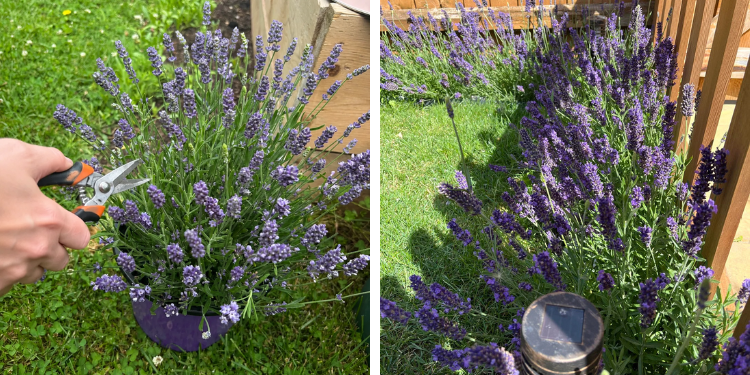
Pruning doesn’t require special equipment. For a small plant, ordinary clean pruning shears are usually enough. Larger lavender hedges may be easier to shape with garden shears.
Step 1: Check the Plant
Before cutting anything, look at the entire plant.
Identify:
- Spent flowers
- Fresh green growth
- Dead stems
- Woody lower growth
- Areas that have become unusually long or floppy
This will help you decide how much shaping is necessary.
Step 2: Remove Spent Flower Stalks
Cut off faded flower stalks.
You can harvest lavender flowers earlier if you want them for drying, crafts, or other uses. Otherwise, remove the spent stalks once flowering declines.
Don’t stop there, though.
Simply cutting the flowers off at the very top doesn’t do much to maintain the plant’s shape.
Step 3: Shorten the Leafy Stems
After removing the flowers, shorten some of the green leafy growth.
For established plants, trimming approximately one-third of the leafy portion is often sufficient.
Remember:
- Keep green leaves below your cuts.
- Don’t cut every stem down to bare wood.
- Remove less if you’re uncertain.
- You can always make another small cut; you can’t put a branch back.
Step 4: Create a Rounded Shape
Lavender naturally looks best as a compact mound.
As you prune, shape the plant into a rounded dome rather than creating a flat top.
Keep the center slightly higher and gradually shorten stems toward the edges.
This shape isn’t just decorative. It can help prevent long outer stems from flopping onto the ground as they become heavy with flowers.
Step 5: Remove Dead Growth
Completely dead stems can be removed.
To determine whether a questionable stem is alive, look for green leaves or buds. You can also gently scratch a tiny section of the outer bark. Living tissue may appear green underneath, while completely dead stems tend to be dry and brittle.
Don’t confuse naturally woody stems with dead stems. Lavender develops brown woody bases as it ages, and these may still support healthy green growth farther up.
The Most Important Rule: Don’t Cut Deeply Into Old Wood
This is where many lavender pruning mistakes happen.
A neglected lavender plant may tempt you to cut it almost to the ground and start again.
Unfortunately, lavender doesn’t reliably regenerate from old bare wood.
If you cut below all visible green growth, some branches may never produce new shoots.
Before making each major cut, ask:
Are there healthy leaves below where I’m cutting?
If yes, the cut is generally safer.
If you’re looking at a completely bare woody stem with no visible green shoots, be cautious.
This is especially important with older English lavender plants that have developed thick woody bases.
Pruning English Lavender
English lavender (Lavandula angustifolia) is one of the most popular garden lavenders and among the more cold-hardy types.
It generally responds well to annual pruning.
After the main flowering period, remove the spent flower stems and shorten the leafy growth while maintaining a rounded shape.
English lavender may become woody surprisingly quickly when left unpruned, so annual maintenance is worthwhile.
Best approach:
Spring: Remove winter-damaged stems and lightly tidy.
After flowering: Perform the main shaping prune.
Late season: Avoid severe pruning if freezing weather is approaching.
Pruning French and Spanish Lavender
French and Spanish lavenders can behave somewhat differently from English lavender, particularly in warm climates where their flowering seasons may be longer.
Spanish lavender (Lavandula stoechas), recognizable by the distinctive petal-like bracts above its flower heads, can benefit from regular deadheading.
Remove fading flower stems to keep the plant tidy and encourage continued flowering where conditions allow.
A more substantial shaping prune can be performed after a major flowering period, but again, avoid cutting deeply into bare wood.
French and Spanish lavenders are generally less cold hardy than many English varieties, so late pruning can be particularly risky in colder regions.
Should You Prune Lavender in Fall?
This depends largely on your climate.
In regions with mild winters, light shaping after flowering may be perfectly reasonable.
In areas with cold winters and hard freezes, heavy late-fall pruning is usually best avoided.
Pruning stimulates and exposes growth at a time when the plant should be preparing for dormancy. The remaining foliage can also provide some protection to the woody crown during winter.
If flowering finishes very late in your climate, simply remove spent flowers if necessary and leave major corrective pruning until spring.
In cold climates:
Avoid giving lavender a severe haircut immediately before winter.
A slightly untidy plant going into winter is better than a severely pruned plant exposed to freezing conditions.
What About Lavender in August?
August is often an important month for lavender because many plants have finished—or are finishing—their main summer bloom.
If the flowers are fading, this can be an excellent opportunity to deadhead and shape the plant.
Remove old flower stalks and lightly shorten the leafy stems.
However, your local climate matters.
If August is followed by a long mild autumn, the plant has plenty of time to recover.
If cold weather arrives early where you live, prune more conservatively.
August lavender care:
- Remove faded flowers.
- Trim long, floppy green stems.
- Maintain a rounded shape.
- Leave plenty of leafy growth.
- Avoid cutting into bare woody stems.
- Avoid heavy fertilizing after pruning.
Can Pruning Make Lavender Bloom Again?
Sometimes.
Deadheading and light pruning after the first flowering period may encourage certain lavender varieties to produce additional flowers later in the season.
However, don’t expect every lavender to produce another display as large as its first bloom.
Flowering depends on:
- Variety
- Climate
- Sunlight
- Plant age
- Growing conditions
- Timing of pruning
Even when a second flush doesn’t occur, pruning still helps maintain the plant’s shape for future seasons.
What to Do With the Lavender You Cut
Don’t automatically throw healthy lavender stems away.
If the flowers still have good fragrance and color, they can be dried.
Bundle small groups of stems together and hang them upside down somewhere dry, dark, and well ventilated.
Once dried, lavender can be used for decorative bouquets, sachets, wreaths, and other crafts.
Healthy green trimmings can generally be composted.
Save healthy cuttings for propagation
Pruning time can also be an opportunity to propagate lavender.
Select healthy, non-flowering shoots and take short cuttings. Remove the lower leaves and insert the stems into a light, well-draining propagation mix.
Not every cutting will root, so start several at once.
How to Prune an Old, Woody Lavender
Older lavender requires much more caution.
If a plant has developed a large woody center with green growth only at the ends of long branches, don’t suddenly cut the entire shrub down to a few inches.
Instead, work gradually.
Remove dead branches first. Then shorten living stems only as far as you can while still leaving healthy leafy growth.
Over time, careful shaping may improve the appearance.
However, extremely woody, open lavender cannot always be restored to the compact shape of a young plant.
Sometimes replacement is the most practical solution.
This is why annual pruning from the beginning is so important.
5 Common Lavender Pruning Mistakes
1. Not Pruning at All
Leaving lavender untouched for years allows stems to become increasingly woody and sprawling.
A little pruning every year is much easier than attempting major renovation later.
2. Cutting Into Bare Wood
This is the biggest mistake.
If there are no green leaves or shoots below your cut, that stem may struggle to regrow.
3. Pruning Too Late Before Winter
Heavy pruning shortly before freezing weather can leave the plant more vulnerable.
In cold climates, save major pruning for a safer period.
4. Only Cutting Off the Flowers
Deadheading is useful, but cutting only the flower heads doesn’t maintain the shrub’s compact shape.
Shorten some of the leafy stems as well.
5. Overfeeding After Pruning
Lavender isn’t a heavy feeder.
Large amounts of nitrogen fertilizer can encourage soft leafy growth rather than the sturdy, compact growth you want.
Lavender generally performs best in relatively lean, well-drained conditions.
Pruning lavender correctly isn’t about cutting as much as possible. It’s about pruning a moderate amount every year so you never need to make drastic cuts later.
The best gardens don’t just brighten your yard – they become something you can enjoy season after season.
If you’re ready to grow your own backyard pharmacy, the Medicinal Garden Kit is a wonderful place to begin.
Inside you’ll find 2,409 non-GMO seeds, a detailed Herbal Medicinal Guide, and 2 FREE bonuses to help you grow a wide variety of traditional medicinal herbs with confidence.
Take a look at the Medicinal Garden Kit and start growing something truly rewarding.