For many flower lovers, August is a magical month in the garden. While beds and borders are still bursting with late-summer color, the earliest blooms of the season have quietly completed their life cycle.
Beneath fading petals, flower heads are converting energy into dense clusters of mature, viable seeds.
Saving your own flower seeds is one of the most rewarding – and budget-friendly – habits you can build as a gardener. Instead of spending money on commercial seed packets every spring, spending a few warm afternoons in August gathering ripe seed heads gives you hundreds of free plants for next year’s garden.
Here is a guide to 10 easy flower seeds to save in August, why open-pollinated varieties shine, and how to store your harvest for maximum spring germination.
The Botany of Seed Saving: Heirloom vs. Hybrid
Before grabbing your snips, it helps to understand why certain flowers are ideal for seed saving while others are not:
-
Open-Pollinated & Heirloom Flowers: These varieties are pollinated naturally by wind, bees, or butterflies. When you save seeds from an open-pollinated flower (like a traditional zinnia or cosmos), the offspring will grow “true to type” – meaning the new plants will closely resemble the parent plant in color, height, and form.
-
F1 Hybrid Flowers: Hybrids are created by intentionally cross-breeding two distinct parent lines for specific traits (like unusual colors or extreme disease resistance). Seeds harvested from F1 hybrids will not breed true; their offspring usually revert to weaker, unpredictable, or less colorful variations.
10 Flower Seeds to Collect in August
1. Marigolds (Tagetes)
-
Seed Identification: Long, slender, needle-like seeds with a dark bottom and a light tan or yellow feathery top.
-
How to Harvest: Wait until the flower head dries out completely on the stem, turning brown and papery. Pop the base of the seed pod open with your thumb and pull the bundle of black-and-tan “arrows” free.
-
Next Year’s Benefit: Marigolds are stellar companion plants that deter garden pests like nematodes while attracting beneficial pollinators.
2. Zinnias (Zinnia elegans)
-
Seed Identification: Arrowhead-shaped or dark, shield-like seeds attached directly to the base of spent ray petals.
-
How to Harvest: Allow the bloom to fade completely until the central cone turns dry and crisp. Snip the head, pull off the papery petals, and rub the central cone between your hands over a tray. Look for firm, dark seeds attached to the base of the petals.
-
Next Year’s Benefit: Zinnias are legendary cut flowers that produce vibrant blooms from early summer right up until the first fall frost.
3. Cosmos (Cosmos bipinnatus)
- Seed Identification: Long, slender, dark brown or black curved spikes resembling miniature pine needles.
- How to Harvest: After the delicate petals drop, the central green head will swell and turn dark brown. Snip the spiky heads when they are dry to the touch and easily pop loose from the stem.
- Next Year’s Benefit: Cosmos thrive in poor, lean soils and self-seed easily, creating airy drifts of daisy-like flowers with minimal effort.
4. Sunflowers (Helianthus annuus)
-
Seed Identification: Plump, striped or solid dark oval seeds clustered densely in the central flower disk.
-
How to Harvest: Watch for the back of the heavy flower head to turn from green to rich yellow-brown. Cut the head off leaving a few inches of stem, and hang it upside down in a warm, dry area protected from birds and squirrels until the seeds drop easily when rubbed.
-
Next Year’s Benefit: Sunflowers add dramatic vertical structure to the garden while providing valuable winter food for songbirds.
5. Bachelor’s Buttons / Cornflower (Centaurea cyanus)
-
Seed Identification: Small, straw-colored oval seeds featuring a tiny brush-like tuft of bristles on one end.
-
How to Harvest: As the blue petals wither, a small, cup-like pod forms. When the pod dries and opens to reveal a white, fluffy center, pluck the pod and squeeze out the bristle-topped seeds.
-
Next Year’s Benefit: Cornflowers are cool-season annuals that can be sown early in spring (or even late fall) for early summer blooms.
6. Coneflowers (Echinacea purpurea)
-
Seed Identification: Small, angular, cream-to-tan wedge-shaped seeds tucked inside the spiky central cone.
-
How to Harvest: Wait for the bright purple petals to drop and the central spiky cone to turn dark, stiff, and dry. Wear gardening gloves (the cones are sharp!), snip the heads, and crush the dried cones to release the wedge-shaped seeds.
-
Next Year’s Benefit: Echinacea is a hardy perennial native that attracts native bees, butterflies, and goldfinches to the autumn garden.
7. Nasturtiums (Tropaeolum majus)
-
Seed Identification: Large, plump, ribbed, pea-sized green seeds that turn tan and wrinkled when fully mature.
-
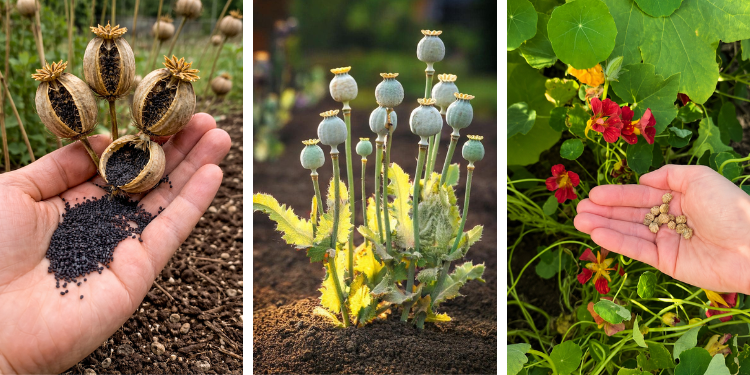
How to Harvest: Unlike most flowers, nasturtium seeds drop to the ground when ripe. Search beneath the trailing vines in late August for large, fallen seeds. Gather them from the soil, brush off dirt, and let them dry on a paper towel.
-
Next Year’s Benefit: Every part of the nasturtium plant—leaves, stems, and flowers—is edible, offering a peppery, radish-like kick to summer salads.
8. Poppies (Papaver)
-
Seed Identification: Microscopic, kidney-shaped black or dark blue seeds inside a salt-shaker pod.
-
How to Harvest: Leave the pod on the plant until it turns hard, greyish-brown, and tiny vents open near the top. Tilt the dry pod over an envelope and shake—hundreds of tiny seeds will pour out easily.
-
Next Year’s Benefit: Poppies easily self-sow and produce breathtaking spring blooms with almost zero maintenance.
9. Calendula / Pot Marigold (Calendula officinalis)
-
Seed Identification: Distinctive, curved, crescent-shaped seeds that resemble tiny bumpy worms or sea shells.
-
How to Harvest: Allow the yellow or orange petals to drop. The central head will transform into a ring of green, curved seeds. Harvest when the entire seed ring turns light brown and brittle.
-
Next Year’s Benefit: Calendula petals are famous in herbalism for their skin-soothing properties and make excellent natural dyes.
10. Sweet Peas (Lathyrus odoratus)
-
Seed Identification: Smooth, round, dark brown or grey peas contained inside a dry, papery pod.
-
How to Harvest: After flowering, sweet peas produce pods resembling edible garden peas. Allow the pods to dry on the vine until they turn brown and brittle. Pop the pods open to collect the hard, round seeds.
-
Next Year’s Benefit: Sweet peas offer unmatched old-fashioned scent and make exquisite, fragrant spring bouquets.
Seed Saving Quick-Reference Guide
| Flower Variety | Plant Type | When to Harvest | Key Visual Indicator |
| Marigold | Annual | Late August | Papery brown stem pod; black arrow seeds |
| Zinnia | Annual | Mid to Late August | Dry cone; arrow-shaped seeds at petal base |
| Cosmos | Annual | August through Frost | Dark, spiky pine-needle seeds on open head |
| Sunflower | Annual | Late August / Sept | Back of flower head turns yellow-brown |
| Cornflower | Annual | Mid to Late August | Open cup with fluffy bristle-topped seeds |
| Echinacea | Perennial | Late August / Autumn | Stiff, dry, spiky black central cone |
| Nasturtium | Annual | August | Plump, ribbed seeds fallen on the ground |
| Poppy | Annual / Biennial | August | Brown pod with open vents near top rim |
| Calendula | Annual | Mid to Late August | Ring of brown, curved, worm-like seeds |
| Sweet Pea | Annual | Late August | Brown, brittle, papery pea-like pods |
4 Rules for Storing Saved Seeds for High Germination
Collecting seeds is only half the job – proper drying and storage ensure they stay viable until spring:
By taking advantage of August’s natural seed harvest, you close the loop on your garden’s life cycle.
With a few paper envelopes and a dry afternoon, you’ll have a custom seed collection ready to bring vibrant color back to your yard next spring – completely for free.