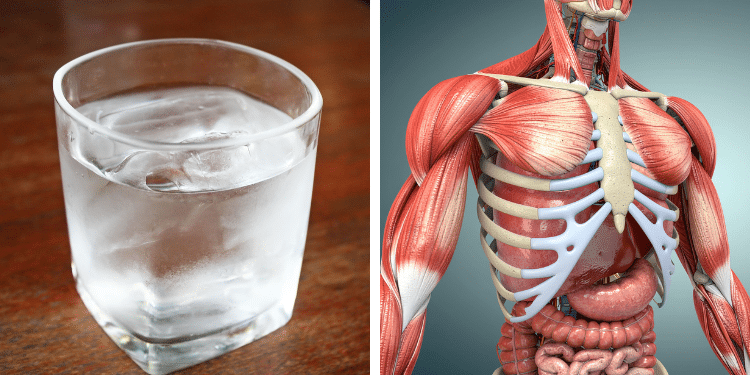
The first thing many of us reach for in the morning is a tall glass of water. It feels refreshing, crisp, and wakeful.
However, the temperature of that water – specifically when it is ice-cold and your stomach is completely empty -triggers a series of rapid physiological responses that differ significantly from drinking room-temperature water.
While hydration is always a net positive, plunging your internal system into a “cold shock” first thing in the morning affects your digestion, your metabolic rate, and even your heart rate.
This guide breaks down exactly what happens inside your body when that ice-cold liquid hits your empty stomach, separating the biological facts from the common myths.
The Immediate Response: The “Internal Thermostat” Shift
The moment ice-cold water enters your esophagus and stomach, your body treats it as a temperature emergency.
To maintain homeostasis, your body must immediately go to work to warm that water up before it can be efficiently processed and sent to the rest of your organs.
5 Potential Effects of Ice-Cold Water on an Empty Stomach
1. The Sudden Constriction of Blood Vessels
When cold water hits the lining of an empty stomach, the local blood vessels immediately constrict (shrink). This is a survival mechanism called vasoconstriction.
In an empty stomach, the blood flow is typically ready to assist with the secretion of digestive juices. By forcing these vessels to narrow, you temporarily reduce the blood flow to your digestive tract.
For some individuals, this can lead to a “heavy” feeling or mild cramping as the stomach muscles react to the sudden temperature drop.
2. The Digestion Slowdown
Digestion is a chemical process that relies heavily on enzymes, and enzymes are temperature-dependent. They function most efficiently at body temperature.
Drinking ice water on an empty stomach can solidify fats from any lingering food particles and temporarily “stun” the enzymes responsible for breaking down nutrients.
While this won’t stop digestion entirely, it can lead to delayed gastric emptying, which might cause bloating or a sensation of fullness before you’ve even eaten breakfast.
3. Vagus Nerve Stimulation and Heart Rate
The vagus nerve is a major part of your parasympathetic nervous system that runs right behind the esophagus and stomach. It is responsible for controlling involuntary functions like your heart rate.
Extreme cold can stimulate the vagus nerve, which may cause a temporary drop in your heart rate (bradycardia).
While harmless for most healthy people, this is why some individuals feel a sudden, slight “chill” or a sense of lightheadedness immediately after gulping down a large amount of ice water.
4. The “Metabolic Boost” Myth vs. Reality
You may have heard that drinking ice water burns hundreds of calories because your body has to work to warm it up.
Research suggests that drinking a large glass of ice water burns roughly 5 to 15 extra calories. While technically a metabolic “boost,” it is not a significant enough factor for weight loss on its own.
5. Hydration Delay
Ironically, ice-cold water may actually take longer to hydrate you than room-temperature water.
Your stomach lining cannot absorb water into the bloodstream effectively until it reaches a temperature closer to your internal core.
Therefore, the water must sit in the stomach for a few extra minutes to warm up before it can be moved into the small intestine for full absorption.
Who Should Be More Cautious?
While most people can handle cold water just fine, certain groups should be more mindful:
-
Migraine Sufferers: A study published in Cephalalgia found that drinking ice-cold water through a straw can trigger a “brain freeze” (sphenopalatine ganglioneuralgia) that may escalate into a full-blown migraine in susceptible individuals.
-
People with Achalasia: This is a condition where the esophagus has trouble moving food into the stomach. Cold water can make the esophageal sphincter more rigid, making swallowing more difficult or painful.
The Better Way: The Room-Temperature Alternative
If your goal is to wake up your digestive system and flush out toxins efficiently, most traditional wellness practices- including Ayurveda and Traditional Chinese Medicine – recommend warm or room-temperature water on an empty stomach instead.
| Feature | Ice Cold Water | Room Temperature Water |
| Digestion | Can cause vessel constriction | Stimulates peristalsis (muscle movement) |
| Enzyme Activity | Temporarily suppressed | Remains optimal |
| Absorption Speed | Slower (must warm up first) | Rapidly enters the bloodstream |
| Morning Wake-up | Sharp “shock” to the system | Gentle “flush” for the organs |
Hydration is the most important part of your morning ritual, regardless of the temperature.
However, if you find that you feel bloated, experience mild stomach cramps, or get a sudden headache after your morning water, try switching to room-temperature or lukewarm water.