The human body is an asymmetrical marvel of biological engineering. While we often think of our internal systems as centered, the reality is a complex map of “left-leaning” and “right-leaning” organs that respond significantly to the force of gravity.
Sleep posture is not merely a matter of comfort; it is a mechanical intervention that influences hemodynamics, biliary drainage, and organ filtration.
When you shift your weight to the right side – a position known as the right lateral decubitus – you alter the physical pressure on the mediastinum (the chest cavity) and the abdominal space. For many, this shift provides a functional advantage for the heart, the liver, and the gallbladder.
Here is the scientific deep-dive into what sleeping on your right side may do for your heart rate, gallbladder, and liver function.
1. The Cardiac “Gravity Shift”: Stabilizing the Heart Rate
The heart is situated slightly to the left of the midline. When you sleep on your left side, gravity pulls the heart toward the chest wall, allowing it to “shift” within the chest cavity.
This can lead to increased cardiac output but also higher electrical sensitivity.
Research published in the Journal of the American College of Cardiology suggests that sleeping on the right side provides more space for the heart in the chest cavity. This prevents the heart from pressing against the ribs and the mediastinum.
For individuals with certain heart conditions, the right lateral position activates the parasympathetic nervous system (the “rest and digest” mode) more effectively.
By reducing the physical “burden” on the heart, sleeping on the right side can lead to a lower resting heart rate and a more stable heart rate variability (HRV). It is a “passive” way to reduce cardiac workload during the 7 to 9 hours of restorative sleep.
2. Optimizing the “Biliary Drain”: The Gallbladder and Digestion
The gallbladder is a small, pear-shaped reservoir located on the right side of the abdomen, tucked under the liver. Its primary job is to store and concentrate bile, which is necessary for the emulsification of fats.
Because the gallbladder and the common bile duct are positioned on the right, gravity plays a crucial role in how bile moves into the small intestine.
When you lie on your right side, the gallbladder is positioned “above” the exit point of the stomach. This uses gravity to facilitate the natural downward flow of bile through the biliary tree.
This position may help prevent the stagnation of bile, which is a primary factor in the formation of gallstones (cholelithiasis).
3. Liver Filtration: Protecting the “Heaviest” Organ
The liver is the body’s largest internal organ and is situated almost entirely on the right side of the upper abdomen. It is remarkably heavy and dense.
When you sleep on your left side, the liver hangs over the stomach and other digestive organs, potentially compressing them and the large blood vessels (like the inferior vena cava) that run behind it.
By sleeping on your right side, the liver is supported by the rib cage and the mattress. It remains in its natural “pocket,” preventing it from exerting pressure on the stomach and the heart.
This ensures that the blood flow to and from the liver remains unobstructed. Proper hepatic blood flow is essential for the liver to perform its 500+ functions, including the detoxification of the blood and the synthesis of proteins.
4. Reducing Gastric Pressure and Reflux (The Trade-Off)
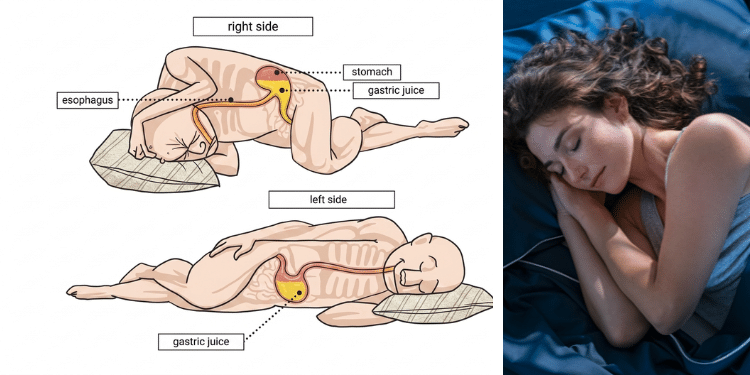
While we have established that the right side is excellent for the heart and gallbladder, there is a “valve” consideration to keep in mind regarding the stomach.
The stomach’s exit to the esophagus (the lower esophageal sphincter) is on the left.
On the right side, the stomach sits “above” the esophagus. For some, this can lead to acid reflux if the valve is weak.
If your goal is heart and liver health, sleep on the right. However, if you are experiencing a “flare-up” of heartburn, you may temporarily shift to the left to keep gastric acid below the esophageal entry point.
5. Enhancing the “Glymphatic” Cleanse
The brain has a dedicated waste-clearance system called the glymphatic system, which becomes ten times more active during sleep.
Recent studies in The Journal of Neuroscience indicate that lateral (side) sleeping – regardless of which side – is the most efficient position for the brain to flush out metabolic waste, such as amyloid-beta (linked to Alzheimer’s).
Because the right side is often more comfortable for the heart, it promotes a deeper, more continuous state of REM sleep.
Since the glymphatic system is most active during deep sleep, the right-side position indirectly supports brain detoxification by ensuring you stay asleep longer.
6. Respiratory Efficiency and Oxygen Saturation
For those who struggle with “shallow breathing” or minor respiratory congestion, the right side provides a structural benefit.
The right lung is slightly larger and has three lobes, compared to the two lobes of the left lung (to make room for the heart).
Sleeping on the right side allows the larger right lung to expand more fully against the mattress, potentially improving oxygen saturation levels throughout the night.
Summary: The Right Lateral “Body Reset”
| System | Physiological Benefit | Why It Works |
| Heart | Lower heart rate & stability. | Reduced physical pressure on the heart. |
| Gallbladder | Better bile drainage. | Gravity assists flow into the intestine. |
| Liver | Improved filtration. | Organ is supported by the ribs; no compression. |
| Brain | Waste clearance. | Promotes deep sleep for glymphatic action. |
| Lungs | Higher oxygen intake. | Maximizes expansion of the larger right lung. |
Sleeping on your right side is a masterclass in anatomical alignment.
By respecting the asymmetrical layout of your organs, you provide your heart with the space it needs to rest, your gallbladder with the gravity it needs to drain, and your liver with the support it needs to filter.
It is a simple, cost-free “habit of position” that optimizes your internal machinery while you dream.