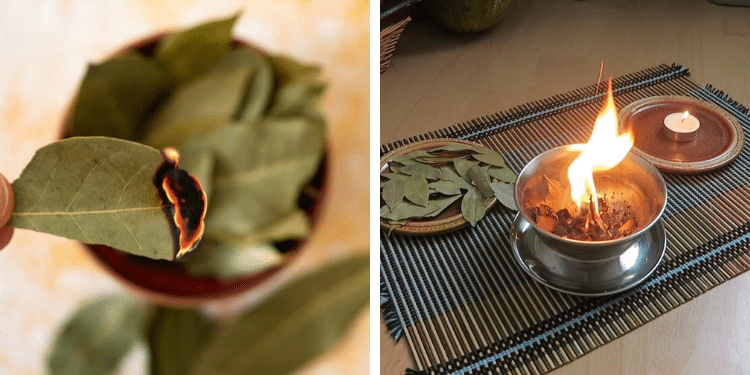
Burning bay leaves indoors is one of those practices that sits somewhere between tradition, sensory experience, and curiosity.
You may have seen it described as a way to “cleanse” a room, refresh the air, or create a calmer environment.
While those ideas are often shared in a symbolic or cultural sense, many people today are asking a more grounded question:
What actually happens to the air when you burn a bay leaf?
To answer that properly, you need to look at both sides – the traditional use of aromatic plants and the scientific understanding of indoor air, combustion, and plant compounds.
When you do, a clearer picture emerges. It’s not a miracle method, but it’s also not meaningless. The truth sits somewhere in between.
Where the Practice Comes From
Burning dried leaves and herbs is not new. Cultures around the world have used aromatic plants in various forms—sometimes for ritual, sometimes for scent, sometimes simply to change the atmosphere of a space.
Bay leaves, in particular, have a long history. They’ve been used in cooking, medicine, and symbolic practices across regions for centuries.
When dried, they burn slowly and release a distinct aroma that’s both herbal and slightly warm.
What makes bay leaves appealing for indoor use is that they are:
- Easily available
- Naturally aromatic
- Slow-burning compared to many other leaves
This combination makes them practical for controlled, short-term burning indoors.
What Happens Chemically When You Burn a Bay Leaf
To understand the effect on indoor air, you first need to understand combustion.
When you light a bay leaf, it doesn’t burn like paper. Instead, it smolders. This means it releases heat slowly while breaking down the organic material inside the leaf.
During this process, several things are released into the air:
- Volatile organic compounds (VOCs) from the plant’s essential oils
- Carbon dioxide
- Small amounts of carbon monoxide
- Fine particulate matter (tiny airborne particles)
The aromatic compounds are what give bay leaves their recognizable scent. These include substances such as cineole, eugenol, and other naturally occurring plant oils.
These same compounds are present when you cook with bay leaves, but burning them changes how they are released – turning them into airborne particles and gases.
The Role of Aromatic Compounds in Perception
One of the most immediate effects of burning a bay leaf is not chemical – it’s sensory.
Your sense of smell is directly connected to parts of the brain that regulate memory, mood, and emotional response. This is why scent can quickly change how a space feels.
The aroma released from a burning bay leaf is often described as:
- Warm
- Herbal
- Slightly spicy
- Grounding
Even without measurable changes in air quality, this scent can make a room feel:
- Fresher
- Calmer
- More comfortable
This is not an illusion – it’s a real neurological response. However, it’s important to recognize that it’s perception-driven rather than air-purification-driven.
Does Burning Bay Leaves Clean the Air?
This is where expectations often need adjustment.
From a scientific standpoint, burning plant material does not “clean” air in the way people might imagine. It does not remove pollutants, neutralize toxins in a measurable way, or replace proper ventilation.
In fact, any form of combustion – even natural – introduces additional particles into the air.
These include:
- Fine particulate matter (PM2.5)
- Combustion gases
- Trace compounds from the burning material
So while the scent may make the air feel cleaner, the measurable air quality does not improve in the same way it would with ventilation or filtration.
What About Antimicrobial Effects?
Some research has explored how plant smoke interacts with microorganisms in the air.
Certain plant compounds, including those found in bay leaves, have demonstrated antimicrobial properties in laboratory settings.
When released into the air, these compounds may have a mild effect on airborne bacteria.
However, the key word here is mild.
In real-world indoor environments:
- The concentration of these compounds is low
- The exposure time is short
- The effect is not strong enough to sterilize or significantly purify air
So while there may be a theoretical antimicrobial component, it is not strong enough to rely on as a cleaning method.
The Part Most People Notice: Psychological and Environmental Shift
Where this practice does have a noticeable effect is in how it changes the experience of a space.
Lighting a bay leaf is a deliberate action. It interrupts routine. It creates a moment of focus. Combined with the aroma, it can shift your awareness of the environment.
This leads to effects such as:
- A sense of reset in the room
- Reduced mental tension
- A feeling of calm or clarity
These responses are not caused by air purification, but by a combination of scent, ritual, and attention.
This is why many people feel a difference, even if air measurements remain unchanged.
Comparing Bay Leaf Smoke to Other Indoor Air Methods
To understand its place, it helps to compare it to other common approaches.
Opening a window improves air quality by exchanging indoor air with outdoor air. Air purifiers remove particles mechanically. Plants may influence air chemistry over time, though their effect indoors is limited.
Burning a bay leaf fits into a different category entirely.
It is not a filtration method or a ventilation method. It is an atmospheric modifier, primarily through scent and perception.
This distinction is important because it prevents misunderstanding its role.
Potential Downsides and Considerations
Even natural practices have limitations.
Burning bay leaves produces smoke, and smoke contains particles that can irritate the respiratory system, especially for sensitive individuals.
People with conditions such as asthma or allergies may find even small amounts of smoke uncomfortable.
Additionally, in poorly ventilated spaces, repeated burning can lead to a buildup of airborne particles.
This is why moderation and airflow matter.
How to Use It More Thoughtfully
If you choose to burn bay leaves indoors, the way you do it makes a difference.
Using a single leaf, allowing it to smolder briefly, and ensuring there is some airflow in the room helps keep the effect light and temporary.
This approach keeps the experience focused on aroma and atmosphere rather than prolonged exposure to smoke.
It also aligns more closely with how the practice has traditionally been used – short, intentional, and occasional.
Why the Practice Still Exists Today
Despite modern air fresheners and purifiers, this method continues to be used.
The reason is not efficiency – it’s simplicity.
It requires no devices, no electricity, and no complex setup. It provides an immediate sensory change without relying on synthetic fragrances.
For many people, that alone is enough.
What You Can Realistically Expect
When you burn a bay leaf indoors, you are not purifying the air in a measurable sense. You are not removing pollutants or improving air quality in the way a mechanical system would.
What you are doing is:
- Introducing a natural scent
- Creating a moment of intentional change
- Shifting how the space feels
The effect is subtle but noticeable.
The science of smudging with bay leaves is not about dramatic transformations. It’s about understanding what is actually happening and using the practice accordingly.
From a scientific perspective, burning bay leaves introduces both aromatic compounds and small amounts of particulate matter into the air. It does not function as an air purifier.