For many gardeners, the sunset marks the end of the day’s work – a time to put away the tools and retreat indoors.
However, for a select group of horticultural enthusiasts, the true magic of the landscape only begins when the sky fades to indigo.
This is the realm of the Moonlight Garden, a specialized landscape designed specifically to be enjoyed under the silver glow of the moon.
While daylight gardens rely on vibrant reds, oranges, and deep purples to attract the eye, a moonlight garden utilizes white, cream, and silver foliage to reflect light.
More importantly, it features a unique class of botanical wonders: nocturnal bloomers. These plants have evolved to remain dormant during the heat of the day, only unfurling their petals and releasing intoxicating, heavy scents when the sun disappears.
The Science of Nocturnal Blooming: Why They Wait
Before we explore the species, it is essential to understand the biological “why” behind this behavior.
Plants that bloom at night are typically pollinated by nocturnal insects and mammals, such as sphinx moths, bats, and beetles.
Because these pollinators cannot rely on bright colors in the dark, night-blooming flowers have adapted two primary traits:
-
Luminescence: They often feature white or pale-yellow petals that act as “reflectors” for moonlight, making them visible in the dark.
-
Scent Signaling: They release powerful, volatile organic compounds (VOCs) that travel further in the cool, damp night air, acting as a chemical beacon to guide pollinators from miles away.
1. The Moonflower (Ipomoea alba)
If the moonlight garden had a centerpiece, it would be the Moonflower. A relative of the morning glory, this vigorous vine performs one of nature’s most dramatic “live shows.”
The Evening Spectacle
In the late afternoon, the tightly furled, cone-shaped buds begin to quiver. Within the span of just one to two minutes, the 6-inch, pure-white blossoms spiral open before your eyes.
Once fully expanded, they resemble glowing white saucers. Their fragrance is a soft, lemony musk that intensifies as the night deepens.
Because they are vines, they are perfect for trellises near a bedroom window or a patio where their scent can be appreciated.
2. Night-Blooming Jasmine (Cestrum nocturnum)
While its flowers are visually modest – small, greenish-white tubular blooms – the Night-Blooming Jasmine is arguably the most fragrant plant on Earth.
The Olfactory Powerhouse
During the day, this shrub looks like a standard evergreen. However, as soon as the sun sets, it releases a scent so powerful and sweet that it can be detected up to 20 feet away.
The fragrance is a rich, creamy floral that embodies the essence of the tropics. In a moonlight garden, this plant acts as the “ambient background,” filling every corner of the yard with its invisible presence.
3. Four O’Clocks (Mirabilis jalapa)
As the name suggests, the Four O’Clock is the ultimate “time-keeper” of the garden. While many flowers wait for total darkness, these blooms begin their shift just as the work day ends.
The Color Shift
Available in shades of white, yellow, and bi-colors, the white varieties are the stars of the evening garden. They remain tightly shut through the midday sun to conserve moisture, opening only in the late afternoon.
By dusk, they are in full bloom, releasing a spicy, ginger-like fragrance. An added benefit? They are incredibly hardy and will continue to bloom until the first frost.
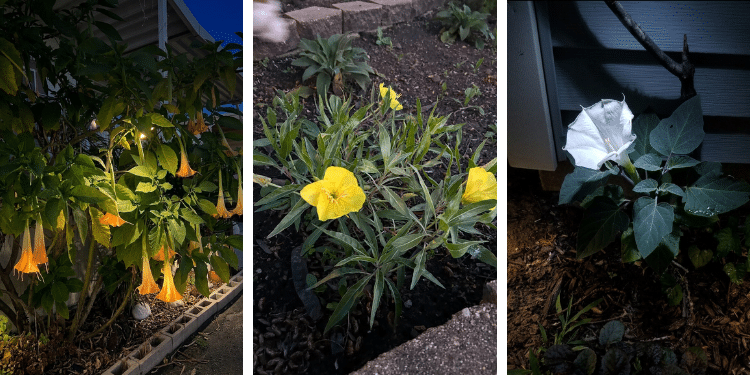
4. Evening Primrose (Oenothera biennis)
Not to be confused with the common garden primrose, the Evening Primrose is a native wildflower that has earned a place in the most refined moonlight landscapes.
The “Electric” Glow
The blossoms are a pale, luminous yellow that seems to hold onto the light even on moonless nights. Like the Moonflower, they open rapidly at dusk.
As they unfurl, they release a scent that is remarkably similar to honey. They are a favorite of the Luna Moth, one of the most beautiful nocturnal insects in North America, making this plant an ecological necessity for a wildlife-friendly night garden.
5. Angel’s Trumpet (Brugmansia)
For those in warmer climates (or those willing to move large pots indoors for winter), the Angel’s Trumpet provides unparalleled architectural drama.
The Hanging Chandelier
The blooms are massive, pendulous trumpets that can reach up to 12 inches in length. During the day, they hang limp and scentless.
At night, the trumpets stiffen, the tips curl back, and they emit a heavy, narcotic fragrance that is a mix of gardenia and citrus.
Because the flowers hang downward, they are best viewed from a seated position or planted in elevated containers where the moonlight can catch the inner “glow” of the trumpet.
6. Tuberose (Agave amica)
The Tuberose has a history rooted in royalty and high-end perfumery. It was a favorite in the moonlit gardens of the Victorian era and the Mughal Empire.
The Concentrated Essence
The flowers grow on tall, elegant spikes, with waxy white florets that open from the bottom up. While they are pretty by day, they are a revelation by night.
The scent is incredibly complex – sweet, spicy, and buttery. Because the flowers are waxy, they reflect the moon’s light with a pearlescent sheen, making them look as though they are carved from marble.
7. Mock Orange (Philadelphus)
If you are looking for a woody shrub to provide structure to your moonlight garden, the Mock Orange is the premier choice for late spring and early summer.
The Citrus Beacon
While it doesn’t wait until midnight to open, its fragrance reaches its peak intensity during the twilight hours. The small, four-petaled white flowers cover the bush like a blanket of snow.
The scent is famously identical to orange blossoms. In the silver light of a full moon, a mature Mock Orange bush looks like a glowing white cloud, providing a soft, ethereal backdrop for smaller perennials.
8. Queen of the Night (Epiphyllum oxypetalum)
The Queen of the Night is the rarest and most elusive member of the moonlight garden. A member of the cactus family, it is the ultimate “event” plant.
The One-Night Stand
This plant is famous for blooming only one night a year. The buds grow slowly over several weeks, and when the night finally arrives, the massive, intricate white flowers open after 8:00 PM and reach full glory by midnight.
By dawn, they have wilted. The fragrance is divine – a delicate, sophisticated floral. Many gardeners host “bloom parties,” inviting friends over with flashlights and wine to witness the rare, fleeting beauty of the Queen’s arrival.
Design Tips for Your Moonlight Garden
To maximize the “glow” and the scent of these 8 flowers, consider these three design principles:
-
The “Silver Lining”: Surround your white flowers with silver-foliaged plants like Lamb’s Ear, Artemisia, or Dusty Miller. These plants reflect even the dimmest light, creating a glowing “border” that guides you through the garden at night.
-
Pathways of Light: Use light-colored paving stones or white gravel for your walkways. Dark mulch disappears at night, but light stones will catch the moonlight, making the garden safe to navigate without harsh electric lights.
-
The Wind Shield: Scent is the primary draw of a moonlight garden, but a strong wind will whisk those volatile oils away. Plant your fragrant nocturnal bloomers near a wall, a solid fence, or a dense hedge to trap the scent in a “pocket,” allowing it to intensify.
A moonlight garden is more than just a collection of plants; it is an invitation to slow down and experience the world in a different light.
By choosing flowers that wait for the sun to set, you are creating a landscape that rewards patience and honors the quiet, hidden cycles of nature.