In the world of high-end landscaping, we often overlook the most effective solutions sitting right at our feet.
Every autumn and spring, pine trees carpet the ground with “pine straw” – the slender, acidic needles that many homeowners mistakenly rake up and send to the landfill.
However, for a savvy gardener, these needles are a “brown gold” that can transform the health and aesthetic of your shrubbery.
Using pine needles as mulch is a practice rooted in forest ecology. In nature, pine trees drop their needles to create a protective, self-sustaining mat that regulates soil temperature and recycles nutrients.
When you replicate this under your garden shrubs, you are installing a high-performance, long-lasting mulch that outperforms wood chips in several key categories.
Here are the seven long-term benefits of scattering pine needles under your shrubs and why your landscape needs this “forest floor” treatment today.
The Best Candidates: Which Shrubs Love Pine Needles?
To make this guide even more practical, it is essential to know which specific plants in your landscape will benefit the most from this “brown gold.”
Because pine needles are naturally acidic, they are a premier choice for acid-loving shrubs that struggle in neutral or alkaline soils.
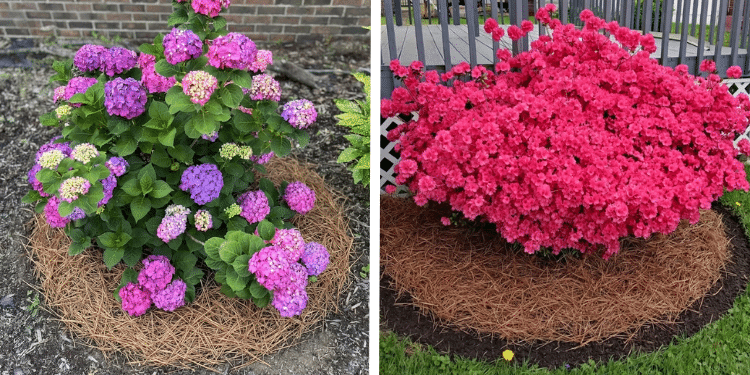
Popular ornamental favorites like Azaleas, Rhododendrons, and Camellias will thrive under a pine needle mulch, as it helps maintain the low pH they require to absorb iron effectively.
Furthermore, fruit-bearing shrubs like Blueberries and evergreen staples like Holly and Gardenias find the light, airy texture of pine needles ideal for their sensitive, shallow root systems.
Even if your shrubs aren’t strictly acid-loving, the superior drainage and insulation provided by pine needles make them an excellent choice for Boxwoods and Hydrangeas, providing a clean, professional aesthetic that highlights their vibrant foliage.
1. Superior Moisture Retention Through “Interlocking”
The most critical job of any mulch is to keep moisture in the soil. Wood chips and shredded bark often form a dense “crust” that can actually repel water if it becomes too dry. Pine needles, however, have a unique physical structure.
The Interlocking Advantage
As pine needles settle, they interlock like a game of “pick-up sticks.” This creates a porous but stable mat.
Rainwater easily trickles through the gaps between the needles to reach the roots, but the mat then acts as a lid, preventing that moisture from evaporating in the summer sun.
This interlocking property also means pine needles stay put on sloped landscapes where wood chips would simply wash away during a heavy downpour.
2. Natural Soil Acidification for “Acid-Loving” Shrubs
Many of the most popular ornamental shrubs – including Azaleas, Rhododendrons, Blueberries, Pieris, and Hydrangeas—thrive in acidic soil (a low pH).
The Slow Release of Acidity
While there is a common garden myth that pine needles will instantly turn your soil into an acid bath, the truth is more nuanced and beneficial.
Fresh pine needles are acidic, but as they decompose, they neutralize slightly. However, over the long term, the consistent application of pine straw helps maintain a lower soil pH.
This creates the ideal environment for these shrubs to uptake iron and other essential micronutrients, leading to deeper green foliage and more vibrant blooms.
3. Exceptional Weed Suppression
Weeds are the primary frustration of any landscape enthusiast. Pine needles provide a dual-action defense against these opportunistic invaders.
The Physical and Chemical Barrier
First, the thick, interlocking mat of needles physically prevents weed seeds from reaching the soil surface.
Second, as pine needles decompose, they release a mild allelopathic compound that can inhibit the germination of certain weed seeds.
Unlike wood mulch, which can sometimes harbor weed seeds from the processing facility, pine needles gathered from your own yard or a local source are typically “clean,” providing a sterile but organic barrier.
4. Improved Soil Aeration and “Breathability”
One of the “hidden” dangers of heavy wood mulch is soil compaction. Over time, wood chips break down into a fine silt that can suffocate the “feeder roots” of your shrubs, which sit near the surface.
The Loft Factor
Pine needles are lightweight and have a natural “loft.” Even after a year of sitting under a shrub, they do not compress into a solid block.
This allows oxygen to reach the soil and carbon dioxide to escape – a gas exchange that is vital for the health of beneficial soil microbes and fungi. A “breathing” soil is a living soil, and living soil produces the most resilient shrubs.
5. Erosion Control on Slopes and Hillsides
If you have shrubs planted on a slope, you know the struggle of keeping mulch in place. Traditional bark mulch is buoyant and easily “floats” away during spring thaws or summer storms.
The “Matting” Effect
Because pine needles are long and thin, they weave together into a cohesive fabric. This mat “grips” the soil surface.
Not only does the mulch stay in place, but it also protects the underlying soil from being washed away. This makes pine needles the gold-standard mulch for tiered landscapes, hillsides, and areas prone to heavy runoff.
6. Pest Repellency and “Clean” Decay
Wood mulches, especially those that are poorly aged, can attract pests like termites, carpenter ants, and artillery fungus (the fungus that “shoots” black spots onto your house siding).
A Natural Deterrent
Pine needles contain natural resins and tannins that many insects find unappealing. Furthermore, because pine needles dry out quickly on the surface while staying moist underneath, they are less likely to host the “slime molds” and fungi that can be unsightly or damaging.
When pine needles do eventually break down, they turn into a rich, dark humus that improves soil structure without the risk of nitrogen tie-up often associated with “fresh” wood chips.
7. Cost-Effectiveness and Sustainable Aesthetics
From a design perspective, pine needles offer a “seamless” look. Their fine texture and uniform reddish-brown color provide a neutral backdrop that makes the vibrant green of your shrubs “pop.”
The Sustainable Choice
If you have pine trees on your property, this mulch is 100% free. Even if you purchase it by the bale, it is often more cost-effective than premium bagged bark.
Utilizing pine needles is the ultimate form of “closed-loop” gardening. Instead of buying a product that was shredded, dyed, and shipped across the country, you are using a local, renewable resource that returns directly to the earth.
How to Apply Pine Needles for Maximum Benefit
To unlock these seven long-term benefits, follow these application rules:
-
The 3-Inch Rule: Apply a layer of needles approximately 3 inches thick. Anything thinner won’t suppress weeds; anything thicker might prevent smaller spring rains from reaching the soil.
-
The “Donut” Shape: Just like wood mulch, never pile pine needles against the actual trunk or stems of the shrub. Leave a 2-inch gap around the base to prevent moisture from rotting the bark.
-
Tucking the Edges: Use a spade to “tuck” the edges of your pine needle bed into a shallow trench. This gives the landscape a professional, manicured look and further prevents wind-drift.
-
Refresh Annually: Pine needles decompose more slowly than many people think, but they do settle. Adding a light 1-inch “top-off” every spring will keep the color fresh and the weed barrier intact.
Scattering pine needles under your shrubs is a simple shift that aligns your gardening practices with the laws of nature.
By choosing “pine straw,” you are investing in a mulch that breathes, protects, acidifies, and stays put.