In the world of organic gardening, the most powerful fertilizers aren’t always found in a plastic bag at the garden center.
Often, they are sitting in your compost bin. Among all the kitchen scraps available to a gardener, the humble banana peel stands out as a “superfood” specifically tailored for the needs of the rose bush (Rosa).
Roses are notoriously “heavy feeders.” They require a constant supply of micronutrients to produce those iconic, velvet-petaled blooms and to maintain the glossy, deep-green foliage that signifies a healthy plant.
While synthetic fertilizers provide a quick hit of nutrients, they often neglect the long-term health of the soil microbiome.
By scattering banana peels around your rose bushes, you are engaging in a 30-day biological transformation. Here is the science behind why this works and the eight incredible results you will notice within just one month.
The Nutrient Profile: Why Roses Crave Bananas
To understand the results, we must look at the “N-P-K” of a banana peel. While they are low in nitrogen (N), they are exceptionally rich in:
-
Potassium (K): Often called the “regulator,” potassium is vital for immune health, water movement within the plant, and the physical strength of the stems.
-
Phosphorus (P): The engine behind flower production and root development.
-
Magnesium: Essential for chlorophyll production (the green in the leaves).
-
Calcium: Strengthens cell walls, making the plant less susceptible to pests.
The 30-Day Timeline: What Happens Under the Soil
When you scatter or bury banana peels, a 30-day countdown begins.
-
Days 1–7: Beneficial soil microbes, fungi, and earthworms migrate toward the peels. The decomposition process begins, releasing a small amount of sugar that “wakes up” the soil biology.
-
Days 8–20: As the peels darken and break down, the concentrated potassium and phosphorus begin to leach into the rhizosphere (the area around the roots).
-
Days 21–30: The rose bush uptakes these stabilized nutrients, leading to visible changes in the plant’s structure and performance.
8 Incredible Results After 30 Days
1. Explosive Bloom Production
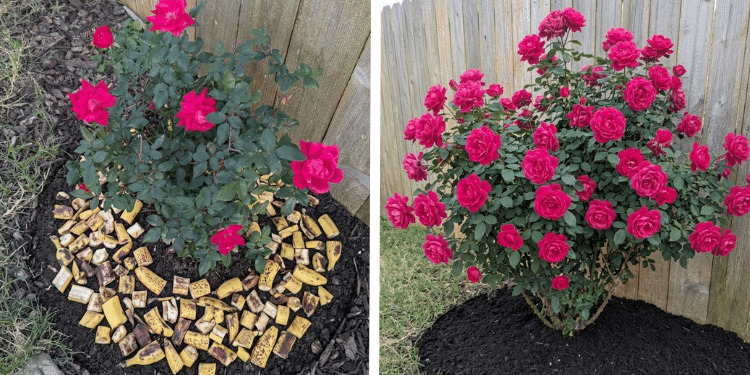
By day 30, the most visible result is a surge in flower buds. Because banana peels provide a slow-release dose of phosphorus and potassium, the plant shifts its energy from leaf production to reproductive growth.
You will notice more “buds per cane” than in previous cycles, and the flowers themselves are likely to be larger and more complex.
2. Intense Color Saturation
Potassium plays a direct role in the synthesis of anthocyanins—the pigments responsible for the red, pink, and orange hues in roses.
Within 30 days of consistent banana peel application, gardeners often report that their roses look “photoshopped.”
The colors appear deeper and more vibrant because the plant has the specific mineral support to build stronger pigment molecules.
3. Thickened, “Rigid” Stems
Have you ever had a beautiful rose bloom that “nodded” or drooped because the stem was too weak to hold its weight?
The calcium and potassium in banana peels strengthen the cell walls of the plant’s vascular system. After a month, the new growth on your rose bushes will feel sturdier and more upright.
4. Resistance to “Black Spot” and Powdery Mildew
Fungal diseases like Black Spot thrive on stressed or nutrient-deficient roses. Potassium is essentially the “vitamin C” of the plant world; it bolsters the plant’s natural immune system.
A rose bush fed with banana peels develops a thicker cuticle (the waxy outer layer of the leaf), making it much harder for fungal spores to take root.
5. Enhanced Fragrance
A rose’s scent is produced by volatile oils. The production of these oils is a metabolic process that requires significant energy and mineral co-factors.
By providing a steady supply of magnesium and sulfur (found in trace amounts in the peels), you enable the plant to produce a higher concentration of these aromatic oils.
You may find that your garden smells noticeably sweeter by the end of the month.
6. A Surge in Earthworm Activity
Earthworms are the “tilling machines” of the garden. They are highly attracted to the decomposing sugars in banana peels.
Within 30 days, if you move the mulch aside, you will likely see an increase in worm activity. These worms create tunnels that aerate the soil and leave behind “castings,” which are the most nutrient-dense fertilizer on Earth.
7. Improved Drought Tolerance
Potassium regulates the opening and closing of the stomata (the tiny pores on the leaves through which the plant breathes).
A plant with optimal potassium levels can manage its water loss much more efficiently. After 30 days, you may notice that your rose bushes don’t wilt as quickly during a hot afternoon compared to untreated plants.
8. Rapid Recovery from Pruning
If you prune your roses in conjunction with adding banana peels, the recovery time is slashed.
The readily available nutrients allow the plant to seal off the pruning cuts and push out “apical” growth (new shoots) much faster, filling in gaps in your landscape with fresh, healthy foliage.
3 Ways to Apply Banana Peels
To get these 8 results, you can use any of these three popular methods:
1. The “Chop and Drop”
Cut the peels into 1-inch pieces and scatter them directly under the drip line of the rose bush. Cover them with a light layer of mulch to prevent them from attracting fruit flies and to speed up decomposition.
2. The “Banana Peel Tea”
Soak 3-4 peels in a gallon of water for 48 hours. Remove the peels (throw them in the compost) and pour the nutrient-rich water directly onto the soil at the base of the rose. This provides the fastest nutrient uptake.
3. The “Deep Burial”
Dig a small trench 3 inches deep around the base of the rose. Place whole peels in the trench and cover with soil. This is the best method for long-term results, as it places the nutrients directly in the path of the roots.
The practice of scattering banana peels around your rose bushes is a perfect example of “closed-loop” gardening.
Instead of relying on laboratory-made chemicals, you are utilizing the natural mineral concentration of a fruit that has already traveled from the tropics to your kitchen.