In an era of high-tech gardening gadgets, pressurized seed-starting trays, and expensive peat pellets, the most revolutionary tool in your spring arsenal might actually be sitting in your recycling bin.
The humble egg carton – whether made of molded pulp (cardboard), styrofoam, or clear plastic – is an engineering masterpiece for the home gardener.
Designed to cradle fragile eggs, these 12-chambered vessels are perfectly sized for the first 4 to 6 weeks of a seedling’s life.
By repurposing them, you aren’t just saving twenty dollars at the garden center; you are engaging in a zero-waste practice that reduces plastic waste and aligns your gardening habits with the natural cycles of reuse and decay.
1. The “Biodegradable” Direct-Plant Pot
The primary challenge of starting seeds indoors is the “transplant shock” that occurs when moving a seedling from its starter pot to the garden.
Many of the most popular garden vegetables, such as cucumbers, pumpkins, squash, and sweet peas, possess delicate taproots that are highly sensitive to disturbance.
If these roots are bent or exposed to air for too long during a move, the plant can stall for weeks.
Cardboard (molded pulp) egg cartons are made of organic fibers that break down quickly when exposed to soil microbes.
-
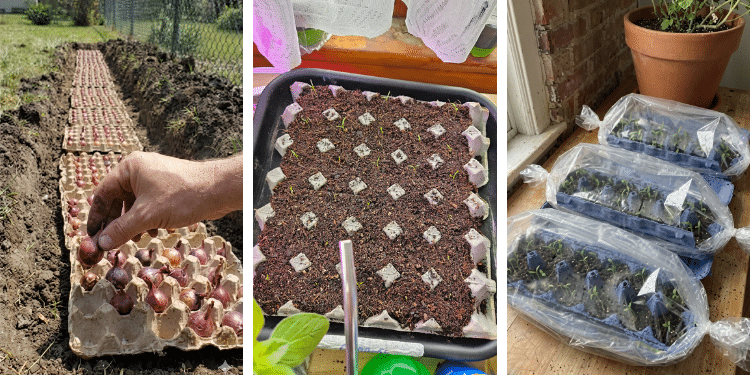
Preparation: Before you even add soil, use heavy-duty kitchen shears to cut the egg carton into 12 individual cups.
-
Planting: Fill each cup with a sterile seed-starting mix.
-
The Move: When the seedling has its first set of “true leaves,” do not pull the plant out. Instead, snip a small “X” into the bottom of the cardboard cup with scissors to make it easier for roots to escape.
-
Planting: Bury the entire cardboard cup directly into the garden soil. The cardboard acts as a temporary moisture reservoir and eventually decomposes, adding carbon back to the soil while the roots grow through the softened walls completely undisturbed.
2. The Built-In Greenhouse Humidity Dome
For a seed to germinate, it requires two things above all else: warmth and constant humidity.
In a dry, indoor environment, the top layer of soil can dry out in hours, causing the emerging seed to wither before it even breaks the surface.
If you have a clear plastic egg carton, you possess a professional-grade mini-greenhouse.
-
The Chamber: After filling the bottom cells with soil and seeds, simply snap the lid shut.
-
The Greenhouse Effect: The clear plastic allows sunlight to enter but prevents moisture from escaping. This creates a “tropical” micro-climate where water evaporates from the soil, condenses on the lid, and drips back down.
-
Temperature Control: This trapped heat can raise the soil temperature by 5–10 degrees, which is critical for heat-loving seeds like peppers and eggplants.
-
Pro Tip: If you see large beads of water forming (oversaturation), simply prop the lid open with a toothpick for an hour a day to allow for fresh gas exchange.
3. The “Self-Wicking” Bottom Watering System
“Damping off” is a fungal disease that is the bane of every indoor gardener. It occurs when moisture sits on the soil surface or the delicate stems of seedlings, causing them to rot at the base and fall over overnight.
Top-watering with a watering can also often displace tiny seeds like lettuce or carrots.
Cardboard egg cartons are naturally porous.
-
The Setup: Place your filled carton inside a shallow plastic tray or the flat lid of a large storage bin.
-
The Physics: Instead of watering from the top, pour about half an inch of water into the tray.
-
Capillary Action: Through a process called capillary action, the cardboard will “wick” the moisture upward. The soil absorbs the water from the bottom, delivering it directly to the roots. This keeps the surface of the soil and the plant stems dry, effectively creating a barrier against fungal pathogens and ensuring the seeds are never “drowned” by a heavy stream of water.
4. The “No-Label” Master Organization Grid
Organization is where many gardeners fail. You plant six varieties of peppers, but three weeks later, you can’t remember which is the “Sweet Bell” and which is the “Carolina Reaper.” Plastic labels are bulky and often fall out of tiny cells.
The egg carton is a natural 2×6 grid that remains fixed in place.
-
The Mapping: Instead of labeling each cell, use the inside of the carton’s lid.
-
The Layout: Using a permanent marker, draw a grid on the inside lid that mirrors the 12 cells below.
-
The Labeling: Write the variety name, the date planted, and the expected germination date (usually found on the seed packet) in the corresponding square. Because the lid is physically attached to the pots, your “Master Key” travels with the plants wherever you move them, eliminating the risk of a garden-wide identity crisis.
5. The “Perfect Depth” Seed Dippler
A common reason for seed failure is planting “too deep.” A seed has a finite amount of energy stored within its hull; if it is buried too deep, it will run out of fuel before it reaches the light of the surface.
The design of an egg carton includes pointed “pillars” in the center to keep eggs from touching.
-
The Tool: Take a spare egg carton and cut out one of these center pillars.
-
The Action: Once your seed-starting mix is in the cells, use the pillar to gently press down into the center of each cell.
-
The Uniformity: This creates a firm, uniform depression. For most vegetable seeds, this “pocket” is exactly the right depth (roughly 1/4 to 1/2 inch). By ensuring a firm, consistent depth, you guarantee that your seedlings emerge at the same time, making it easier to manage light and watering for the whole tray.
6. The “Eggshell Liner” Calcium Boost
To maximize the biological potential of your egg carton, you can reintroduce the original contents: the eggshells. This is a “double-decker” hack for plants that are heavy calcium feeders.
-
Preparation: Next time you cook, crack your eggs near the top rather than the middle. Rinse the shells thoroughly with warm water.
-
The Liner: Place the empty shells back into the egg carton cells for stability. Fill the shells with soil and plant your seeds inside.
-
The Transplant: When it’s time to move the plant to the garden, gently crush the shell in your hand to create cracks (this allows roots to escape) and plant the entire shell.
-
The Benefit: Plants like tomatoes and peppers are prone to “Blossom End Rot,” which is caused by a calcium deficiency. As the eggshell decomposes in the soil, it provides a localized, slow-release boost of calcium exactly where the plant needs it most.
7. The Space-Saving “Stackable” Station
Urban gardeners and those in smaller apartments often struggle with the “real estate” needed to start a garden. During the first phase of gardening, space is at a premium.
During the initial “germination” phase (before green shoots appear), seeds do not need light; they need constant heat.
-
The Stack: Because egg cartons are uniform and have lids, you can stack 4 or 5 closed cartons on top of one another.
-
The Placement: Place this stack on top of a refrigerator, a cable box, or a warm shelf.
-
The Management: This allows you to start 48 to 60 seeds in a footprint no larger than a shoebox. Check the “stack” every morning. As soon as you see a green “crook” (the first sign of a sprout) in a carton, unstack it and move that specific unit to a sunny windowsill.
8. DIY Seed Tapes Using the Lid
Tiny seeds – like carrots, lettuce, and radishes – are incredibly difficult to space properly by hand.
This usually results in “clumping,” where dozens of plants grow on top of each other and must be “thinned” (killed) to allow room for growth.
-
The Material: Cut the flat lid of a cardboard egg carton into long, 1-inch-wide strips.
-
The Glue: Mix a teaspoon of flour with a few drops of water to create a thick, edible paste.
-
The Spacing: Place a tiny dot of the paste every 2 inches along the cardboard strip. Stick one seed to each dot.
-
The Planting: Once dry, take these strips to your garden bed. Dig a shallow trench, lay the strip down, and cover it with soil. The cardboard strip holds moisture around the seed and ensures that your carrots or lettuce grow with perfect, professional spacing, saving you hours of thinning later in the season.
3 Essential Rules for Egg Carton Success
To ensure your egg carton garden doesn’t end in mold or withered stems, follow these three strict rules:
I. Drainage is Mandatory
If you are using plastic or styrofoam cartons, they are waterproof. If you do not provide an exit for water, the soil will become anaerobic, and the roots will rot.
Use a nail or a heated skewer to poke a hole the size of a pencil lead in the bottom of every single cell.
II. Monitor Moisture Daily
Cardboard is breathable, which is excellent for root health, but it also means the soil will dry out much faster than in a plastic pot. You must check the cartons every day.
The cardboard should feel like a “wrung-out sponge” – damp to the touch, but not dripping wet.
III. The “True Leaf” Transplant Rule
Egg carton cells are small. They are meant for starting, not growing. Once your seedlings have their “True Leaves” (the second set of leaves that look jagged or like the adult plant), their roots will likely be hitting the bottom of the carton.
You must transplant them to a larger pot or the garden immediately to avoid them becoming “root-bound,” which can permanently stunt the plant’s growth.
The egg carton is a testament to the fact that effective gardening doesn’t have to be expensive.
By viewing your household waste through the lens of utility, you can create a high-performance nursery that supports your plants from the moment they sprout until they reach the soil.