In the realm of domestic “life hacks,” few combinations are as potent or as steeped in tradition as the pairing of onions and vinegar.
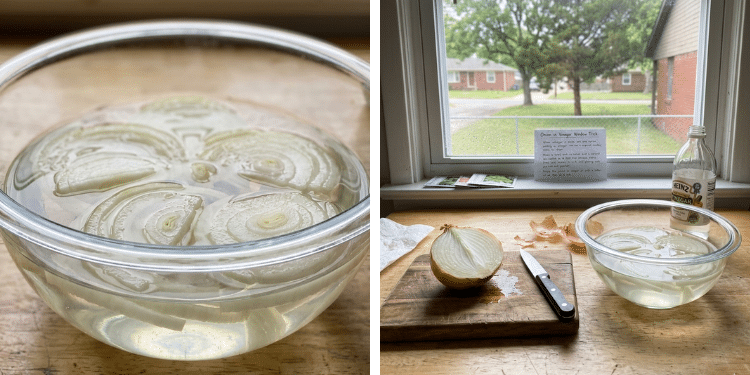
While these two ingredients are culinary staples, their utility extends far beyond the kitchen. A rising wellness and household trend involves a simple, low-tech setup: cutting an onion, submerging it in a bowl of white vinegar, and placing it on a windowsill.
This practice is a masterclass in botanical fumigation and acetic acid evaporation. By combining the volatile sulfur compounds of the onion with the antimicrobial properties of vinegar, you create a natural “passive diffuser” that addresses several modern household challenges.
Here are the 6 primary reasons why this simple bowl is becoming a mainstay in health-conscious homes.
1. Natural Air Purification and Odor Neutralization
Modern air fresheners often rely on synthetic phthalates to “mask” smells. In contrast, the onion-vinegar solution works through chemical neutralization.
-
The Science of Acetic Acid: Vinegar is approximately 5–8% acetic acid. As it evaporates, the acid molecules bond with alkaline odor molecules (like those from cigarette smoke, burnt food, or pet dander), neutralizing them rather than just covering them up.
-
The Sulfur Contribution: Onions are rich in sulfuric compounds (specifically syn-propanethial-S-oxide). Traditionally, these were believed to “absorb” toxins. In a modern sense, they act as a biological filter, contributing to a crisper, “cleaner” olfactory environment.
-
The Result: Placing this bowl near a window allows the cross-breeze to carry these neutralizing vapors throughout the room, effectively “scrubbing” the air.
2. Respiratory Support and Sinus Decongestion
For those living in urban environments or dealing with seasonal allergens, indoor air can become “heavy” and irritating to the bronchial tubes.
-
The Expectorant Effect: The sharp, pungent aroma of a freshly cut onion acts as a mild, natural expectorant. Inhaling these subtle vapors can help thin mucus and clear the sinuses.
-
Vinegar as a Clarifier: Vinegar vapors have been used in traditional medicine to help “open” the airways. When placed near a window, the gentle evaporation provides a consistent, low-level aromatic support that is particularly beneficial during the damp, pollen-heavy months of spring.
3. Deterring Household Pests and Insects
Most common household pests – including flies, gnats, and even spiders – rely on a highly sensitive sense of smell to navigate. The intense chemical signature of an onion-vinegar bowl is an effective, non-toxic deterrent.
-
The Repellent Mechanism: Insects find the combination of acetic acid and allyl sulfides (found in onions) overwhelming. It disrupts their pheromone trails and makes the area around the window – a primary entry point – unattractive.
-
The Fruit Fly Trap: If you leave the bowl uncovered, it also serves as a dual-purpose trap. Fruit flies are attracted to the fermentation profile of the vinegar but are quickly overcome by the acidic surface tension and the pungent onion vapors.
4. Inhibiting Airborne Mold and Fungal Spores
Windowsills are notorious for accumulating moisture due to condensation, making them a primary breeding ground for household mold.
-
The Antimicrobial Barrier: Acetic acid is a proven antifungal agent. By placing the bowl near the window, you create a localized zone of acidic vapor. This can help inhibit the growth of spores that settle on the window frame or nearby curtains.
-
The “Clean-Zone” Effect: While it won’t replace a deep-cleaning protocol, the presence of the bowl acts as a preventive measure, keeping the air around your entry points more hostile to fungal colonization.
5. Humidity Regulation and “Crisp” Air
In many homes, indoor air can feel “stale” or “dead.” The evaporation of a vinegar-based solution adds a specific type of “active moisture” to the room.
-
Evaporative Cooling: As the liquid in the bowl evaporates, it provides a slight cooling effect in the immediate vicinity of the window.
-
Sensory Sharpness: The “zest” of the vinegar and the “bite” of the onion create a sensory experience that many report makes the room feel more vibrant and less stagnant. It is a form of environmental priming that shifts the mood of the space from sluggish to alert.
6. Ancient Wisdom Meets Modern “Grounding”
There is a psychological component to using “living” ingredients for household maintenance. This practice is a form of environmental grounding.
-
The Ritual Aspect: Preparing the onion and vinegar is an intentional act. It moves the homeowner away from “pressurized-can” solutions and toward a more rhythmic, natural way of managing the home.
-
The “Safety” Signal: In folklore, onions were placed in rooms to ward off illness. From a modern psychological perspective, this creates a “safety signal” in the brain – a tangible sign that the environment is being cared for and “cleansed.”
The Professional Setup: How to Do It Correctly
To maximize the efficacy of your onion-vinegar bowl without creating an overwhelming “salad” smell in your home, follow this protocol:
1. Variety Selection
Use a Yellow Onion or a White Onion. These have higher sulfur concentrations than red or sweet onions, making them more effective for air purification.
2. The Cut
Do not dice the onion. Instead, cut it into thick quarters. This exposes enough surface area to release the sulfur compounds but prevents the onion from breaking down too quickly.
3. The Vinegar Choice
White Distilled Vinegar is preferred for air purification because it has a higher acidity and a “cleaner” scent profile than apple cider vinegar.
4. The Placement
Place the bowl on a windowsill that receives a light breeze. This ensures that the vapors are distributed throughout the room rather than pooling in one corner.
5. The “Refresh” Cycle
Change the vinegar and the onion every 48 to 72 hours. Once the onion begins to look translucent or “water-logged,” its ability to release volatile compounds has ceased.
Cutting an onion and placing it in a bowl of vinegar is a testament to the power of functional simplicity.
By leveraging basic chemistry – neutralization, evaporation, and antimicrobial action – you can transform your indoor environment.
It is a reminder that some of the most effective wellness tools aren’t found in a laboratory, but in the produce aisle and the pantry.