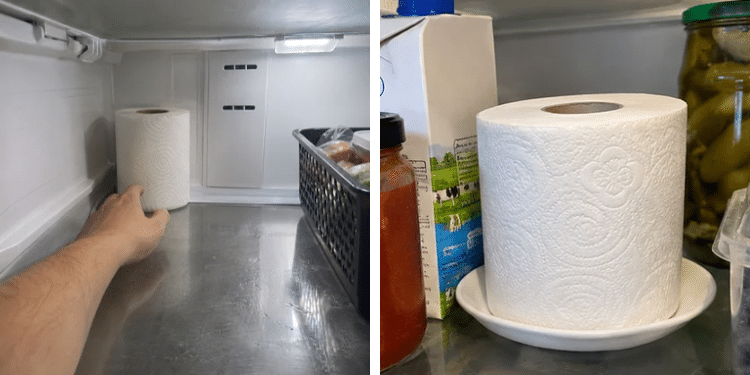

If you open the refrigerator door in certain households, you might do a double take at an unusual item sitting on the middle shelf right next to the milk carton and leftover containers: a fresh, unopened roll of white toilet paper.
At first glance, storing bathroom tissue alongside groceries looks like a bizarre organizational mistake.
Yet across frugal living communities, RV and boat owners, and home science enthusiasts, placing a roll of toilet paper in the refrigerator is a well-known, low-cost domestic hack designed to solve two persistent kitchen headaches: excess internal humidity and stubborn refrigerator odors.
By taking advantage of the porous, hygroscopic structure of cellulose wood pulp – and optionally pairing it with common kitchen odor neutralizers like baking soda – a simple roll of toilet paper acts as a high-surface-area desiccant sponge inside an enclosed cold space.
Here is an evidence-based look at the material science behind putting toilet paper in your fridge, why it works, where it falls short compared to specialized deodorizers, and how to use this trick safely and hygienically.
The Material Science: How Cellulose Paper Controls Fridge Conditions
To understand why a roll of toilet paper alters the micro-environment inside a refrigerator, it helps to examine what toilet paper is made of and how moisture behaves in chilled appliances.
1. Hydrophilic Cellulose Fibers and Capillary Wicking
Standard white toilet paper is manufactured from virgin or recycled cellulose fibers derived from wood pulp.
At the microscopic level, cellulose polymer chains are densely covered in hydroxyl groups, which are strongly attracted to polar water molecules through hydrogen bonding.
Furthermore, toilet paper is engineered specifically to be ultra-porous, loosely bonded, and creped to maximize absorbency.
A single multi-ply roll contains hundreds of square feet of overlapping fibrous surface area interspersed with microscopic air pockets.
When placed inside a refrigerator, those porous fibers act as a passive hygroscopic sink, drawing excess airborne water vapor and surface condensation into the paper matrix via capillary action.
2. Why Refrigerators Accumulate Excess Moisture
Every time you open the refrigerator door, warm, humid kitchen air rushes inside. Unchecked moisture creates three problems:
-
Accelerated Produce Spoilage: Excess surface water encourages fungal spores and psychrotrophic bacteria (cold-tolerant microbes) to multiply rapidly on leafy greens, berries, and vegetables.
-
Frost Buildup: In older or heavily stocked refrigerators, excess humidity freezes onto evaporator coils, forcing the compressor to work harder and consume more electricity.
-
Odor Transmission: Airborne volatile odor molecules from onions, garlic, fish, and cheese dissolve readily into water droplets. When humid air condenses across the fridge interior, those water films trap and spread stale smells throughout the appliance.
3. Trapping Water-Soluble Odor Molecules
As the cellulose layers absorb airborne moisture, they simultaneously capture water-soluble volatile compounds suspended in that vapor.
While dry paper alone does not chemically neutralize acids or sulfur gases the way sodium bicarbonate or activated charcoal does, physically removing moisture from the air reduces the primary medium that carries and deposits refrigerator odors.
4 Main Reasons People Put Toilet Paper in Their Fridge
1. Reducing Excess Condensation and Keeping Produce Crisp
In humid climates or households where the refrigerator door is opened dozens of times a day, condensation often pools on glass shelves and inside crisper drawers.
Placing a roll of toilet paper on a back shelf absorbs ambient moisture before it settles onto fresh vegetables, helping keep lettuce, herbs, and berries drier and crisp for longer.
2. Acting as an Emergency Deodorizer When Out of Baking Soda
Most households keep an open box of baking soda in the fridge to neutralize acidic food odors.
However, when a box runs out – or when a pungent spill occurs – a roll of toilet paper lightly misted with a solution of water and baking soda (or placed alongside a shallow dish of baking soda) dramatically expands the exposed surface area available to trap moisture-borne smells.
3. Preventing Musty Smells in Unplugged RVs, Boats, and Dorm Fridges
One of the most practical uses for this hack comes from seasonal campers, boat owners, and college students.
When an RV, cabin, or mini-fridge is unplugged and closed up for weeks between trips, trapped residual moisture inevitably breeds musty mildew odors.
Leaving two dry rolls of toilet paper inside an unplugged, clean refrigerator absorbs lingering dampness and keeps the interior smelling dry until the next trip.
4. Helping Older Refrigerators Run Slightly More Efficiently
By capturing excess humidity before it condenses and freezes on internal cooling fins, a moisture-absorbing roll can help reduce minor frost accumulation in compact or older refrigerators, supporting steadier airflow and temperature regulation.
Refrigerator Moisture & Odor Control Methods Compared
| Method | Moisture Absorption | Odor Neutralization | Surface Area | Cost & Reusability |
| Plain Toilet Paper Roll | Moderate to High (Hygroscopic cellulose) | Low to Moderate (Traps water-borne odors) | Very High (Multi-ply spiral) | approx 0.75$ roll (Replace every 3–4 weeks) |
| Baking Soda + Damp Paper Roll | Moderate | High (Chemically buffers acidic odors) | Very High | approx 1.00$ total (Replace every 3–4 weeks) |
| Open Box of Baking Soda | Low (Tends to cake over on top) | Moderate to High (Neutralizes food acids) | Low (Only top layer exposed) | approx 1.25$ box (Replace every 1–3 months) |
| Activated Charcoal Pouch | Moderate | Very High (Adsorbs broad-spectrum VOCs) | Extremely High (Microporous carbon) | 8.00 – 15.00$ (Rechargeable in sunlight) |
Step-by-Step: How to Use Toilet Paper in Your Fridge Properly
If you want to test this household hack cleanly and effectively, follow these simple steps to maximize moisture control while keeping food storage hygienic:
Important Hygiene Rules and Limitations
While placing a roll of toilet paper in your refrigerator is harmless when done cleanly, keeping a few practical boundaries in mind ensures food safety:
-
Never Reuse Bathroom Rolls: Only use a fresh roll taken directly from an unopened multipack. Storing a roll that has been exposed to bathroom aerosols is unhygienic and defeats the purpose of keeping your fridge fresh.
-
Keep Away from Open Liquids and Raw Meats: Position the roll on a high shelf well away from raw poultry, defrosting meats, or open sauces so it cannot absorb liquid spills and become a breeding ground for bacteria.
-
Address Underlying Appliance Issues: If your refrigerator consistently has puddles of water on the bottom shelf or heavy condensation on the walls, a roll of toilet paper is only a temporary bandage. Inspect the rubber door gasket (seal) for cracks or gaps that let warm room air leak inside, and check that the internal defrost drain hole at the back of the fridge is not clogged with food debris.
Putting a fresh, unscented roll of toilet paper in your refrigerator is a clever, inexpensive way to harness the natural absorbency of cellulose fibers – keeping excess humidity in check, protecting fresh produce, and helping your fridge stay clean and odor-free.