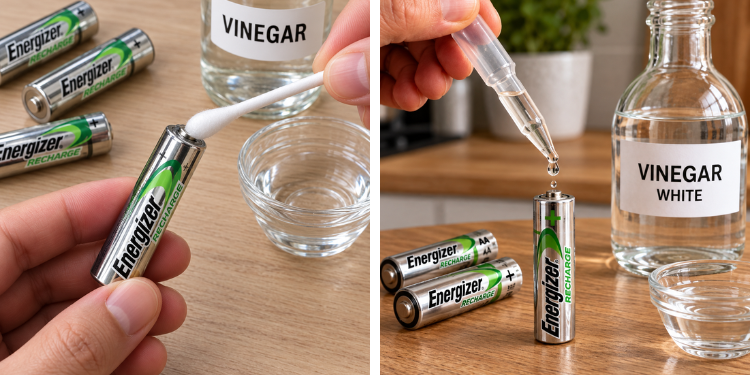
Have you ever opened an old remote control, flashlight, or electronic toy only to find a crusty, chalky white residue caked inside the battery compartment?
Most people assume the device is ruined and throw it away, but experienced DIYers turn to a common kitchen staple instead: distilled white vinegar.
Applying a tiny amount of vinegar to corroded battery terminals is a widely recommended, inexpensive household hack.
Far from a internet gimmick, this trick relies on a simple chemical reaction to restore dead contacts, clean out leaks, and bring neglected electronics back to life.
The Chemistry: Why Vinegar Cleans Battery Corrosion
To understand why vinegar works so well on AA and AAA battery corrosion, it helps to understand what that white crust actually is.
1. Understanding Alkaline Battery Leaks
Despite their name, standard single-use AA and AAA batteries are alkaline batteries. Inside their metal casing is a fluid electrolyte composed of potassium hydroxide ($\text{KOH}$), a strong chemical base (alkali).
As batteries age, discharge, or experience temperature fluctuations, hydrogen gas builds up inside the casing. Eventually, the seals rupture, leaking potassium hydroxide onto the nickel- or brass-plated contacts.
When potassium hydroxide contacts carbon dioxide in the surrounding air, it turns into potassium carbonate – the dry, white crystalline crust you see in old electronics.
2. Acid-Base Neutralization
Because battery leakage is strongly alkaline (basic), wiping it with plain water or a dry cloth won’t fully break down the crust.
Distilled white vinegar contains acetic acid. When you apply a weak acid like vinegar to alkaline potassium carbonate, a classical acid-base neutralization reaction occurs:
The acetic acid rapidly dissolves the hard mineral crust, bubbling slightly as carbon dioxide gas escapes. Once neutralized, the caked residue turns into a soft liquid salt that easily wipes clean, exposing pristine metal contacts underneath.
Why People Recommend the Vinegar Trick
1. It Restores Electrical Conductivity
The white crust formed by battery leaks is an electrical insulator. Even a thin layer prevents the battery terminal from touching the metal spring or plate inside the compartment, causing the device to fail.
Vinegar completely removes this barrier, restoring proper electrical flow without needing to buy a replacement device.
2. It Neutralizes Caustic Residue
Potassium hydroxide is corrosive to skin, clothing, and circuit boards. Simply scraping away the dry crust leaves behind microscopic alkaline traces that continue to corrode the metal contacts over time.
Vinegar chemically neutralizes the base, stopping active corrosion in its tracks.
3. Safe, Cheap, and Non-Toxic
Commercial chemical contact cleaners are often expensive, flammable, and filled with harsh solvents. White vinegar costs a fraction of a cent per use, is completely non-toxic, and is already sitting in almost every kitchen pantry.
Cleaning Solutions Compared
| Method | Chemical Action | Effective on Alkaline Leaks? | Risk to Electronics | Cost |
| White Vinegar / Lemon Juice | Mild Acid | Highly Effective (Neutralizes base) | Very low if applied carefully | Minimal |
| Baking Soda Paste | Mild Base | Ineffective (Base on base) | High (Leaves gritty residue) | Minimal |
| Plain Water | Neutral | Poor (Cannot dissolve crust) | High (Can short circuits) | Free |
| Electronic Contact Cleaner | Solvent Blend | Moderate (Cleans oil, slow on crust) | Zero | 8.00 – 15.00$ |
Important Exception: Never use vinegar on car batteries or lithium-ion batteries, which contain acidic electrolytes. Acidic leaks require a base like baking soda to neutralize them. The vinegar trick is strictly for single-use alkaline AA, AAA, C, D, and 9V batteries.
How to Clean Corroded Battery Terminals Step-by-Step
Cleaning battery corrosion with vinegar takes less than 10 minutes. Follow these simple steps:
Pro-Tips for Long-Term Battery Care
-
Remove Batteries from Unused Devices: If you plan to store a remote, lantern, or toy for more than a month, pull the batteries out to prevent future leaks.
-
Don’t Mix Old and New Batteries: Mixing fresh and partially drained batteries causes uneven discharge rates, dramatically increasing the risk of casing rupture and leakage.
Using white vinegar to clean AA and AAA battery corrosion is an easy, scientific, and budget-friendly household hack that saves old electronics from the landfill.