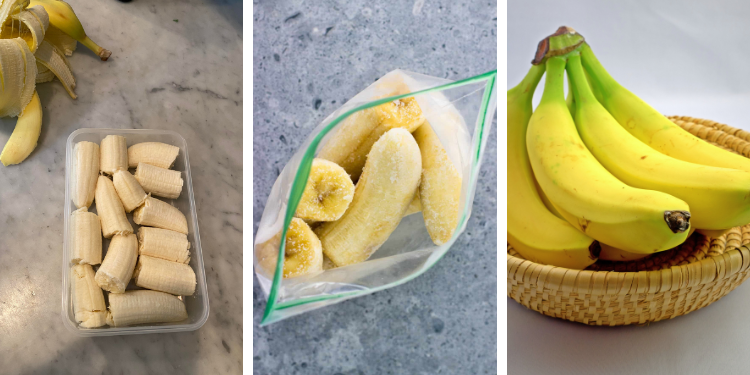
Bananas are among the most popular fruits in the world, valued for their convenience, high potassium content, and natural sweetness.
However, they are also infamous for their notoriously short shelf life. One day they are perfectly yellow with a hint of green, and seemingly the next, they are covered in brown spots and turning soft on the kitchen counter.
While most people default to making banana bread when their fruit becomes overripe, a growing number of home cooks, nutritionists, and culinary enthusiasts are turning to a far better solution: freezing them.
Freezing bananas does not merely preserve them before they spoil; it fundamentally changes their cellular structure, unlocking culinary possibilities that fresh bananas simply cannot match.
The Food Science: What Happens When You Freeze a Banana?
To understand why frozen bananas perform so uniquely in recipes, it helps to examine the biochemical transformations occurring inside the fruit during maturation and freezing:
-
Enzymatic Conversion of Starches to Sugars: As bananas ripen, enzymes like amylase convert complex, insoluble starches into simple, soluble sugars (fructose, glucose, and sucrose). Freezing bananas at peak ripeness locks in this maximum sugar concentration, halting cellular decay while preserving optimal natural sweetness.
-
Cell Wall Rupture: Bananas have a high water content (roughly 75%). As the water inside the fruit’s cells freezes, it expands and forms micro-ice crystals. These microscopic crystals pierce the rigid plant cell walls (cellulose). When thawed or blended, this structural breakdown releases bound moisture and pectins, creating a silky, custard-like emulsion rather than a watery slurry.
-
Pectin Gelation: Bananas contain high levels of pectin, a soluble structural fiber. The combination of ruptured cell walls and high pectin allows blended frozen bananas to mimic the molecular viscosity and mouthfeel of heavy dairy fat without containing any actual fat.
5 Compelling Reasons to Always Keep Bananas in Your Freezer
1. It Creates 100% Fruit “Nice Cream”
Perhaps the most famous culinary trick involving frozen bananas is turning them into dairy-free soft serve, commonly dubbed “Nice Cream.”
When you process frozen banana slices in a high-speed blender or food processor for 60 to 90 seconds, the ruptured cell walls and pectin whip into an extraordinarily smooth, velvety texture indistinguishable from traditional ice cream.
It requires zero added sugar, heavy cream, or dairy, offering a naturally low-glycemic, high-potassium dessert option.
2. Eliminates Ice Cubes in Smoothies
Adding standard water ice cubes to a smoothie dilutes its flavor as the ice melts. Using frozen banana slices instead acts as a natural cooling agent and thickener.
The frozen fruit chills the beverage instantly while providing a rich, shake-like consistency that holds ingredient suspensions together without separating.
3. Stops Household Food Waste Cold
Bananas rank among the most frequently discarded produce items in home kitchens. Freezing ripe bananas eliminates waste entirely.
Instead of throwing away spotted fruit or feeling forced to bake banana bread immediately, peeling and freezing them extends their usable lifespan by up to 6 to 9 months with minimal quality loss.
4. Concentrates Flavor for Baking
When frozen bananas thaw, they release a sweet, amber liquid known as “banana juice.” This liquid contains concentrated sugars, pectins, and aromatic esters.
Using thawed frozen bananas (and their collected juices) in banana bread, muffin, or pancake batters yields significantly more moisture, deeper caramel notes, and a more pronounced natural banana flavor than using fresh fruit.
5. Preserves Vital Micronutrients
Freezing fruit at peak ripeness locks in its nutritional value. Bananas are excellent sources of Vitamin B6, Vitamin C, Potassium, and Manganese.
Because sub-zero temperatures suspend oxidative degradation, frozen bananas maintain their antioxidant activity and essential mineral ratios just as effectively as fresh ones.
Fresh Bananas vs. Frozen Bananas: Functional Comparison
| Culinary / Physical Attribute | Fresh Bananas (Yellow/Spotted) | Frozen Bananas (Thawed or Blended) |
| Primary Texture | Firm, fibrous, creamy | Creamy (when blended) or soft/liquid (when thawed) |
| Smoothie Impact | Thickens slightly; requires added ice | Creates heavy shake-like texture; chills without dilution |
| Baking Performance | Good moisture; requires manual mashing | Exceptional moisture; easily incorporates into batters |
| Ice Cream Alternative | Cannot form frozen emulsion | Creates dairy-free “Nice Cream” soft serve |
| Shelf-Life Horizon | 3 to 7 days on counter | 6 to 9 months in freezer |
How to Freeze Bananas the Right Way (Step-by-Step)
The way you freeze bananas determines how easy they are to use later. Freezing unpeeled whole bananas is a common mistake; the skin turns dark black, becomes leathery, and sticks stubbornly to the fruit, making peeling nearly impossible when frozen.
Follow this flash-freezing method for seamless kitchen preparation:
Baking Pro-Tip: If you are freezing bananas strictly for future baking projects (like banana bread or cake), peel 3 whole bananas, place them directly into a freezer bag, and label the bag with “3 Bananas (1 Cup Mashed).” When ready to bake, thaw them in a bowl overnight in the refrigerator, and dump both the fruit and the released juices straight into your batter!
Freezing bananas is far more than an emergency measure to save overripe fruit – it is a deliberate culinary upgrade.
Keeping a container of frozen banana coins stocked in your freezer provides instant access to healthy non-dairy desserts, thick morning smoothies, and ultra-moist baked goods year-round.