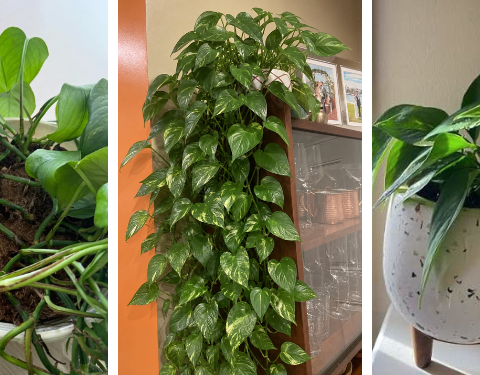
The Peace Lily (Spathiphyllum) is one of the most beloved houseplants in the world, prized for its glossy, emerald-green foliage and its legendary ability to purify indoor air.
However, for many indoor gardeners, the Peace Lily remains a “foliage-only” plant. While the leaves stay lush, the iconic white, hood-like blooms – known as spathes – often fail to appear for years at a time.
The most common mistake is assuming that Peace Lilies bloom year-round without intervention. In reality, these tropical natives follow a specific seasonal rhythm.
To see those elegant white flowers by early summer, you must act during the critical transition period of March and April.
1. The “Light Lift”: Moving to Bright, Indirect Sunlight
In the wild, Peace Lilies live on the forest floor beneath a canopy of trees. They have evolved to bloom when the light intensity increases during the spring months.
If your plant is tucked away in a dark corner or a hallway, it will survive, but it will never have enough energy to produce a flower.
The Strategic Move:
Before May, move your Peace Lily to a spot that receives 6 to 8 hours of bright, filtered light. A north or east-facing window is ideal.
-
The “Goldilocks” Rule: Direct afternoon sun will scorch the leaves, turning them yellow or brown. However, if the light is too dim, the plant will prioritize chlorophyll production (green leaves) over reproductive growth (flowers).
-
The Goal: You want the leaves to be a healthy, vibrant green, but the plant needs enough light energy to “fund” the expensive metabolic process of blooming.
2. The “Spring Flush” Deep Watering Reset
During the winter, Peace Lilies go into a semi-dormancy where they require very little water. If you continue a “winter watering” schedule into April, the plant won’t realize that the growing season has begun.
The Technique:
Perform a “Spring Flush.” Take your plant to the sink or shower and water it until the water runs freely out of the drainage holes for several minutes.
This washes away accumulated salts from the soil and fully rehydrates the root ball.
-
The Schedule: Once the flush is complete, allow the top inch of soil to dry out before watering again.
-
The Signal: Peace Lilies are famous for “fainting” when thirsty. By providing consistent, deep moisture in April, you signal to the plant that it has the resources necessary to support a heavy blooming cycle.
3. The “Bloom-Booster” Nutrient Shift
Peace Lilies are not “heavy feeders,” and over-fertilizing with a standard houseplant food can actually prevent flowering.
Standard fertilizers are high in nitrogen, which encourages lush, green leaves but can “blind” the plant to flower production.
The Adjustment:
In early April, switch to a fertilizer with a higher Phosphorus (P) ratio – often labeled as “Bloom Booster” or “Rose Food.”
-
The Dilution: Use the fertilizer at half-strength.
-
The Benefit: Phosphorus is the primary mineral responsible for flower development. By providing a boost of phosphorus in April, you ensure the plant has the specific building blocks required to form the white spathes that will emerge in May and June.
4. Humidity Calibration: Mimicking the Rainforest
Peace Lilies originate from the hot, humid rainforests of Central and South America. Indoor air, especially as we transition from winter heating to spring breezes, is often too dry.
Low humidity causes the flower buds to “blast” (dry up and turn brown) before they ever open.
The Solution:
Before May, increase the ambient humidity around your plant to at least 50-60%.
-
Pebble Trays: Place the pot on a tray filled with pebbles and water. As the water evaporates, it creates a humid micro-climate around the leaves.
-
Grouping: Place your Peace Lily near other plants. Through a process called transpiration, plants release moisture, naturally raising the humidity for their neighbors.
-
Misting: While misting helps, it is temporary. Focus on consistent humidity to protect the emerging flower spikes.
5. The “Leaf Polish”: Maximizing Photosynthesis
Dust is the enemy of the Peace Lily. Because the leaves are wide and flat, they act as dust magnets. A thick layer of dust blocks the “stomata” (pores) and prevents the plant from absorbing the light it needs to trigger blooms.
The Task:
Spend time in April cleaning every leaf. Use a soft, damp cloth to gently wipe the top and bottom of each leaf.
-
Avoid Leaf Shine: Do not use commercial “leaf shine” products, as these can clog the pores.
-
The Impact: A clean leaf is a high-performance solar panel. By maximizing the plant’s ability to photosynthesize in April, you provide the massive “energy surge” needed to push out multiple flowers simultaneously.
6. Temperature Stabilization: Avoiding “Spring Drafts”
Peace Lilies are tropical and highly sensitive to temperature fluctuations. As we move into April, the temptation to open windows can introduce “cold shocks” that signal the plant to stay in a protective foliage state.
The Fix:
Ensure your Peace Lily is kept in a stable environment between 18°C and 27°C.
-
Draft Check: Ensure the plant is not in the direct path of an air conditioning vent or a drafty window.
-
The Signal: Consistent warmth combined with the increased light of spring is the final biological “trigger” the plant needs to send up its first flower spikes.
Triggering a Peace Lily to bloom is not about luck; it is about mimicking the seasonal shifts of the tropics.
By adjusting the light, moisture, and nutrients during this critical window before May, you are providing the “environmental cues” the plant needs to stop focusing on leaves and start focusing on flowers.